QUESTION IMAGE
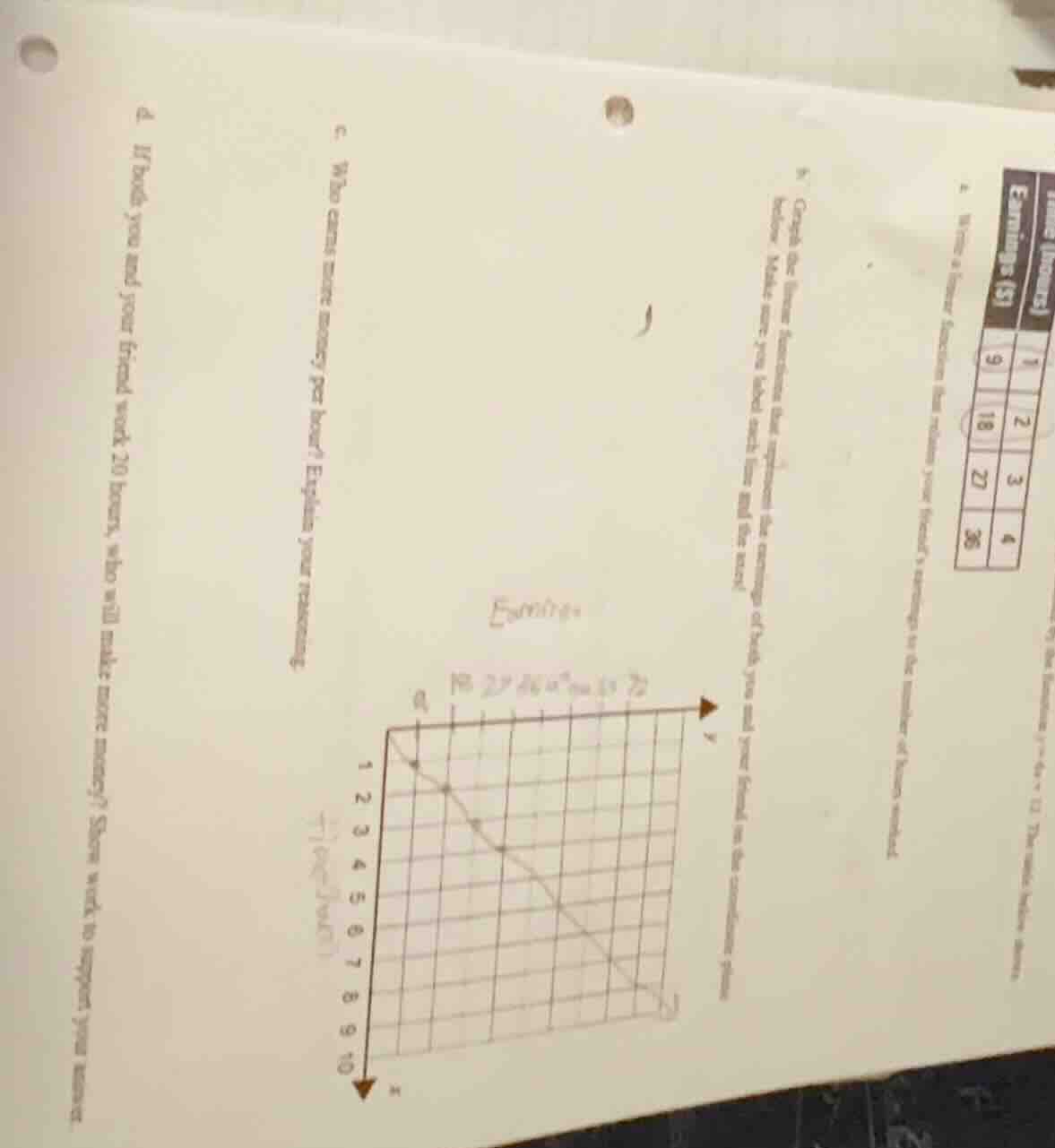
Question
a. write a linear function that shows your friend’s earnings in the number of hours worked.
b. graph the linear functions that represent the earnings of both you and your friend in the coordinate plane below. make sure you label each line and the axes!
c. who earns more money per hour? explain your reasoning.
d. if both you and your friend work 10 hours, who will make more money? show work to support your answer.
To solve this problem, we analyze the earnings - hours relationship for you and your friend.
Part a: Determine the function for your friend's earnings
We are given a table for your friend's earnings (\(y\)) with respect to the number of hours worked (\(x\)):
| \(x\) (hours) | 1 | 2 | 3 | 4 |
|---|
We can see that the relationship between \(x\) and \(y\) is linear. The slope \(m\) (which represents the earnings per hour) can be calculated using the formula \(m=\frac{y_2 - y_1}{x_2 - x_1}\).
Taking the points \((1,9)\) and \((2,18)\):
\(m=\frac{18 - 9}{2 - 1}=\frac{9}{1} = 9\)
Since the line passes through the origin (\(x = 0,y=0\)), the equation of the line (the function) for your friend's earnings is \(y = 9x\), where \(y\) is the earnings in dollars and \(x\) is the number of hours worked.
Part b: Graph the functions (assuming your earnings function is \(y = 10x\) from the graph - since at \(x = 1,y = 10\), \(x=2,y = 20\) etc.)
- Your friend's function (\(y = 9x\)):
- When \(x = 0\), \(y=0\); when \(x = 1\), \(y = 9\); when \(x=2\), \(y = 18\); when \(x = 3\), \(y=27\); when \(x = 4\), \(y = 36\)
- Your function (\(y=10x\)):
- When \(x = 0\), \(y = 0\); when \(x=1\), \(y = 10\); when \(x = 2\), \(y=20\); when \(x=3\), \(y = 30\); when \(x = 4\), \(y=40\)
We can plot these points on a coordinate plane with \(x\) (hours) on the horizontal axis and \(y\) (earnings in dollars) on the vertical axis. For your friend's graph, we plot the points \((0,0),(1,9),(2,18),(3,27),(4,36)\) and draw a line through them. For your graph, we plot the points \((0,0),(1,10),(2,20),(3,30),(4,40)\) and draw a line through them. We label your friend's line as "Friend" and your line as "You" and also label the axes with "Hours (\(x\))" and "Earnings (\(y\) in \(\$\))"
Part c: Who earns more per hour?
To find out who earns more per hour, we compare the slopes of the two linear functions (since the slope of a linear function \(y=mx + b\) in the context of earnings and hours represents the earnings per hour).
- Your friend's earnings per hour: From the function \(y = 9x\), the slope \(m = 9\) dollars per hour.
- Your earnings per hour: From the function \(y=10x\) (from the graph), the slope \(m = 10\) dollars per hour.
Since \(10>9\), you earn more money per hour.
Part d: Who earns more when working 20 hours?
We use the earnings functions for both you and your friend.
- Your friend's earnings for \(x = 20\) hours:
Using the function \(y=9x\), substitute \(x = 20\) into the equation:
\(y=9\times20=180\) dollars.
- Your earnings for \(x = 20\) hours:
Using the function \(y = 10x\), substitute \(x=20\) into the equation:
\(y=10\times20 = 200\) dollars.
Since \(200>180\), you will earn more money when both of you work 20 hours.
Final Answers
- a) Your friend's earnings function: \(\boldsymbol{y = 9x}\)
- c) You earn more per hour.
- d) You earn more when working 20 hours.

Snap & solve any problem in the app
Get step-by-step solutions on Sovi AI
Photo-based solutions with guided steps
Explore more problems and detailed explanations
To solve this problem, we analyze the earnings - hours relationship for you and your friend.
Part a: Determine the function for your friend's earnings
We are given a table for your friend's earnings (\(y\)) with respect to the number of hours worked (\(x\)):
| \(x\) (hours) | 1 | 2 | 3 | 4 |
|---|
We can see that the relationship between \(x\) and \(y\) is linear. The slope \(m\) (which represents the earnings per hour) can be calculated using the formula \(m=\frac{y_2 - y_1}{x_2 - x_1}\).
Taking the points \((1,9)\) and \((2,18)\):
\(m=\frac{18 - 9}{2 - 1}=\frac{9}{1} = 9\)
Since the line passes through the origin (\(x = 0,y=0\)), the equation of the line (the function) for your friend's earnings is \(y = 9x\), where \(y\) is the earnings in dollars and \(x\) is the number of hours worked.
Part b: Graph the functions (assuming your earnings function is \(y = 10x\) from the graph - since at \(x = 1,y = 10\), \(x=2,y = 20\) etc.)
- Your friend's function (\(y = 9x\)):
- When \(x = 0\), \(y=0\); when \(x = 1\), \(y = 9\); when \(x=2\), \(y = 18\); when \(x = 3\), \(y=27\); when \(x = 4\), \(y = 36\)
- Your function (\(y=10x\)):
- When \(x = 0\), \(y = 0\); when \(x=1\), \(y = 10\); when \(x = 2\), \(y=20\); when \(x=3\), \(y = 30\); when \(x = 4\), \(y=40\)
We can plot these points on a coordinate plane with \(x\) (hours) on the horizontal axis and \(y\) (earnings in dollars) on the vertical axis. For your friend's graph, we plot the points \((0,0),(1,9),(2,18),(3,27),(4,36)\) and draw a line through them. For your graph, we plot the points \((0,0),(1,10),(2,20),(3,30),(4,40)\) and draw a line through them. We label your friend's line as "Friend" and your line as "You" and also label the axes with "Hours (\(x\))" and "Earnings (\(y\) in \(\$\))"
Part c: Who earns more per hour?
To find out who earns more per hour, we compare the slopes of the two linear functions (since the slope of a linear function \(y=mx + b\) in the context of earnings and hours represents the earnings per hour).
- Your friend's earnings per hour: From the function \(y = 9x\), the slope \(m = 9\) dollars per hour.
- Your earnings per hour: From the function \(y=10x\) (from the graph), the slope \(m = 10\) dollars per hour.
Since \(10>9\), you earn more money per hour.
Part d: Who earns more when working 20 hours?
We use the earnings functions for both you and your friend.
- Your friend's earnings for \(x = 20\) hours:
Using the function \(y=9x\), substitute \(x = 20\) into the equation:
\(y=9\times20=180\) dollars.
- Your earnings for \(x = 20\) hours:
Using the function \(y = 10x\), substitute \(x=20\) into the equation:
\(y=10\times20 = 200\) dollars.
Since \(200>180\), you will earn more money when both of you work 20 hours.
Final Answers
- a) Your friend's earnings function: \(\boldsymbol{y = 9x}\)
- c) You earn more per hour.
- d) You earn more when working 20 hours.