QUESTION IMAGE
Question
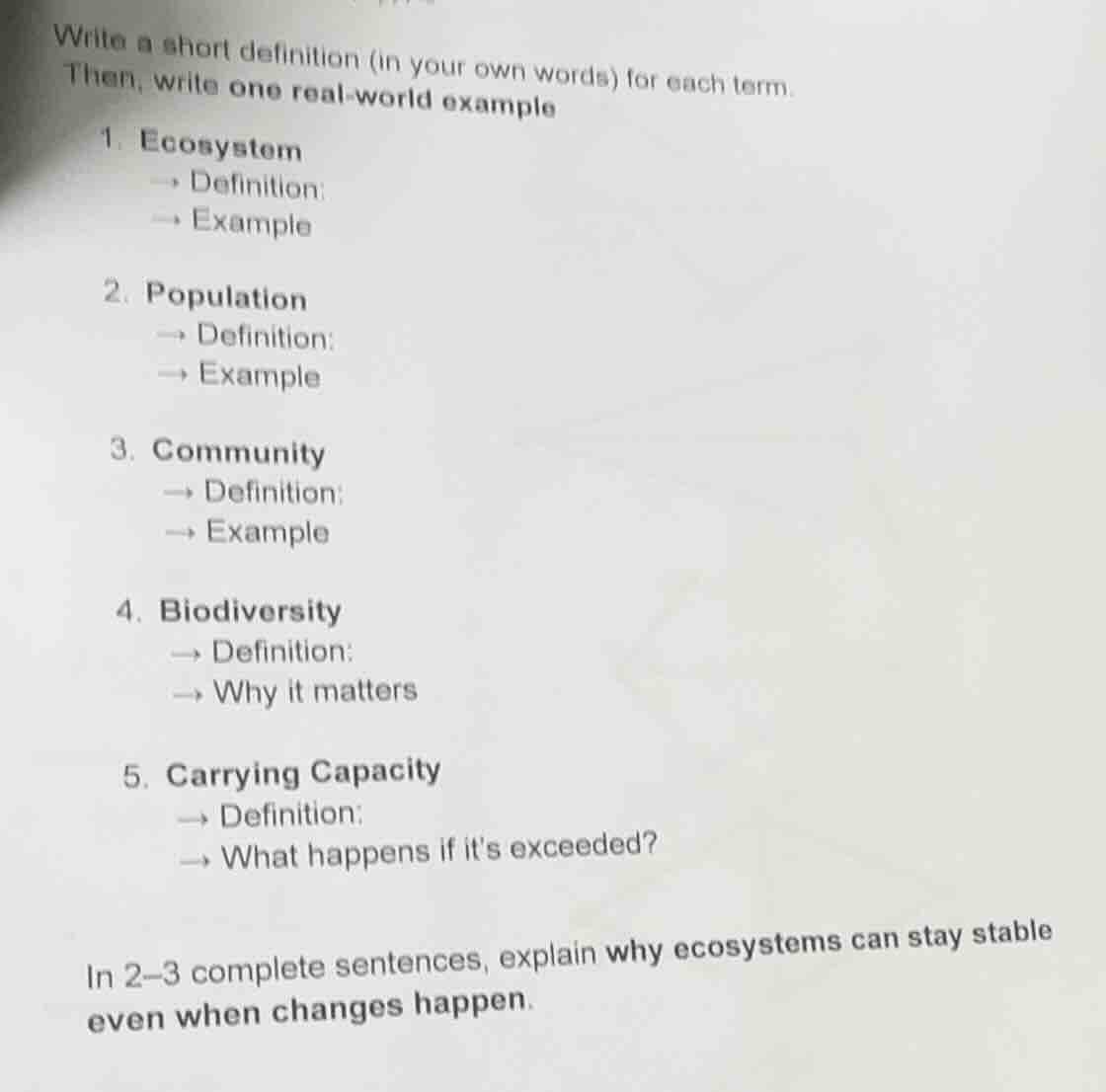
write a short definition (in your own words) for each term. then, write one real - world example
- ecosystem
→ definition:
→ example
- population
→ definition:
→ example
- community
→ definition:
→ example
- biodiversity
→ definition:
→ why it matters
- carrying capacity
→ definition:
→ what happens if its exceeded?
in 2–3 complete sentences, explain why ecosystems can stay stable even when changes happen.
- Ecosystem: Defined as a connected system of living organisms and their physical non-living environment, where they interact and exchange resources. A real-world example is a forest, where trees, animals, soil, water, and sunlight all depend on and affect one another.
- Population: A group of the same species living in one specific area at the same time, able to breed with each other. A real-world example is all the gray wolves living in Yellowstone National Park.
- Community: All the different groups of living organisms (populations of various species) that live and interact in a single specific area. A real-world example is all the birds, deer, insects, trees, and fungi that live in a single mountain meadow.
- Biodiversity: The total variety of all living organisms in a given area, including different species, genetic differences within species, and the variety of ecosystems. It matters because it supports ecosystem functions like pollination, water purification, and nutrient cycling, provides food and medicine for humans, and helps ecosystems recover from disturbances.
- Carrying Capacity: The maximum number of individuals of a species that an ecosystem can support long-term with its available resources (food, water, space). If this limit is exceeded, resources become scarce, leading to starvation, increased disease, competition, and a drop in the species' population (either through death or emigration).
- Ecosystem Stability: Ecosystems stay stable during changes due to ecological resilience and feedback loops. Many species have overlapping roles, so if one species is affected, others can fill its niche to keep functions running. Additionally, natural feedback mechanisms (like predators controlling prey populations) adjust to restore balance after small disturbances, such as a temporary drought reducing plant growth, which then limits herbivore numbers until plants recover.

Snap & solve any problem in the app
Get step-by-step solutions on Sovi AI
Photo-based solutions with guided steps
Explore more problems and detailed explanations
- Ecosystem
→ Definition: A linked system of living organisms and their non-living environment, where they interact to cycle resources.
→ Example: A temperate forest, including oak trees, squirrels, soil microbes, rainwater, and sunlight.
- Population
→ Definition: A group of the same species living in one area, able to breed.
→ Example: All the western lowland gorillas in the Congo Basin.
- Community
→ Definition: All interacting species populations in one specific area.
→ Example: All the fish, coral, sea turtles, and algae in a small section of the Great Barrier Reef.
- Biodiversity
→ Definition: The full range of life (species, genes, ecosystems) in an area.
→ Why it matters: It supports critical ecosystem services, provides human resources like food and medicine, and boosts ecosystem resilience to disturbances.
- Carrying Capacity
→ Definition: The maximum sustainable population of a species an ecosystem can support.
→ What happens if it's exceeded? Resources become depleted, leading to increased competition, starvation, disease, and a sharp decline in the species' population.
- Ecosystem Stability Explanation:
Ecosystems maintain stability through inherent resilience and interconnected feedback systems. When small changes occur, such as a short-term drop in food availability, overlapping ecological niches allow other species to fill gaps in key functions like pollination or nutrient cycling. Additionally, natural regulatory loops, such as predator-prey population balances, adjust to counteract shifts, helping the ecosystem return to a balanced state over time.