QUESTION IMAGE
Question
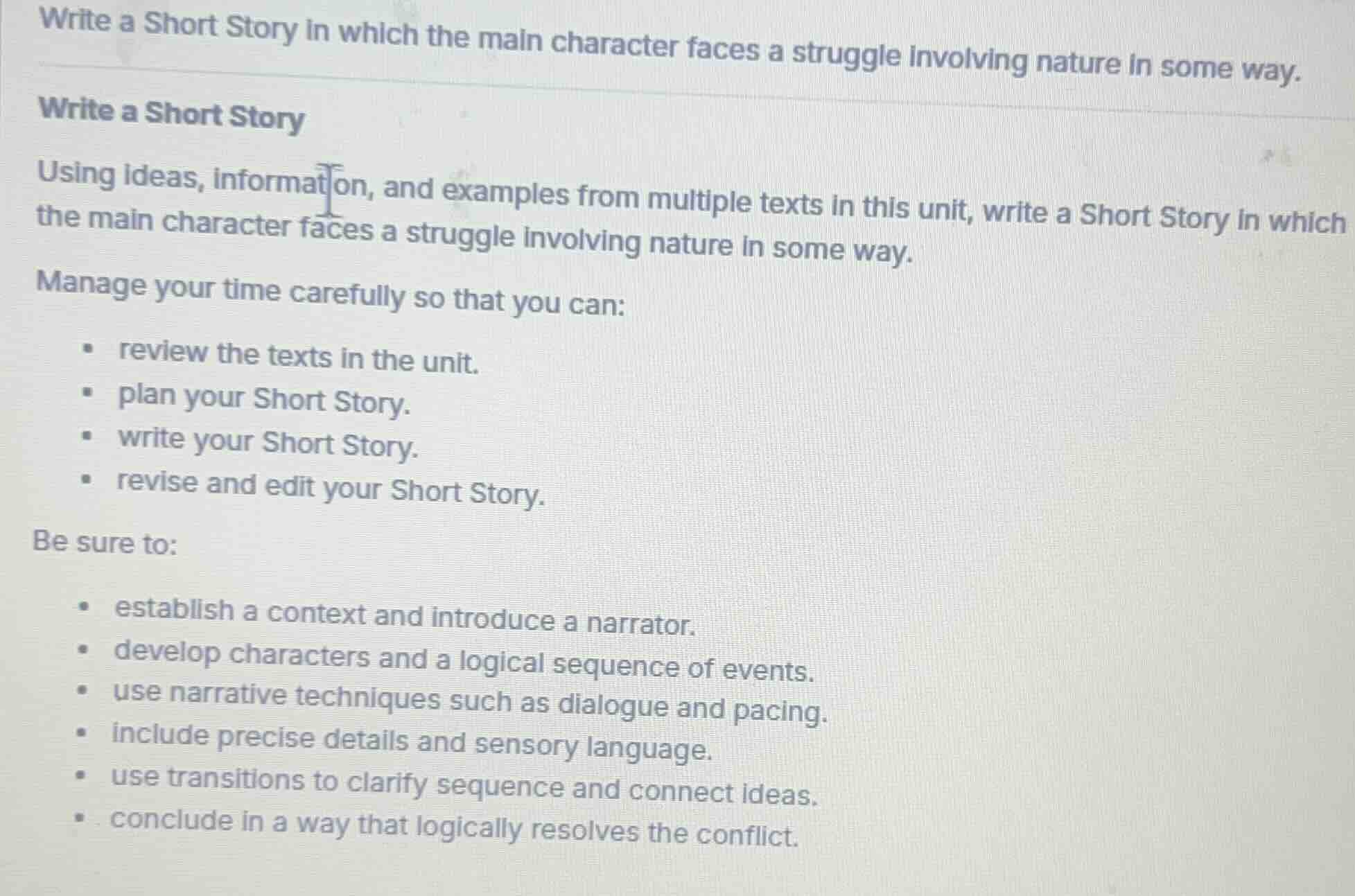
write a short story in which the main character faces a struggle involving nature in some way.
write a short story
using ideas, information, and examples from multiple texts in this unit, write a short story in which the main character faces a struggle involving nature in some way.
manage your time carefully so that you can:
- review the texts in the unit.
- plan your short story.
- write your short story.
- revise and edit your short story.
be sure to:
- establish a context and introduce a narrator.
- develop characters and a logical sequence of events.
- use narrative techniques such as dialogue and pacing.
- include precise details and sensory language.
- use transitions to clarify sequence and connect ideas.
- conclude in a way that logically resolves the conflict.
To write the short story, first, I'll establish the context: a young hiker, Lila, gets lost in a dense forest during a sudden storm. The struggle with nature (the storm, unfamiliar terrain) will drive the plot.
I'll introduce Lila as a curious but inexperienced hiker, setting the scene with sensory details (the smell of damp earth, howling wind). Then, develop events: she loses her path, the storm intensifies (rain, thunder), and she finds an old cave. Through dialogue (maybe her talking to herself or a small animal she meets), I'll show her fear and determination.
Using sensory language, I'll describe the cold rain, the creaking trees, and the warmth of the cave. Transitions like "Suddenly," "As the night fell," will clarify the sequence. Finally, resolve the conflict: she uses skills from a survival text (e.g., finding shelter, signaling for help) and is rescued at dawn, having learned respect for nature.
Short Story: "Lost in the Whispering Woods"
The air smelled of pine and damp earth as Lila stepped off the trail, chasing a flash of blue—a bird, she thought. “Just a minute,” she’d mumbled to her hiking group, but the forest swallowed her words. Now, the sun dipped behind steel-gray clouds, and the trees leaned closer, their branches hissing like angry snakes.
“Hello?” Her voice cracked. The wind answered with a howl, shaking the leaves. Rain hammered down, soaking her jacket in seconds. She stumbled over a root, and her backpack thudded against a mossy rock. “Stupid, stupid,” she whispered, fumbling for her compass. But the rain had blurred the numbers, and the forest spun around her—trees, rocks, and shadows that looked like beasts.
As darkness crept in, Lila found a narrow cave. She huddled inside, teeth chattering. The storm raged outside, thunder booming like a giant’s footsteps. She remembered a story from class: “Find shelter, stay calm.” So she dug in her backpack, pulling out a soggy granola bar and a tattered map. The map! A tiny trail marker—she’d passed it hours ago.
“I can fix this,” she said, though her voice trembled. She tied a strip of her shirt to a branch, a signal. Then, she curled up, listening to the rain and the forest’s whispers. When dawn broke, a search party’s voices cut through the quiet. “Over here!” she shouted, waving her shirt.
As they led her back, Lila watched the sun gild the trees. The forest still felt wild, but now she saw its beauty, not just its danger. She’d fought nature—and learned to respect it, too.
(Note: This story uses a nature-based struggle, sensory details, dialogue, and a resolved conflict, meeting the assignment’s requirements.)

Snap & solve any problem in the app
Get step-by-step solutions on Sovi AI
Photo-based solutions with guided steps
Explore more problems and detailed explanations
To write the short story, first, I'll establish the context: a young hiker, Lila, gets lost in a dense forest during a sudden storm. The struggle with nature (the storm, unfamiliar terrain) will drive the plot.
I'll introduce Lila as a curious but inexperienced hiker, setting the scene with sensory details (the smell of damp earth, howling wind). Then, develop events: she loses her path, the storm intensifies (rain, thunder), and she finds an old cave. Through dialogue (maybe her talking to herself or a small animal she meets), I'll show her fear and determination.
Using sensory language, I'll describe the cold rain, the creaking trees, and the warmth of the cave. Transitions like "Suddenly," "As the night fell," will clarify the sequence. Finally, resolve the conflict: she uses skills from a survival text (e.g., finding shelter, signaling for help) and is rescued at dawn, having learned respect for nature.
Short Story: "Lost in the Whispering Woods"
The air smelled of pine and damp earth as Lila stepped off the trail, chasing a flash of blue—a bird, she thought. “Just a minute,” she’d mumbled to her hiking group, but the forest swallowed her words. Now, the sun dipped behind steel-gray clouds, and the trees leaned closer, their branches hissing like angry snakes.
“Hello?” Her voice cracked. The wind answered with a howl, shaking the leaves. Rain hammered down, soaking her jacket in seconds. She stumbled over a root, and her backpack thudded against a mossy rock. “Stupid, stupid,” she whispered, fumbling for her compass. But the rain had blurred the numbers, and the forest spun around her—trees, rocks, and shadows that looked like beasts.
As darkness crept in, Lila found a narrow cave. She huddled inside, teeth chattering. The storm raged outside, thunder booming like a giant’s footsteps. She remembered a story from class: “Find shelter, stay calm.” So she dug in her backpack, pulling out a soggy granola bar and a tattered map. The map! A tiny trail marker—she’d passed it hours ago.
“I can fix this,” she said, though her voice trembled. She tied a strip of her shirt to a branch, a signal. Then, she curled up, listening to the rain and the forest’s whispers. When dawn broke, a search party’s voices cut through the quiet. “Over here!” she shouted, waving her shirt.
As they led her back, Lila watched the sun gild the trees. The forest still felt wild, but now she saw its beauty, not just its danger. She’d fought nature—and learned to respect it, too.
(Note: This story uses a nature-based struggle, sensory details, dialogue, and a resolved conflict, meeting the assignment’s requirements.)