QUESTION IMAGE
Question
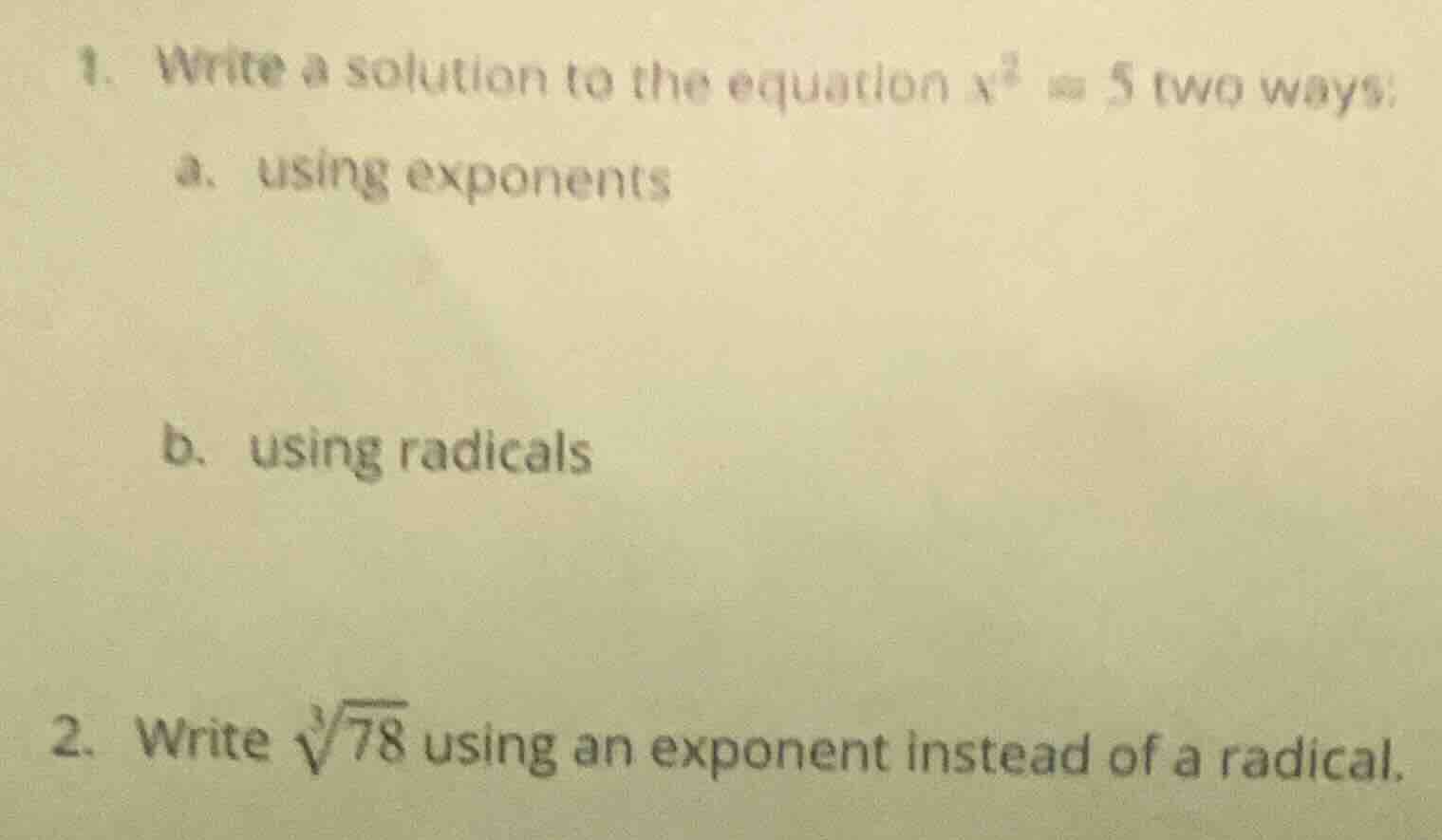
- write a solution to the equation $x^2 = 5$ two ways:
a. using exponents
b. using radicals
- write $sqrt3{78}$ using an exponent instead of a radical.
Problem 1
Part a: Using exponents
Step1: Recall exponent rule for roots
To solve \(x^{2}=5\) for \(x\), we use the property that if \(x^{n}=a\), then \(x = a^{\frac{1}{n}}\) (for real - valued solutions when \(n\) is even and \(a\geq0\)). Here \(n = 2\) and \(a = 5\).
So \(x=5^{\frac{1}{2}}\) (we can also consider the negative solution \(x=- 5^{\frac{1}{2}}\) since \((-5^{\frac{1}{2}})^{2}=5\) as well)
Part b: Using radicals
Step1: Recall radical notation
The square root of a number \(a\) is denoted as \(\sqrt{a}\), and for the equation \(x^{2}=5\), by the definition of square root, if \(x^{2}=a\) (\(a\geq0\)), then \(x = \pm\sqrt{a}\).
So \(x=\pm\sqrt{5}\)
Problem 2
Step1: Recall the relationship between radicals and exponents
The \(n\) - th root of a number \(a\), \(\sqrt[n]{a}\), can be written as \(a^{\frac{1}{n}}\) in exponential form. Here, we have the cube root of \(78\), so \(n = 3\) and \(a = 78\).
So \(\sqrt[3]{78}=78^{\frac{1}{3}}\)
Final Answers
- a. \(x = 5^{\frac{1}{2}}\) (or \(x=-5^{\frac{1}{2}}\))
- b. \(x=\pm\sqrt{5}\)
- \(78^{\frac{1}{3}}\)

Snap & solve any problem in the app
Get step-by-step solutions on Sovi AI
Photo-based solutions with guided steps
Explore more problems and detailed explanations
Step1: Recall the relationship between radicals and exponents
The \(n\) - th root of a number \(a\), \(\sqrt[n]{a}\), can be written as \(a^{\frac{1}{n}}\) in exponential form. Here, we have the cube root of \(78\), so \(n = 3\) and \(a = 78\).
So \(\sqrt[3]{78}=78^{\frac{1}{3}}\)
Final Answers
- a. \(x = 5^{\frac{1}{2}}\) (or \(x=-5^{\frac{1}{2}}\))
- b. \(x=\pm\sqrt{5}\)
- \(78^{\frac{1}{3}}\)