QUESTION IMAGE
Question
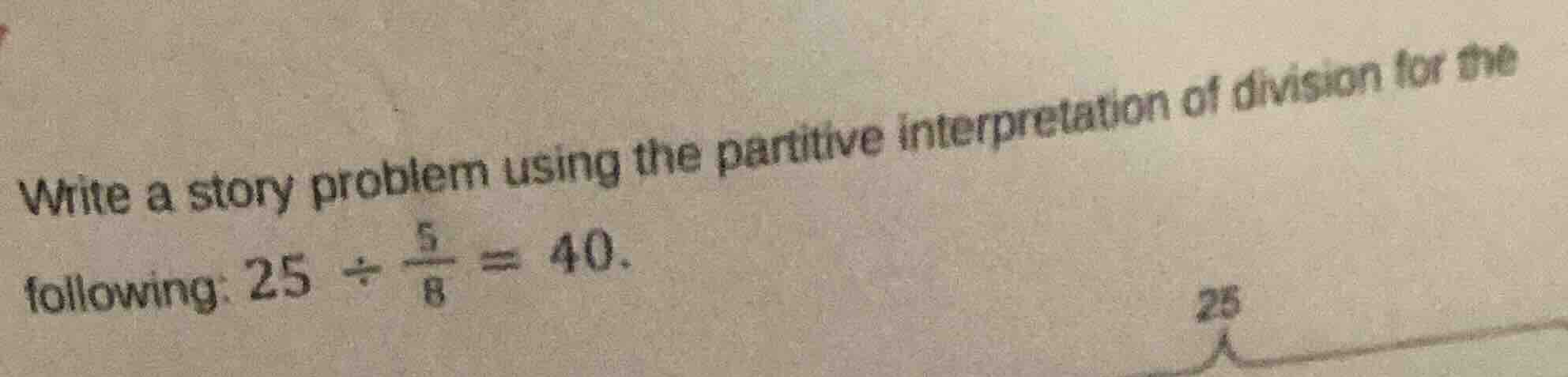
write a story problem using the partitive interpretation of division for the following: $25 \div \frac{5}{8} = 40$.
Step1: Understand Partitive Division
Partitive division means dividing a quantity into a number of equal parts (or groups) and finding the size of each part. Here, we have \(25\div\frac{5}{8} = 40\), so we need to create a story where a total quantity (25 of something) is a fraction (\(\frac{5}{8}\)) of another quantity (the total we're finding, which is 40 in the equation).
Step2: Create the Story
Let's think of a real - life scenario, like with objects or people. For example, in a classroom context: There are 25 students in a class, and these 25 students make up \(\frac{5}{8}\) of the total number of students in the entire grade level. How many students are there in the entire grade level?
We can also use a scenario with items. For instance: A baker has 25 loaves of bread. These 25 loaves are \(\frac{5}{8}\) of the total number of loaves that the baker needs to bake for a big event. How many loaves does the baker need to bake in total?
Let's formalize the first story:
Let the total number of students in the grade be \(x\). We know that \(\frac{5}{8}\) of \(x\) is 25, which can be written as the equation \(\frac{5}{8}x=25\), and when we solve for \(x\) (using division, since \(x = 25\div\frac{5}{8}\)), we get \(x = 40\). So the story is: There are 25 students in Mrs. Smith's class. The number of students in Mrs. Smith's class is \(\frac{5}{8}\) of the total number of students in the third grade. How many students are there in the third grade?

Snap & solve any problem in the app
Get step-by-step solutions on Sovi AI
Photo-based solutions with guided steps
Explore more problems and detailed explanations
There are 25 students in Mrs. Smith's class. The number of students in Mrs. Smith's class is \(\frac{5}{8}\) of the total number of students in the third grade. How many students are there in the third grade? (Other valid stories can also be created following the partitive division concept, like with objects, money, etc.)