QUESTION IMAGE
Question
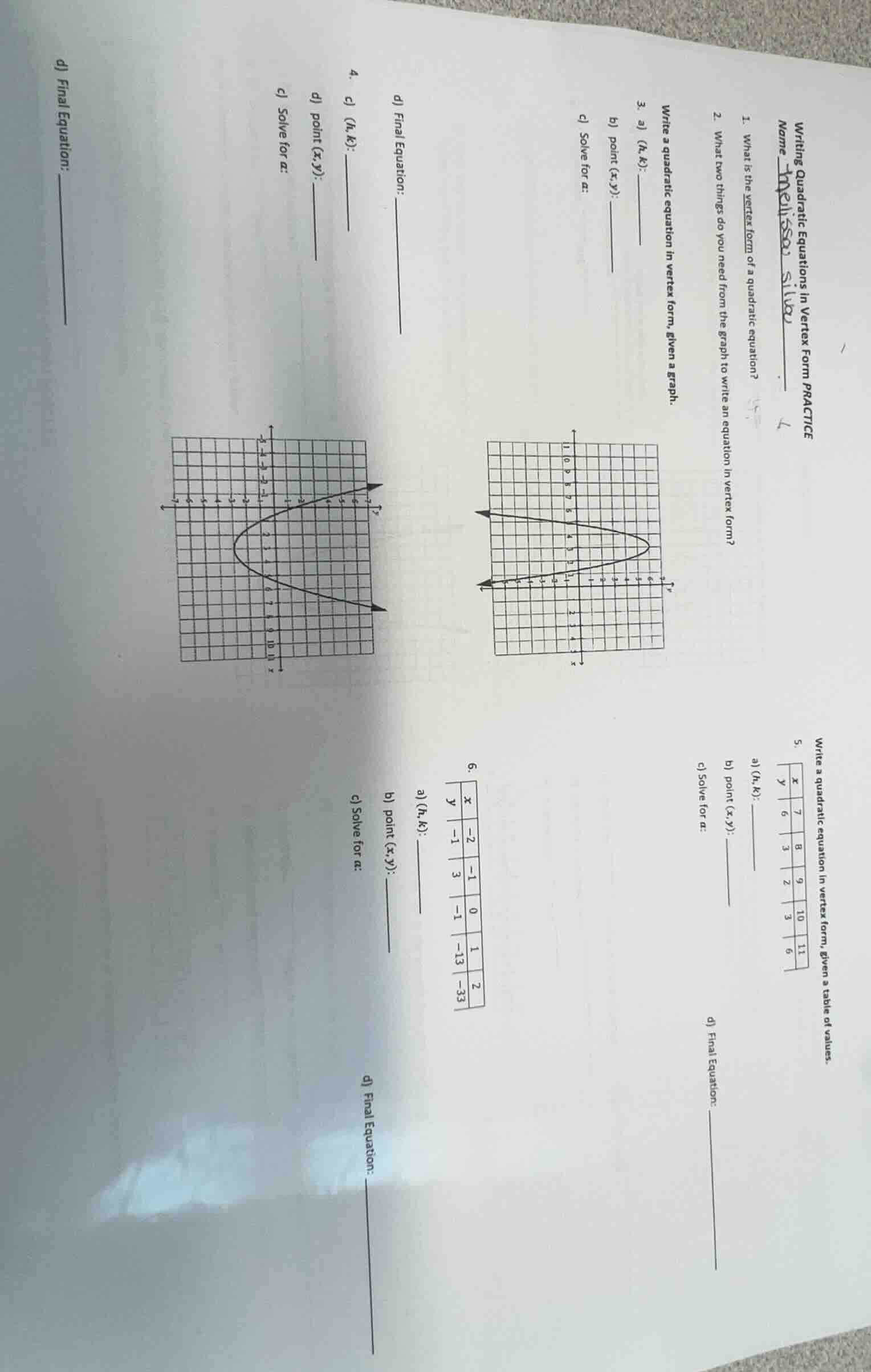
writing quadratic equations in vertex form practice
name
- what is the vertex form of a quadratic equation?
- what two things do you need from the graph to write an equation in vertex form?
- write a quadratic equation in vertex form, given a graph.
a) (h,k):
b) point (x,y):
c) solve for a:
d) final equation:
4.
c) (h,k):
d) point (x,y):
c) solve for a:
d) final equation:
write a quadratic equation in vertex form, given a table of values.
5.
a) (h,k):
b) point (x,y):
c) solve for a:
d) final equation:
6.
a) (h,k):
b) point (x,y):
c) solve for a:
d) final equation:
To solve these quadratic equation in vertex form problems, we'll follow the general steps for each type (graph, table) and address each sub - question:
Problem 1: Vertex Form of Quadratic Equation
The vertex form of a quadratic equation is given by the formula \(y=a(x - h)^{2}+k\), where \((h,k)\) represents the vertex of the parabola and \(a\) determines the direction and the width of the parabola's opening.
Problem 2: Information Needed for Vertex Form
To write a quadratic equation in vertex form, we need two key pieces of information:
- The vertex \((h,k)\) of the parabola. This is the point where the parabola changes direction (it is the minimum point if the parabola opens upwards and the maximum point if it opens downwards).
- Another point \((x,y)\) that lies on the parabola. We use this point to solve for the value of \(a\) in the vertex form equation.
Problem 3: Writing Quadratic from Graph (Let's assume a sample graph with vertex \((h,k)=(2,3)\) and a point \((x,y)=(0, - 1)\) for illustration)
a) \((h,k)\)
From the graph, we identify the vertex. Let's say the vertex is at \((h,k)=(2,3)\) (this will vary depending on the actual graph).
b) point \((x,y)\)
We pick a point on the parabola. For example, if the parabola passes through \((0,-1)\), then \((x,y)=(0, - 1)\).
c) Solve for \(a\)
We substitute \(h = 2\), \(k = 3\), \(x = 0\) and \(y=-1\) into the vertex form equation \(y=a(x - h)^{2}+k\).
\[
\]
d) Final Equation
Substitute \(a=-1\), \(h = 2\) and \(k = 3\) back into the vertex form equation: \(y=-1(x - 2)^{2}+3\) or \(y=-(x - 2)^{2}+3\)
Problem 5: Writing Quadratic from Table (Given table:
| \(x\) | \(7\) | \(8\) | \(9\) | \(10\) | \(11\) |
|---|
a) \((h,k)\)
For a quadratic function, the vertex lies on the axis of symmetry. The axis of symmetry for a set of symmetric \(x\) - values (since the \(y\) - values are symmetric around \(x = 9\): \(y(7)=y(11) = 6\), \(y(8)=y(10)=3\)) is \(x = h=9\). When \(x = 9\), \(y = k = 2\). So \((h,k)=(9,2)\).
b) point \((x,y)\)
We can choose any point from the table. Let's take \((x,y)=(7,6)\).
c) Solve for \(a\)
Substitute \(h = 9\), \(k = 2\), \(x = 7\) and \(y = 6\) into \(y=a(x - h)^{2}+k\)
\[
\]
d) Final Equation
Substitute \(a = 1\), \(h=9\) and \(k = 2\) into the vertex form: \(y=(x - 9)^{2}+2\)
Problem 6: Writing Quadratic from Table (Given table:
| \(x\) | \(-2\) | \(-1\) | \(0\) | \(1\) | \(2\) |
|---|
a) \((h,k)\)
The axis of symmetry is at \(x=\frac{-2 + 0}{2}=-1\) (since \(y(-2)=y(0)=-1\)). When \(x=-1\), \(y = 3\). So \((h,k)=(-1,3)\).
b) point \((x,y)\)
We can choose \((x,y)=(0,-1)\)
c) Solve for \(a\)
Substitute \(h=-1\), \(k = 3\), \(x = 0\) and \(y=-1\) into \(y=a(x - h)^{2}+k\)
\[
\]
d) Final Equation
Substitute \(a=-4\), \(h = - 1\) and \(k = 3\) into the vertex form: \(y=-4(x + 1)^{2}+3\)

Snap & solve any problem in the app
Get step-by-step solutions on Sovi AI
Photo-based solutions with guided steps
Explore more problems and detailed explanations
s:
- The vertex form of a quadratic equation is \(\boldsymbol{y=a(x - h)^{2}+k}\)
- To write a quadratic in vertex form, we need \(\boldsymbol{\text{the vertex }(h,k)\text{ and another point }(x,y)\text{ on the parabola}}\)
- (Answers will vary based on actual graph, sample answers)
- a) \((h,k)=\boldsymbol{(2,3)}\) (sample)
- b) \((x,y)=\boldsymbol{(0,-1)}\) (sample)
- c) \(a=\boldsymbol{-1}\) (sample)
- d) Final Equation: \(\boldsymbol{y=-(x - 2)^{2}+3}\) (sample)
5.
- a) \((h,k)=\boldsymbol{(9,2)}\)
- b) \((x,y)=\boldsymbol{(7,6)}\)
- c) \(a=\boldsymbol{1}\)
- d) Final Equation: \(\boldsymbol{y=(x - 9)^{2}+2}\)
6.
- a) \((h,k)=\boldsymbol{(-1,3)}\)
- b) \((x,y)=\boldsymbol{(0,-1)}\)
- c) \(a=\boldsymbol{-4}\)
- d) Final Equation: \(\boldsymbol{y=-4(x + 1)^{2}+3}\)