QUESTION IMAGE
Question
ws-8 sph3u1
waves interaction
interference the process of generating a new wave when two or more waves meet.
principle of superposition:
at any point the amplitude of two interfering waves is the sum of the amplitudes of the individual waves
constructive interference:
the process of forming a wave with a larger amplitude when two or more waves combine.
destructive interference:
the process of forming a wave with a smaller amplitude when two or more waves combine
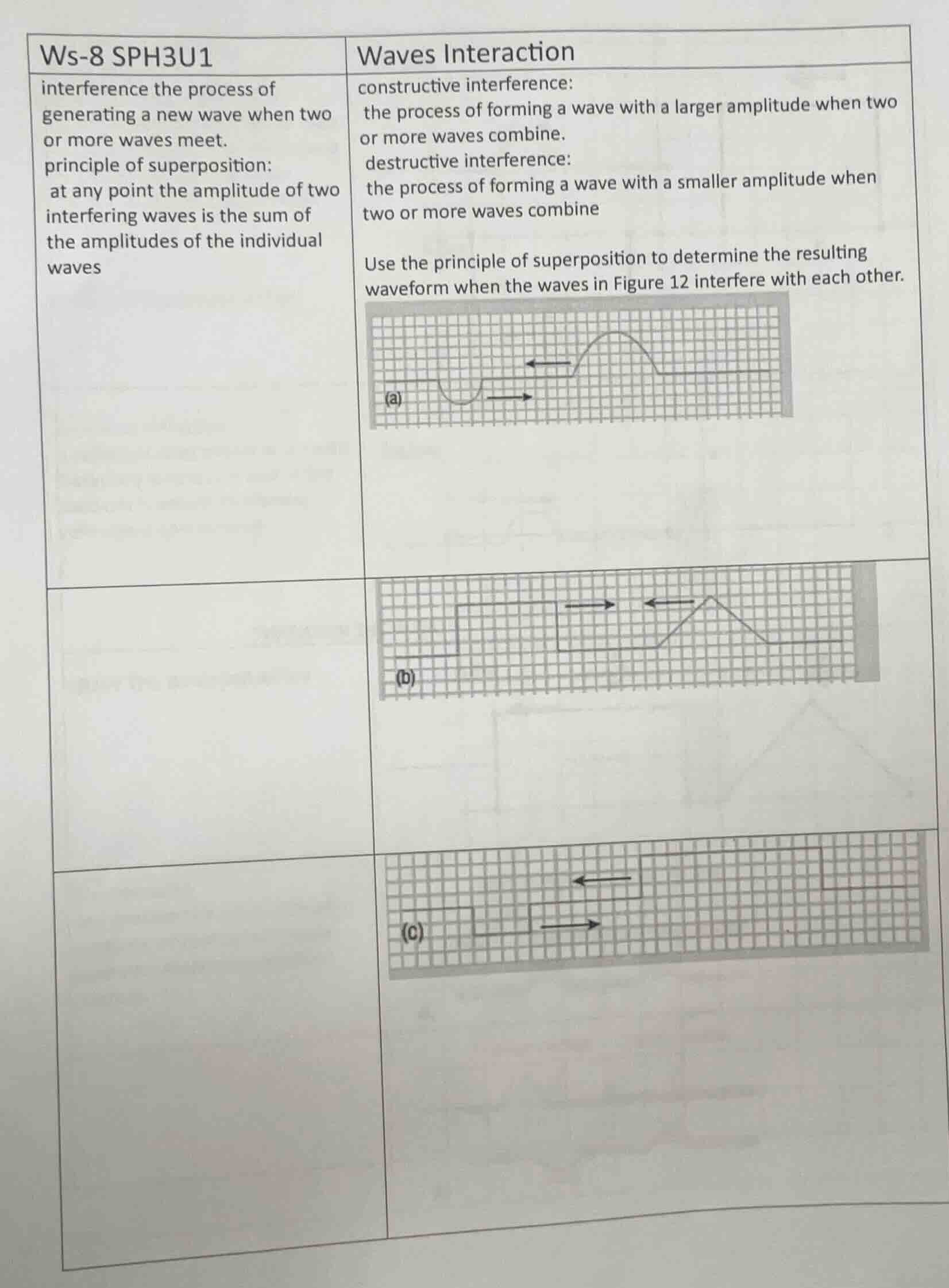
use the principle of superposition to determine the resulting waveform when the waves in figure 12 interfere with each other.
(a) image of waves on grid
(b) image of waves on grid
(c) image of waves on grid
To solve the problem of determining the resulting waveform using the principle of superposition, we analyze each figure:
Part (a)
- Identify the waves: One wave is a downward - facing pulse (negative amplitude) and the other is an upward - facing pulse (positive amplitude).
- Apply superposition principle: At each point, the amplitude of the resultant wave is the sum of the amplitudes of the two interfering waves. Let's assume the amplitude of the downward - facing pulse is $-A$ and the amplitude of the upward - facing pulse is $A$ (where $A$ is the magnitude of the amplitude of each pulse). When they interfere, at the points of overlap, the resultant amplitude $y = y_1 + y_2$, where $y_1=-A$ and $y_2 = A$. So $y=-A + A=0$. Outside the overlap region, the waves retain their original shapes. So the resulting waveform will have zero amplitude (a flat line) in the region of overlap and the original non - overlapping parts of the waves.
Part (b)
- Identify the waves: One wave is a rectangular pulse (constant positive amplitude, say $A$) and the other is a triangular pulse (with amplitude varying linearly, with a maximum amplitude of $A$ at the peak).
- Apply superposition principle: For the regions where the rectangular pulse and the triangular pulse overlap, we add their amplitudes. Let the amplitude of the rectangular pulse be $y_1 = A$ (constant in its region) and the amplitude of the triangular pulse be $y_2(x)$ (where $x$ is the position and $y_2(x)$ varies from 0 to $A$ in its region). The resultant amplitude $y(x)=y_1 + y_2(x)=A + y_2(x)$. So the resulting waveform in the overlap region will be a combination of the rectangular and triangular shapes, with the amplitude being the sum of the two at each point. Outside the overlap region, the waves retain their original shapes.
Part (c)
- Identify the waves: Both waves are rectangular pulses with the same amplitude (say $A$) and they are moving towards each other.
- Apply superposition principle: In the region of overlap, the amplitude of the resultant wave is the sum of the amplitudes of the two rectangular pulses. If each has an amplitude of $A$, the resultant amplitude $y = A+A = 2A$ in the overlap region. Outside the overlap region, the waves retain their original shapes.
Final Answer (General Description of Resulting Waveforms)
- For part (a): A flat line (amplitude = 0) in the overlap region, with original non - overlapping wave parts.
- For part (b): A combined shape (sum of rectangular and triangular amplitudes) in the overlap region, with original non - overlapping wave parts.
- For part (c): A rectangular pulse with amplitude $2A$ in the overlap region, with original non - overlapping wave parts.
(If we were to draw the waveforms:
- In (a), the two pulses cancel each other out in the middle, so the result is a flat line where they meet and the original pulses on either side.
- In (b), the rectangular and triangular pulses add together, so the height of the combined pulse is the sum of the two at each point.
- In (c), the two rectangular pulses add, so the resulting pulse in the middle has twice the height of each original pulse.)

Snap & solve any problem in the app
Get step-by-step solutions on Sovi AI
Photo-based solutions with guided steps
Explore more problems and detailed explanations
To solve the problem of determining the resulting waveform using the principle of superposition, we analyze each figure:
Part (a)
- Identify the waves: One wave is a downward - facing pulse (negative amplitude) and the other is an upward - facing pulse (positive amplitude).
- Apply superposition principle: At each point, the amplitude of the resultant wave is the sum of the amplitudes of the two interfering waves. Let's assume the amplitude of the downward - facing pulse is $-A$ and the amplitude of the upward - facing pulse is $A$ (where $A$ is the magnitude of the amplitude of each pulse). When they interfere, at the points of overlap, the resultant amplitude $y = y_1 + y_2$, where $y_1=-A$ and $y_2 = A$. So $y=-A + A=0$. Outside the overlap region, the waves retain their original shapes. So the resulting waveform will have zero amplitude (a flat line) in the region of overlap and the original non - overlapping parts of the waves.
Part (b)
- Identify the waves: One wave is a rectangular pulse (constant positive amplitude, say $A$) and the other is a triangular pulse (with amplitude varying linearly, with a maximum amplitude of $A$ at the peak).
- Apply superposition principle: For the regions where the rectangular pulse and the triangular pulse overlap, we add their amplitudes. Let the amplitude of the rectangular pulse be $y_1 = A$ (constant in its region) and the amplitude of the triangular pulse be $y_2(x)$ (where $x$ is the position and $y_2(x)$ varies from 0 to $A$ in its region). The resultant amplitude $y(x)=y_1 + y_2(x)=A + y_2(x)$. So the resulting waveform in the overlap region will be a combination of the rectangular and triangular shapes, with the amplitude being the sum of the two at each point. Outside the overlap region, the waves retain their original shapes.
Part (c)
- Identify the waves: Both waves are rectangular pulses with the same amplitude (say $A$) and they are moving towards each other.
- Apply superposition principle: In the region of overlap, the amplitude of the resultant wave is the sum of the amplitudes of the two rectangular pulses. If each has an amplitude of $A$, the resultant amplitude $y = A+A = 2A$ in the overlap region. Outside the overlap region, the waves retain their original shapes.
Final Answer (General Description of Resulting Waveforms)
- For part (a): A flat line (amplitude = 0) in the overlap region, with original non - overlapping wave parts.
- For part (b): A combined shape (sum of rectangular and triangular amplitudes) in the overlap region, with original non - overlapping wave parts.
- For part (c): A rectangular pulse with amplitude $2A$ in the overlap region, with original non - overlapping wave parts.
(If we were to draw the waveforms:
- In (a), the two pulses cancel each other out in the middle, so the result is a flat line where they meet and the original pulses on either side.
- In (b), the rectangular and triangular pulses add together, so the height of the combined pulse is the sum of the two at each point.
- In (c), the two rectangular pulses add, so the resulting pulse in the middle has twice the height of each original pulse.)