QUESTION IMAGE
Question
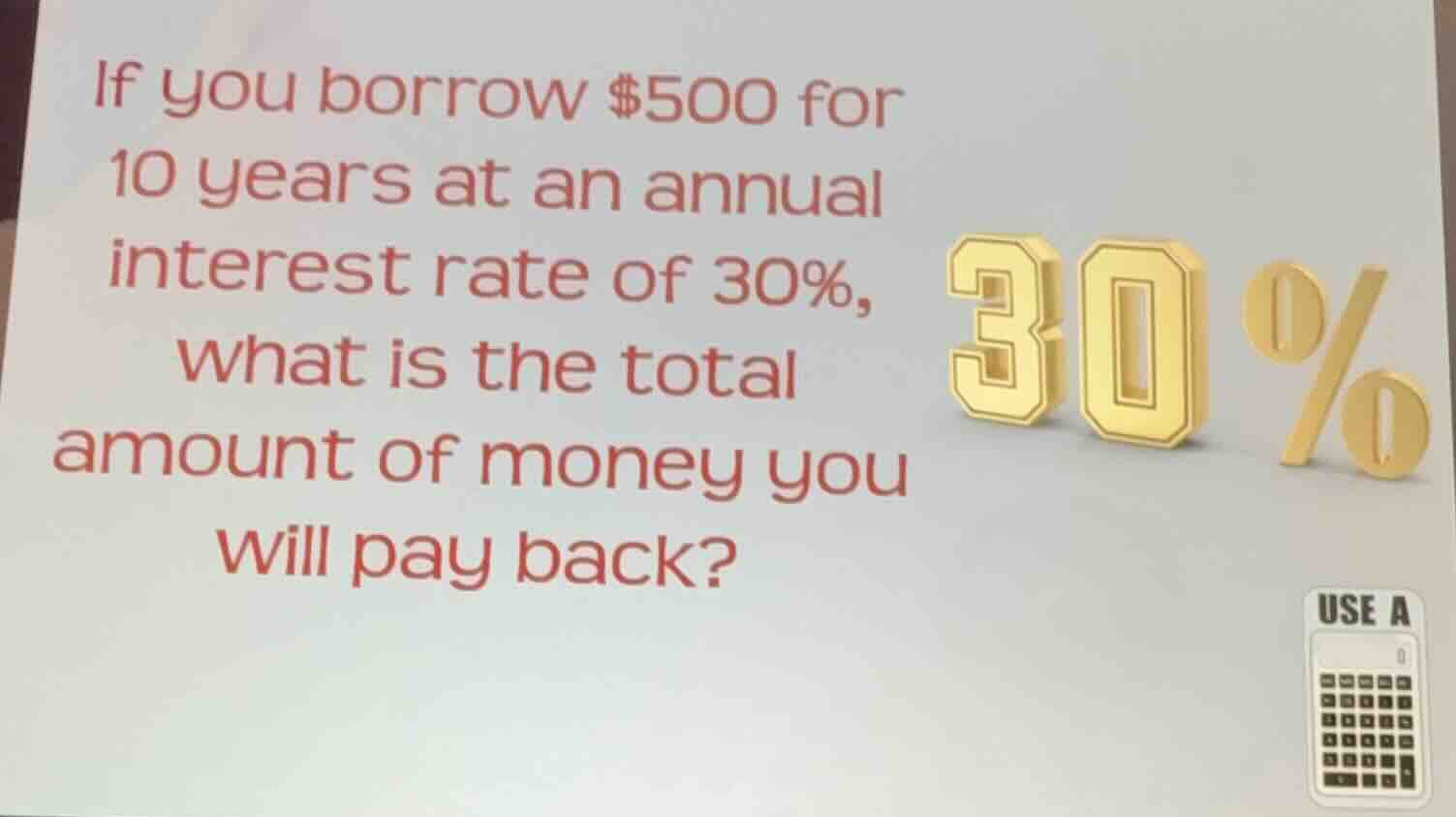
if you borrow $500 for 10 years at an annual interest rate of 30%, what is the total amount of money you will pay back?
Step1: Identify the formula for compound interest
The formula for compound interest is $A = P(1 + r)^t$, where $A$ is the amount of money accumulated after $n$ years, including interest, $P$ is the principal amount (the initial amount of money), $r$ is the annual interest rate (decimal), and $t$ is the time the money is invested or borrowed for, in years.
Step2: Convert the interest rate to decimal
The annual interest rate is 30%, so in decimal form, $r=\frac{30}{100} = 0.3$.
Step3: Identify the values of $P$, $r$, and $t$
We have $P = 500$, $r = 0.3$, and $t = 10$.
Step4: Substitute the values into the formula
Substitute $P = 500$, $r = 0.3$, and $t = 10$ into the formula $A = P(1 + r)^t$:
$$A = 500(1 + 0.3)^{10}$$
First, calculate $(1 + 0.3)^{10}=1.3^{10}$. Using a calculator, $1.3^{10}\approx13.7858$.
Then, multiply by 500: $A = 500\times13.7858 = 6892.9$ (rounded to one decimal place).

Snap & solve any problem in the app
Get step-by-step solutions on Sovi AI
Photo-based solutions with guided steps
Explore more problems and detailed explanations
The total amount of money to pay back is approximately $\$6892.9$ (if we consider compound interest; if it were simple interest, the formula would be $A=P(1 + rt)=500(1 + 0.3\times10)=500\times4 = 2000$, but the problem doesn't specify simple or compound, and in most borrowing cases, compound interest is used. However, if we assume simple interest, it would be $\$2000$. But since the problem says "use a calculator" and 30% annual rate over 10 years, compound interest is more likely. So the answer is approximately $\$6893$ (or more precisely $\$6892.9$)).