QUESTION IMAGE
Question
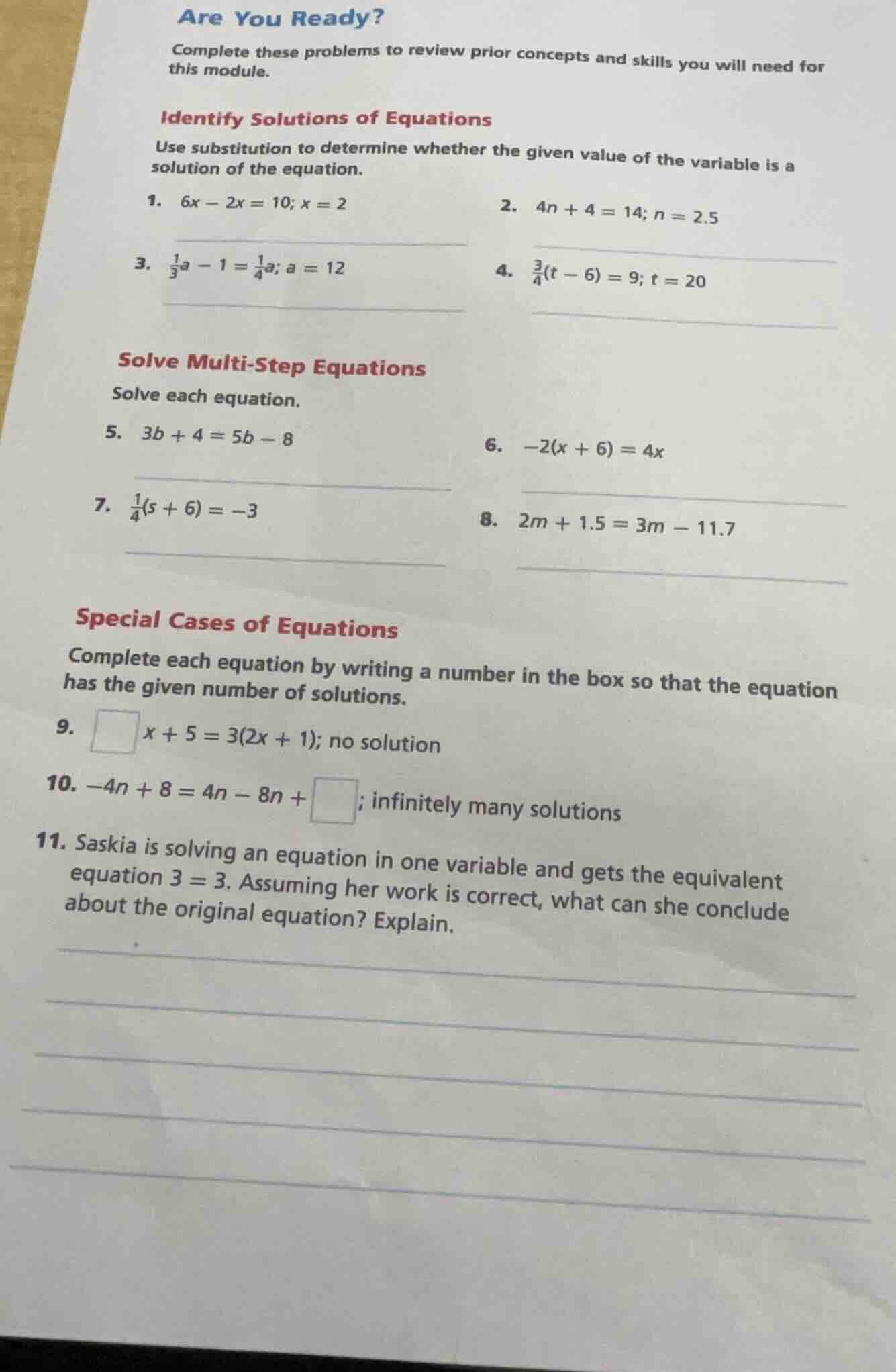
are you ready?
complete these problems to review prior concepts and skills you will need for this module.
identify solutions of equations
use substitution to determine whether the given value of the variable is a solution of the equation.
- $6x - 2x = 10; x = 2$
- $4n + 4 = 14; n = 2.5$
- $\frac{1}{3}a - 1 = \frac{1}{4}a; a = 12$
- $\frac{3}{4}(t - 6) = 9; t = 20$
solve multi - step equations
solve each equation.
- $3b + 4 = 5b - 8$
- $-2(x + 6) = 4x$
- $\frac{1}{4}(s + 6) = -3$
- $2m + 1.5 = 3m - 11.7$
special cases of equations
complete each equation by writing a number in the box so that the equation has the given number of solutions.
- $square x + 5 = 3(2x + 1)$; no solution
- $-4n + 8 = 4n - 8n + square$; infinitely many solutions
- saskia is solving an equation in one variable and gets the equivalent equation $3 = 3$. assuming her work is correct, what can she conclude about the original equation? explain.
---
Identify Solutions of Equations
Problem 1:
Step1: Substitute $x=2$
$6(2)-2(2)=12-4=8$
Step2: Compare to RHS
$8
eq 10$
When solving an equation leads to a true numerical statement with no variables, it means the equation is true for all values of the variable.

Snap & solve any problem in the app
Get step-by-step solutions on Sovi AI
Photo-based solutions with guided steps
Explore more problems and detailed explanations
(1):
$x=2$ is not a solution.
---
Problem 2:
Step1: Substitute $n=2.5$
$4(2.5)+4=10+4=14$
Step2: Compare to RHS
$14=14$