QUESTION IMAGE
Question
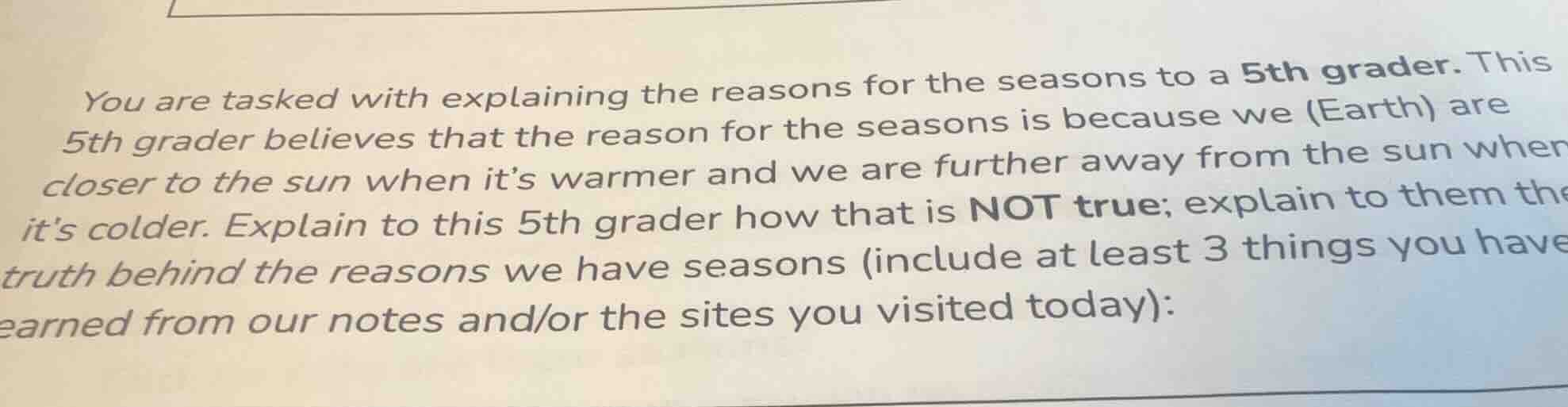
you are tasked with explaining the reasons for the seasons to a 5th grader. this 5th grader believes that the reason for the seasons is because we (earth) are closer to the sun when it’s warmer and we are further away from the sun when it’s colder. explain to this 5th grader how that is not true; explain to them the truth behind the reasons we have seasons (include at least 3 things you have learned from our notes and/or the sites you visited today):
- First, correct the distance myth: Earth is actually closest to the Sun in early January (winter for the Northern Hemisphere), so distance can't be the cause.
- Explain Earth's tilt: Earth spins on a tilted axis (about 23.5 degrees), so one hemisphere leans toward the Sun while the other leans away at different times of the year.
- Cover direct vs. indirect sunlight: When a hemisphere tilts toward the Sun, sunlight hits it more directly—this concentrates the Sun's heat, making temperatures warmer (summer). When tilted away, sunlight hits at a shallow angle, spreading out the heat and making it colder (winter).
- Add daylight hours: The tilted hemisphere facing the Sun also gets more hours of sunlight each day, giving it more time to warm up, while the opposite hemisphere gets fewer daylight hours.

Snap & solve any problem in the app
Get step-by-step solutions on Sovi AI
Photo-based solutions with guided steps
Explore more problems and detailed explanations
Hey there! Let's clear up that myth first: Earth is actually closest to the Sun in early January, which is winter for us in the Northern Hemisphere! So being near or far from the Sun doesn't cause the seasons.
The real reason we have seasons is because Earth is tilted like a top, at an angle of about 23.5 degrees, as it goes around the Sun. Here's how that works:
- When our part of Earth (the Northern Hemisphere) tilts toward the Sun, sunlight hits us more directly. It's like shining a flashlight straight at a piece of paper—all the light and heat are concentrated in one spot, making it warm (that's summer!). We also get way more hours of sunlight each day, so there's more time to warm up.
- When our hemisphere tilts away from the Sun, sunlight hits us at a slant. That's like holding the flashlight at an angle to the paper—the light and heat spread out, so it feels colder (that's winter!). We also get fewer hours of sunlight each day, so things don't have time to warm up much.
- The tilt also means the other hemisphere (the Southern Hemisphere) has the opposite season from us. When we're in winter, they're in summer because their part of Earth is tilted toward the Sun!