QUESTION IMAGE
Question
do you understand?
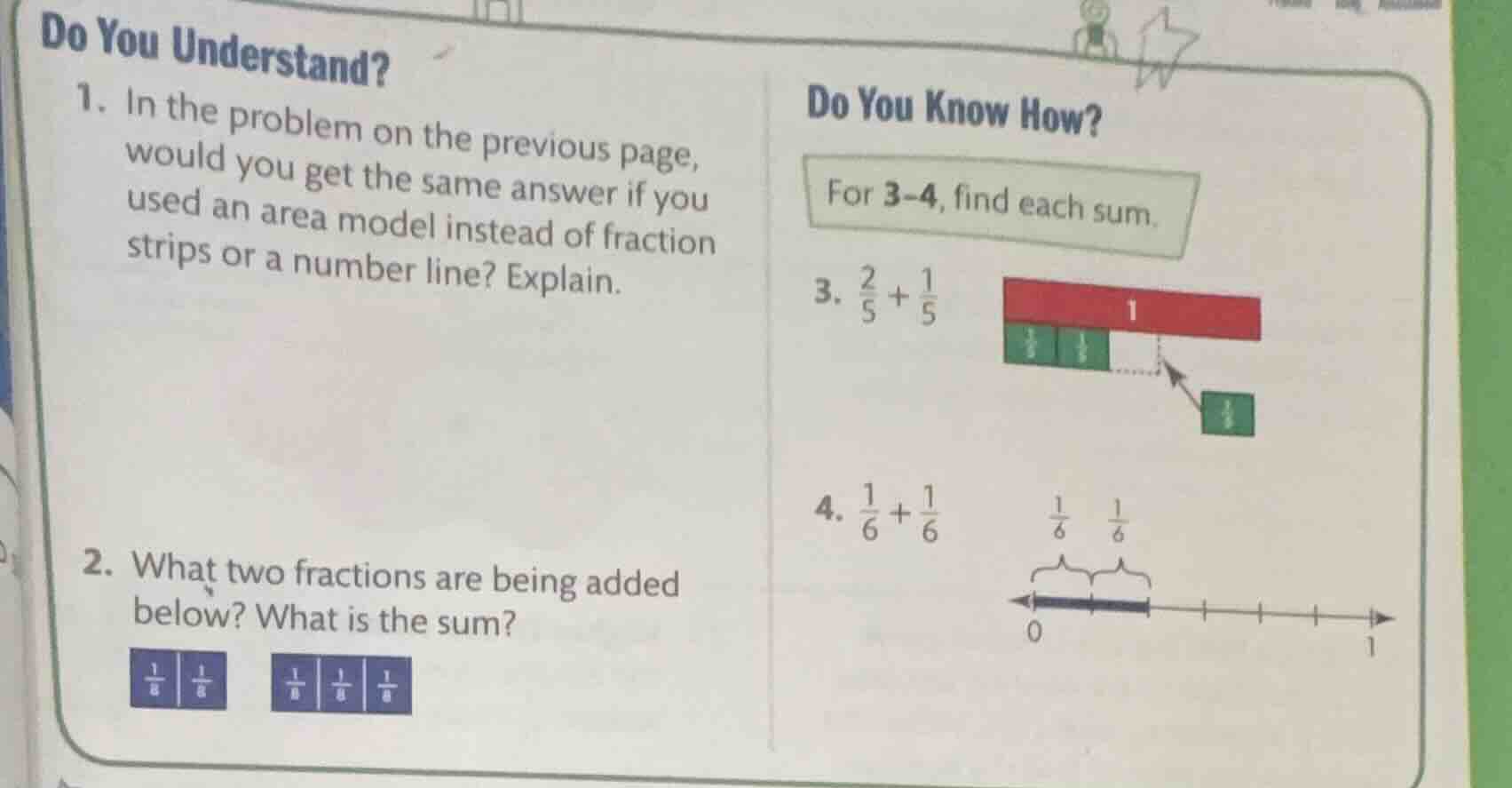
- in the problem on the previous page, would you get the same answer if you used an area model instead of fraction strips or a number line? explain.
- what two fractions are being added below? what is the sum?
\frac{1}{8} \frac{1}{8} \quad \frac{1}{8} \frac{1}{8} \frac{1}{8}
do you know how?
for 3–4, find each sum.
- $\frac{2}{5} + \frac{1}{5}$
(image: a red bar labeled 1, green blocks labeled \frac{1}{5}, and a dashed box with a green block labeled \frac{1}{5})
- $\frac{1}{6} + \frac{1}{6}$
(image: a number line from 0 to 1, with two segments labeled \frac{1}{6} each starting at 0)
Question 1
To determine if using an area model gives the same answer as fraction strips or a number line, we analyze the nature of these models. All three (area model, fraction strips, number line) represent fractions and their addition based on the same mathematical principles of adding like - denominated fractions. For example, if we have a fraction addition problem, the area model divides a whole into equal parts (denominator - sized parts) and shades the number of parts corresponding to the numerators. Fraction strips and number lines also rely on the concept of equal parts (the denominator) and adding the number of parts (the numerators). So, as long as the fractions being added have the same denominator (or are converted to have the same denominator in case of different denominators), the result of addition should be the same across these models because they all operate on the fundamental rules of fraction addition (adding numerators when denominators are equal, finding a common denominator when they are not).
Step 1: Identify the fractions
The first set of tiles has 2 tiles each labeled $\frac{1}{8}$, so the first fraction is $\frac{2}{8}$ (since $2\times\frac{1}{8}=\frac{2}{8}$). The second set of tiles has 3 tiles each labeled $\frac{1}{8}$, so the second fraction is $\frac{3}{8}$ (since $3\times\frac{1}{8}=\frac{3}{8}$).
Step 2: Add the fractions
To add $\frac{2}{8}$ and $\frac{3}{8}$, we use the rule for adding fractions with the same denominator: $\frac{a}{c}+\frac{b}{c}=\frac{a + b}{c}$, where $a = 2$, $b = 3$, and $c = 8$. So $\frac{2}{8}+\frac{3}{8}=\frac{2 + 3}{8}=\frac{5}{8}$.
Step 1: Recall the rule for adding fractions with the same denominator
When adding two fractions with the same denominator, we add the numerators and keep the denominator the same. The formula is $\frac{a}{b}+\frac{c}{b}=\frac{a + c}{b}$, where $a = 2$, $c = 1$, and $b = 5$.
Step 2: Apply the rule
Substitute the values into the formula: $\frac{2}{5}+\frac{1}{5}=\frac{2 + 1}{5}=\frac{3}{5}$.

Snap & solve any problem in the app
Get step-by-step solutions on Sovi AI
Photo-based solutions with guided steps
Explore more problems and detailed explanations
Yes, you would get the same answer. All three models (area model, fraction strips, number line) are based on the principles of fraction addition. They represent fractions as parts of a whole (with the denominator determining the number of equal parts and the numerator determining the number of shaded/selected parts). When adding fractions, the operation of combining the number of parts (numerators) with the same size of parts (denominators) is consistent across these models, so the sum will be the same.