QUESTION IMAGE
Question
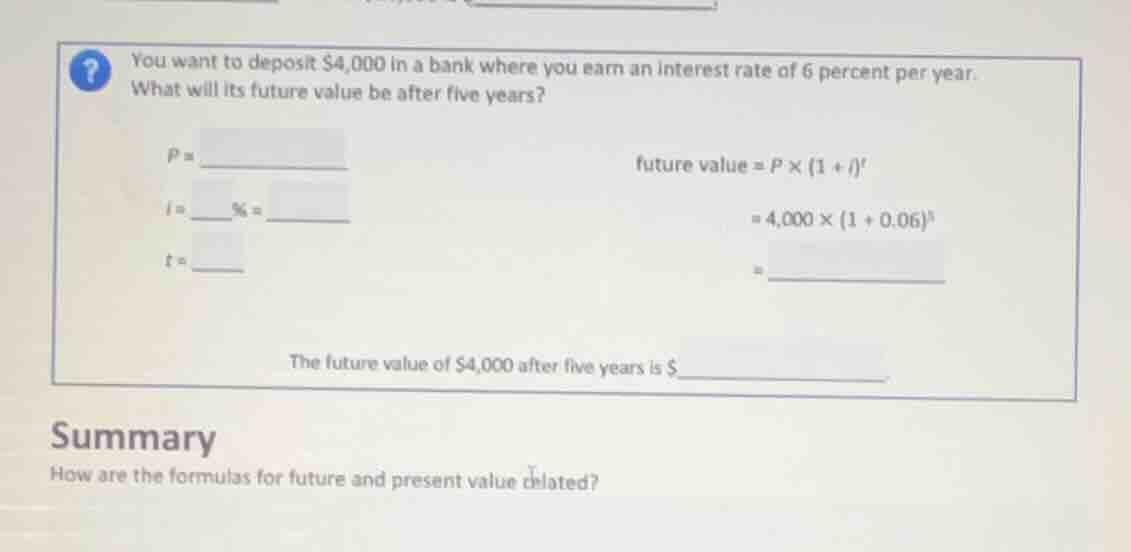
you want to deposit $4,000 in a bank where you earn an interest rate of 6 percent per year. what will its future value be after five years?
p =
i = % =
t =
future value = p × (1 + i)^t
= 4,000 × (1 + 0.06)^5
=
the future value of $4,000 after five years is $ .
summary
how are the formulas for future and present value related?
Step1: Identify the principal amount (P)
The principal amount \( P \) is the initial deposit, which is $4,000. So \( P = 4000 \).
Step2: Identify the interest rate (i)
The annual interest rate is 6 percent. To convert a percentage to a decimal, we divide by 100. So \( i = 6\% = \frac{6}{100} = 0.06 \).
Step3: Identify the time period (t)
The time period \( t \) is 5 years. So \( t = 5 \).
Step4: Calculate the future value
Using the future - value formula \( \text{future value}=P\times(1 + i)^{t} \), substitute \( P = 4000 \), \( i=0.06 \), and \( t = 5 \) into the formula:
\[
\]

Snap & solve any problem in the app
Get step-by-step solutions on Sovi AI
Photo-based solutions with guided steps
Explore more problems and detailed explanations
- \( P=\boldsymbol{4000} \)
- \( i = \boldsymbol{6}\%=\boldsymbol{0.06} \)
- \( t=\boldsymbol{5} \)
- \( 4000\times(1 + 0.06)^{5}=\boldsymbol{5352.90} \) (rounded to two decimal places)
- The future value of $4,000 after five years is \(\boldsymbol{\$5352.90}\)