QUESTION IMAGE
Question
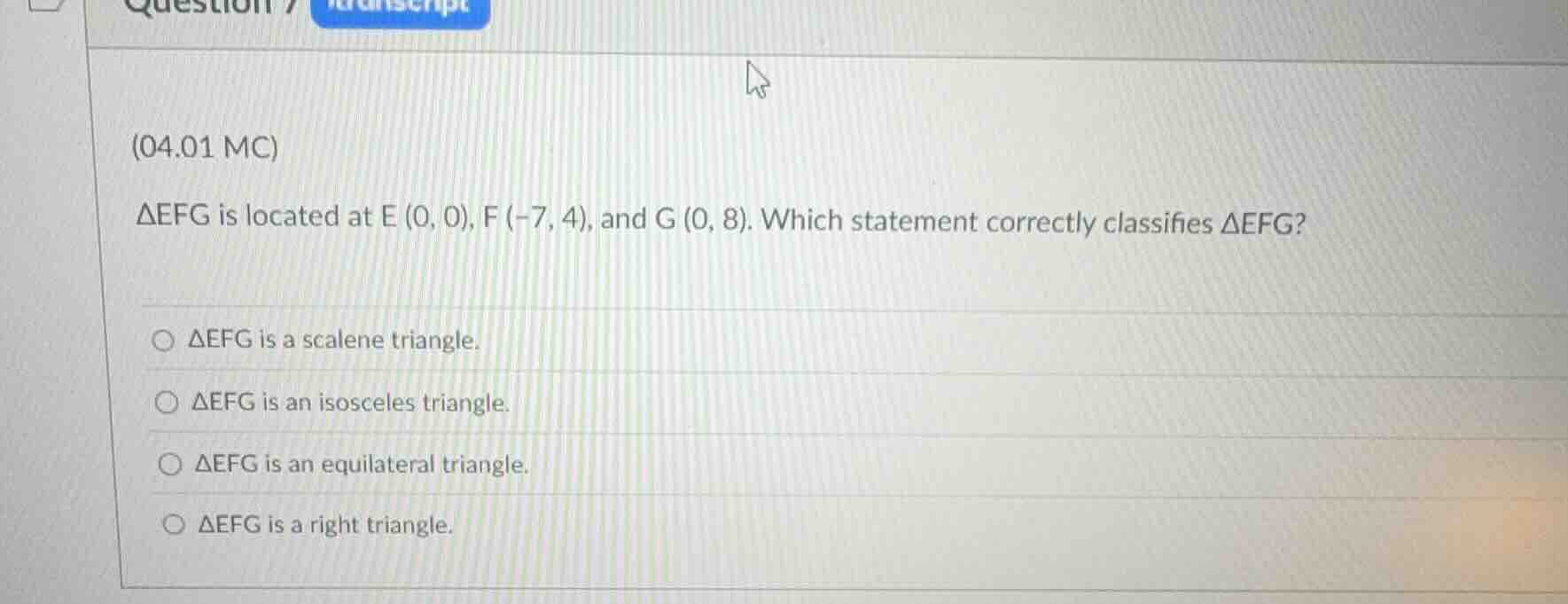
(04.01 mc) δefg is located at e (0, 0), f (-7, 4), and g (0, 8). which statement correctly classifies δefg? ○ δefg is a scalene triangle. ○ δefg is an isosceles triangle. ○ δefg is an equilateral triangle. ○ δefg is a right triangle.
Step1: Calculate the lengths of the sides
To find the lengths of the sides of triangle \( \triangle EFG \) with vertices \( E(0,0) \), \( F(-7,4) \), and \( G(0,8) \), we use the distance formula \( d = \sqrt{(x_2 - x_1)^2 + (y_2 - y_1)^2} \).
- Length of \( EF \):
\( EF = \sqrt{(-7 - 0)^2 + (4 - 0)^2} = \sqrt{(-7)^2 + 4^2} = \sqrt{49 + 16} = \sqrt{65} \)
- Length of \( EG \):
\( EG = \sqrt{(0 - 0)^2 + (8 - 0)^2} = \sqrt{0 + 64} = \sqrt{64} = 8 \)
- Length of \( FG \):
\( FG = \sqrt{(0 - (-7))^2 + (8 - 4)^2} = \sqrt{(7)^2 + 4^2} = \sqrt{49 + 16} = \sqrt{65} \)
Step2: Classify the triangle
Now we analyze the side lengths:
- \( EF = \sqrt{65} \), \( FG = \sqrt{65} \), and \( EG = 8 \).
- Since two sides (\( EF \) and \( FG \)) are equal in length, the triangle is isosceles. Also, we can check if it's a right triangle by verifying the Pythagorean theorem. Let's check if \( EF^2 + FG^2 = EG^2 \), \( EF^2 + EG^2 = FG^2 \), or \( FG^2 + EG^2 = EF^2 \).
- \( EF^2 + FG^2 = 65 + 65 = 130 \), and \( EG^2 = 64 \). Not equal.
- \( EF^2 + EG^2 = 65 + 64 = 129 \), and \( FG^2 = 65 \). Not equal.
- \( FG^2 + EG^2 = 65 + 64 = 129 \), and \( EF^2 = 65 \). Not equal. So it's not a right triangle.
- Since only two sides are equal, it's isosceles (not equilateral, since all sides aren't equal; not scalene, since scalene has all sides different).

Snap & solve any problem in the app
Get step-by-step solutions on Sovi AI
Photo-based solutions with guided steps
Explore more problems and detailed explanations
\( \triangle EFG \) is an isosceles triangle. (The option: \( \triangle EFG \) is an isosceles triangle.)