QUESTION IMAGE
Question
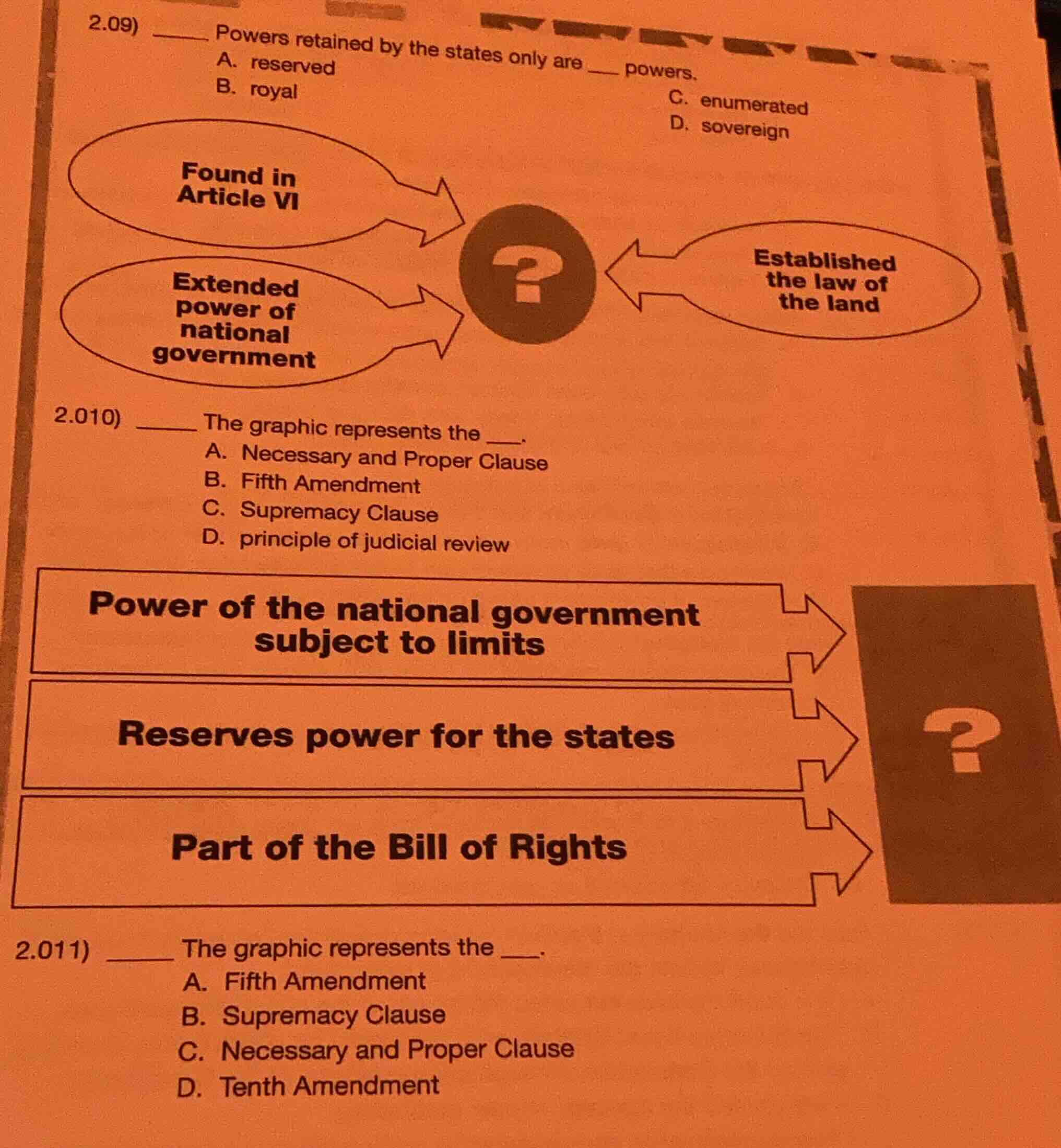
2.09) __ powers retained by the states only are _ powers. a. reserved b. royal c. enumerated d. sovereign
found in article vi
extended power of national government
established the law of the land
2.010) __ the graphic represents the _. a. necessary and proper clause b. fifth amendment c. supremacy clause d. principle of judicial review
power of the national government subject to limits
reserves power for the states
part of the bill of rights
2.011) __ the graphic represents the _. a. fifth amendment b. supremacy clause c. necessary and proper clause d. tenth amendment
2.09)
To solve this, we recall the types of powers in U.S. government. Reserved powers are those not delegated to the federal government and are retained by the states. Royal powers are not a term for U.S. state powers, enumerated powers are federal powers listed in the Constitution, and sovereign powers refer to a government's ultimate authority (not specific to state - retained). So the correct answer is the one related to state - retained powers.
The Supremacy Clause is in Article VI, establishes federal law as the supreme law of the land, and extends the national government's power. The Necessary and Proper Clause is about implied powers, the Fifth Amendment is about rights in legal proceedings, and judicial review is about courts reviewing laws. So the graphic matches the Supremacy Clause.
The Tenth Amendment reserves powers not given to the federal government to the states, relates to limiting federal power and reserving state power, and is part of the Bill of Rights. The Fifth Amendment is about legal rights, the Supremacy Clause is about federal law supremacy, and the Necessary and Proper Clause is about implied powers. So the graphic matches the Tenth Amendment.

Snap & solve any problem in the app
Get step-by-step solutions on Sovi AI
Photo-based solutions with guided steps
Explore more problems and detailed explanations
A. reserved