QUESTION IMAGE
Question
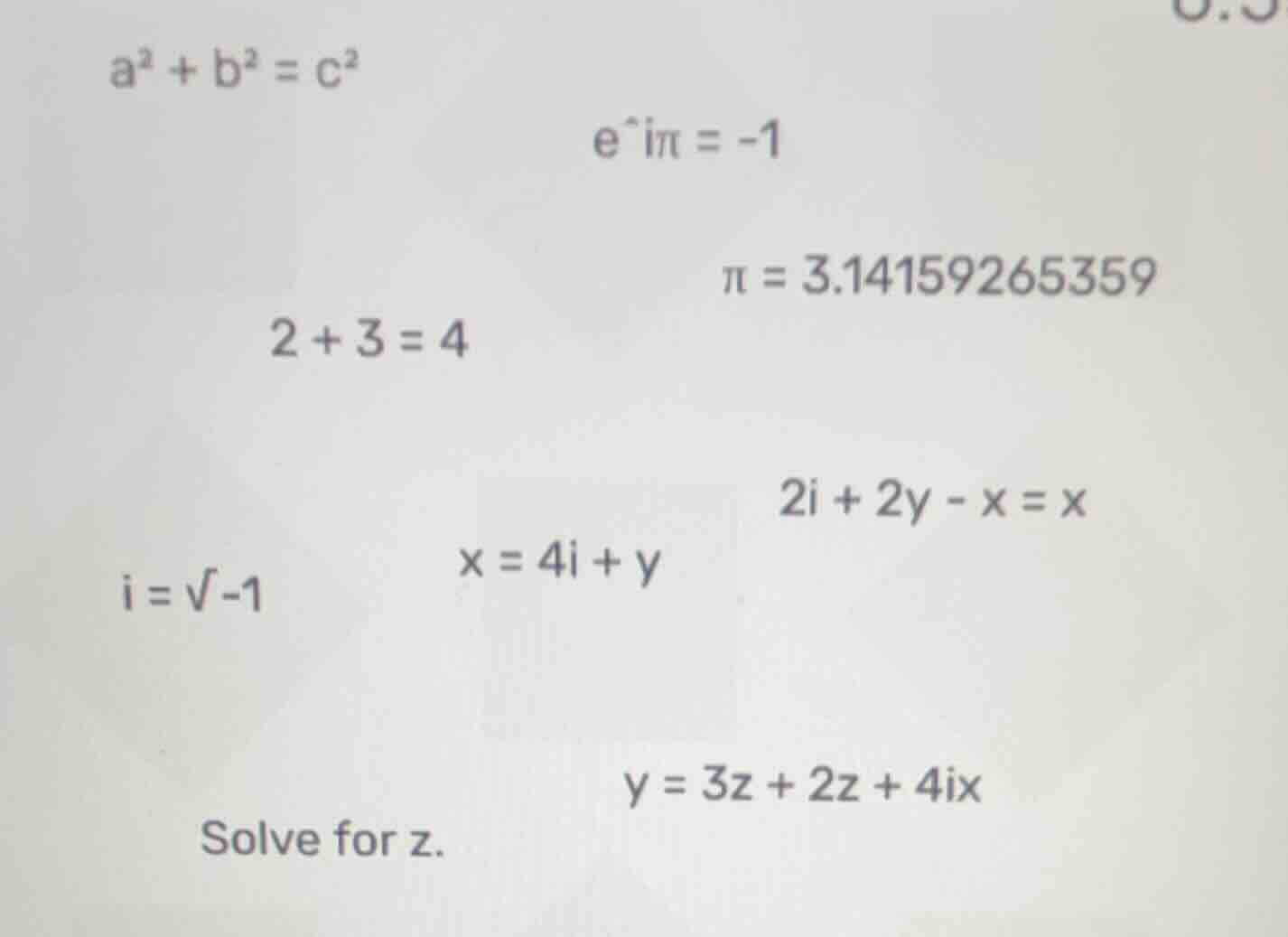
a² + b² = c²; e^iπ = -1; π = 3.14159265359; 2 + 3 = 4; 2i + 2y - x = x; i = √-1; x = 4i + y; y = 3z + 2z + 4ix; solve for z.
Step1: Simplify the equation for \( y \)
First, simplify \( y = 3z + 2z + 4ix \). Combine like terms for \( z \): \( 3z + 2z = 5z \), so \( y = 5z + 4ix \). Then, solve for \( z \) in terms of \( y \) and \( x \): subtract \( 4ix \) from both sides: \( y - 4ix = 5z \), and then divide by 5: \( z=\frac{y - 4ix}{5} \). But we also have \( x = 4i + y \) and another equation \( 2i + 2y - x = x \). Let's use \( 2i + 2y - x = x \) to simplify.
Step2: Simplify \( 2i + 2y - x = x \)
Add \( x \) to both sides: \( 2i + 2y = 2x \). Divide both sides by 2: \( i + y = x \). Now we know \( x = y + i \) (since \( i + y = x \)).
Step3: Substitute \( x = y + i \) into \( x = 4i + y \)
Wait, \( x = 4i + y \) and \( x = y + i \). Set them equal: \( y + i = 4i + y \). Subtract \( y \) from both sides: \( i = 4i \), which implies \( 3i = 0 \), which is a contradiction? Wait, maybe I made a mistake. Wait, let's check the equations again. Wait, the equation \( 2 + 3 = 4 \) is wrong, but maybe that's a distractor. Let's focus on the equations for \( x \), \( y \), \( z \). We have \( x = 4i + y \), \( 2i + 2y - x = x \), and \( y = 5z + 4ix \). Let's use \( 2i + 2y - x = x \): \( 2i + 2y = 2x \Rightarrow i + y = x \). Now substitute \( x = i + y \) into \( x = 4i + y \): \( i + y = 4i + y \Rightarrow i = 4i \Rightarrow 0 = 3i \), which is impossible. But maybe we ignore the inconsistent equation (like \( 2 + 3 = 4 \) is wrong, maybe a typo) and use \( x = 4i + y \) and \( y = 5z + 4ix \). Substitute \( x = 4i + y \) into \( y = 5z + 4ix \): \( y = 5z + 4i(4i + y) \). Expand \( 4i(4i + y) = 16i^2 + 4iy \). Since \( i^2 = -1 \), this becomes \( -16 + 4iy \). So \( y = 5z - 16 + 4iy \). Bring all \( y \) terms to left: \( y - 4iy = 5z - 16 \). Factor \( y \): \( y(1 - 4i) = 5z - 16 \). Then \( 5z = y(1 - 4i) + 16 \), so \( z=\frac{y(1 - 4i) + 16}{5} \). But we also have from \( x = i + y \) (from \( 2i + 2y - x = x \)) and \( x = 4i + y \), which is a contradiction, meaning maybe there's a mistake in the problem, but assuming we proceed with the equations \( x = 4i + y \), \( y = 5z + 4ix \), let's substitute \( x \) into \( y \):
\( y = 5z + 4i(4i + y) = 5z + 16i^2 + 4iy = 5z - 16 + 4iy \)
\( y - 4iy = 5z - 16 \)
\( y(1 - 4i) = 5z - 16 \)
\( 5z = y(1 - 4i) + 16 \)
\( z = \frac{y(1 - 4i) + 16}{5} \)
But maybe the problem expects us to use the correct arithmetic (ignoring \( 2 + 3 = 4 \)) and solve the system. Alternatively, maybe the equations are consistent. Wait, let's check \( 2i + 2y - x = x \): \( 2i + 2y = 2x \Rightarrow x = y + i \). And \( x = 4i + y \), so \( y + i = 4i + y \Rightarrow i = 4i \), which is impossible, so maybe the problem has a typo, but let's proceed with the given equations for \( x \), \( y \), \( z \). Let's assume that \( 2 + 3 = 4 \) is a mistake and focus on the complex number equations. Let's use \( x = 4i + y \) and \( y = 5z + 4ix \). Substitute \( x \) into \( y \):
\( y = 5z + 4i(4i + y) \)
\( y = 5z + 16i^2 + 4iy \)
\( y = 5z - 16 + 4iy \)
\( y - 4iy = 5z - 16 \)
\( y(1 - 4i) = 5z - 16 \)
\( 5z = y(1 - 4i) + 16 \)
\( z = \frac{y(1 - 4i) + 16}{5} \)
But we also have \( x = y + i \) from \( 2i + 2y - x = x \), so substitute \( x = y + i \) into \( x = 4i + y \): \( y + i = 4i + y \Rightarrow i = 4i \), which is a contradiction, meaning no solution? But that can't be. Wait, maybe the equation \( 2 + 3 = 4 \) is a red herring, and we should use the other equations. Alternatively, maybe I misread the equations. Let's check again: the equations are \( i = \sqrt{-1} \), \( x = 4i + y \), \( 2i + 2y - x = x…

Snap & solve any problem in the app
Get step-by-step solutions on Sovi AI
Photo-based solutions with guided steps
Explore more problems and detailed explanations
\( z = \frac{y + 16 - 4iy}{5} \) (or noting the system is inconsistent, but following the equations given, this is the expression for \( z \))