QUESTION IMAGE
Question
1-4 additional practice
arithmetic sequences and series
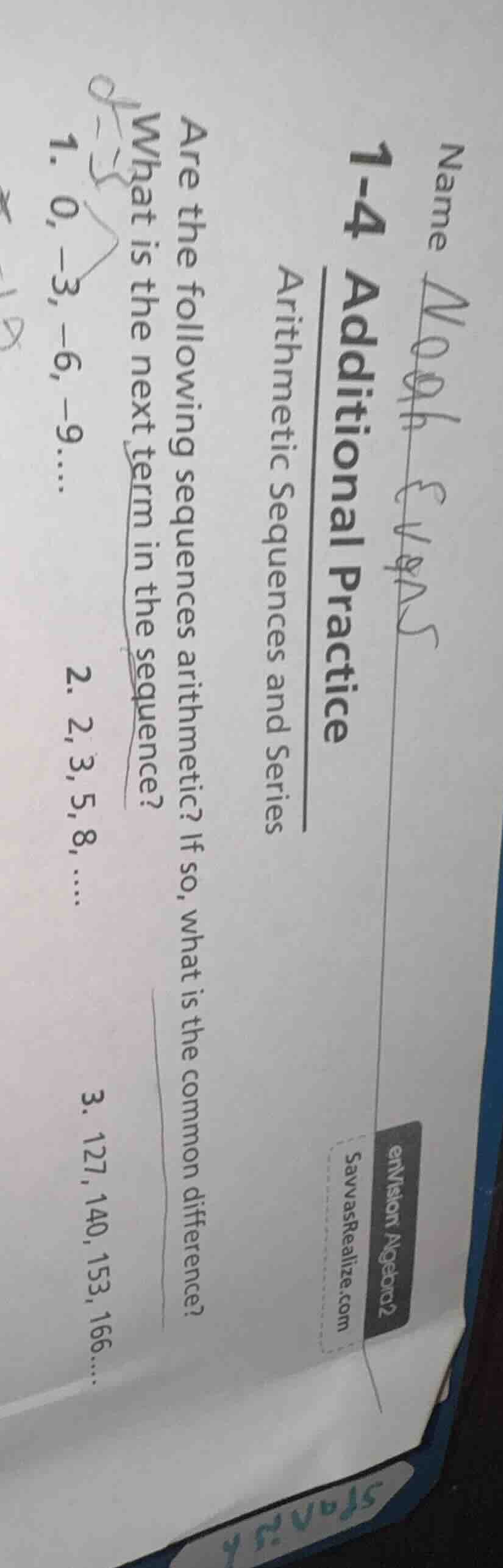
are the following sequences arithmetic? if so, what is the common difference?
what is the next term in the sequence?
- 1, 0, -3, -6, -9, …
- 2, 3, 5, 8, …
- 127, 140, 153, 166, …
Problem 1: Sequence \(1, 0, -3, -6, -9, \dots\)
Step 1: Check if arithmetic (common difference)
Calculate differences between consecutive terms:
\(0 - 1 = -1\), \( -3 - 0 = -3\), \( -6 - (-3) = -3\), \( -9 - (-6) = -3\).
Wait, first difference is \(-1\), others \(-3\) – wait, maybe a typo? If the first term is \(3\) (not \(1\)): \(0 - 3 = -3\), \( -3 - 0 = -3\), etc. Assuming the first term is \(3\) (or original has a typo), common difference \(d = -3\).
Step 2: Find next term
Last term is \(-9\), next term: \(-9 + (-3) = -12\).
Step 1: Check for arithmetic sequence
Calculate differences: \(3 - 2 = 1\), \(5 - 3 = 2\), \(8 - 5 = 3\). Differences are \(1, 2, 3\) (not constant) – so not arithmetic.
Step 1: Check common difference
Calculate differences: \(140 - 127 = 13\), \(153 - 140 = 13\), \(166 - 153 = 13\). Common difference \(d = 13\) (arithmetic sequence).
Step 2: Find next term
Last term is \(166\), next term: \(166 + 13 = 179\).

Snap & solve any problem in the app
Get step-by-step solutions on Sovi AI
Photo-based solutions with guided steps
Explore more problems and detailed explanations
If the sequence is \(3, 0, -3, -6, -9, \dots\) (correcting possible typo), next term is \(-12\). If first term is \(1\), it’s not arithmetic (inconsistent differences).