QUESTION IMAGE
Question
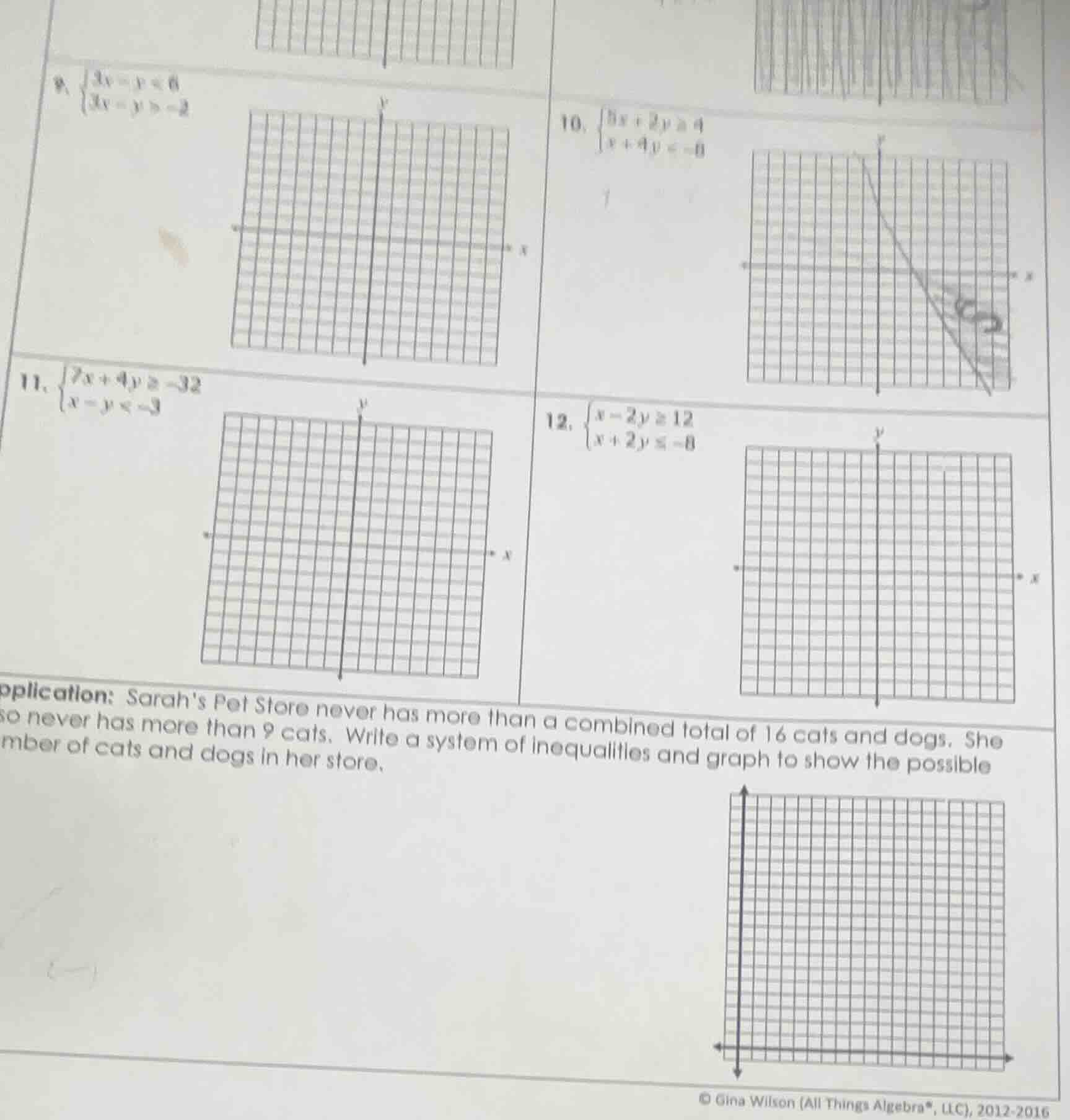
- \\(\
\\) 10. \\(\
\\) 11. \\(\
\\) 12. \\(\
\\) application: sarahs pet store never has more than a combined total of 16 cats and dogs. she so never has more than 9 cats. write a system of inequalities and graph to show the possible number of cats and dogs in her store.
For the application problem (Sarah's Pet Store):
Step1: Define Variables
Let \( x \) be the number of cats and \( y \) be the number of dogs. Both \( x \) and \( y \) should be non - negative integers (since the number of animals can't be negative or a fraction), so we have the implicit inequalities \( x\geq0 \) and \( y\geq0 \).
Step2: Total Animals Inequality
The combined total of cats and dogs is at most 16. So, the sum of \( x \) and \( y \) is less than or equal to 16. Mathematically, this is \( x + y\leq16 \).
Step3: Number of Cats Inequality
Sarah never has more than 9 cats. So, the number of cats \( x \) is less than or equal to 9. In formula form, \( x\leq9 \).

Snap & solve any problem in the app
Get step-by-step solutions on Sovi AI
Photo-based solutions with guided steps
Explore more problems and detailed explanations
The system of inequalities is:
\[
\]
To graph this system:
- For \( x + y\leq16 \), first graph the line \( x + y = 16 \) (a straight line with intercepts \( (16,0) \) and \( (0,16) \)). Since the inequality is \( \leq \), we shade the region below the line. Also, since \( x\geq0 \) and \( y\geq0 \), we are only interested in the first quadrant.
- For \( x\leq9 \), graph the vertical line \( x = 9 \). Since the inequality is \( \leq \), we shade the region to the left of the line \( x = 9 \) within the first quadrant and the region defined by \( x + y\leq16 \). The intersection of all the shaded regions (defined by \( x + y\leq16 \), \( x\leq9 \), \( x\geq0 \), and \( y\geq0 \)) represents the possible number of cats and dogs in the store.