QUESTION IMAGE
Question
10.
d:
r:
function?
Step1: Determine the Domain (D)
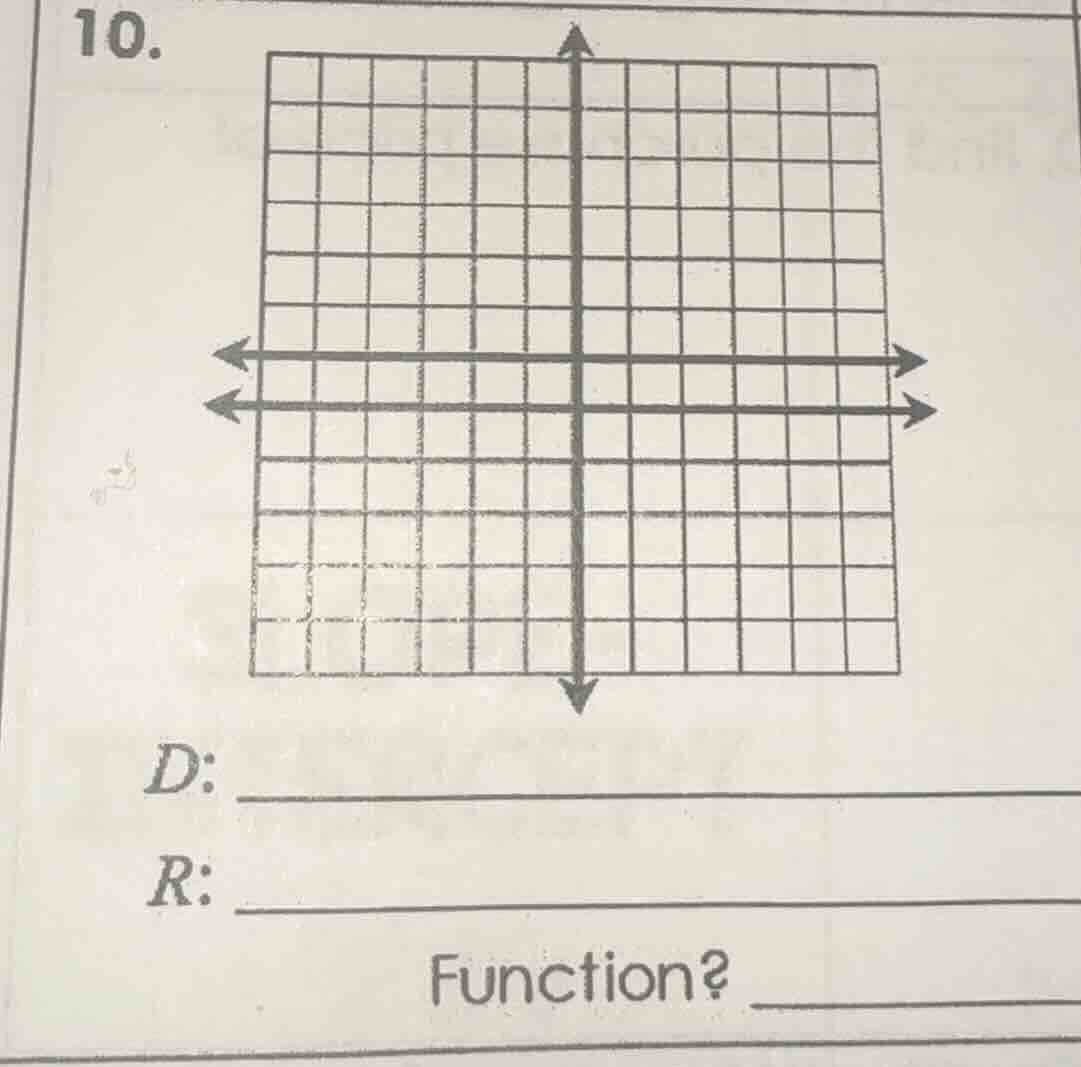
The graph shows two horizontal lines, which extend infinitely in the horizontal direction (along the x - axis). The domain of a relation (set of all x - values) for a horizontal line (or lines) is all real numbers because there are no restrictions on the x - values; the lines go from negative infinity to positive infinity on the x - axis. So, the domain \( D=\mathbb{R} \) (all real numbers), or in interval notation, \( (-\infty,\infty) \).
Step2: Determine the Range (R)
Looking at the horizontal lines, each horizontal line has a constant y - value. From the graph, we can see that there are two horizontal lines, but let's check their y - coordinates. Wait, actually, looking at the grid, the two horizontal lines: let's assume the y - values. Wait, maybe I misread. Wait, the two horizontal lines: let's see, the horizontal lines are parallel to the x - axis. Wait, no, actually, in the graph, the two horizontal lines—wait, maybe it's two horizontal lines? Wait, no, maybe it's a typo, or maybe it's two horizontal lines with different y - values? Wait, no, looking at the graph, the two horizontal lines: let's check the y - coordinates. Wait, maybe the two horizontal lines are, for example, y = - 1 and y = 0? Wait, no, maybe I made a mistake. Wait, actually, the domain of a horizontal line (or a set of horizontal lines) is all real numbers, and the range is the set of y - values that the lines take. Wait, but in the graph, if there are two horizontal lines, then the range is the set of their y - values. But maybe it's a single horizontal line? Wait, no, the arrows are on two horizontal lines. Wait, maybe the graph is of two horizontal lines, say y = a and y = b. But maybe I misinterpret. Wait, no, the key is: for a horizontal line (or lines), domain is all real numbers, and range is the set of y - values of the lines. But maybe in this case, the two horizontal lines have specific y - values. Wait, maybe the graph is of two horizontal lines, like y = - 1 and y = 0? Wait, no, let's think again. Wait, the problem is to find the domain (D) and range (R) of the relation shown (the two horizontal lines), and then determine if it's a function.
Wait, first, domain: the set of all x - values for which the relation is defined. Since the horizontal lines extend infinitely left and right, the domain is all real numbers, so \( D = (-\infty,\infty) \) (all real numbers).
Range: the set of all y - values. If there are two horizontal lines, say with y - values, for example, let's assume from the grid that the two horizontal lines are at y = - 1 and y = 0 (or some other values). But maybe the graph is of two horizontal lines, so the range is the set of their y - values. But maybe I made a mistake. Wait, no, maybe it's a single horizontal line? Wait, no, the arrows are on two horizontal lines. Wait, maybe the original graph has two horizontal lines, so the range is the set of y - values of those lines. But let's check the vertical line test for functions. A relation is a function if every x - value is paired with exactly one y - value. For a set of horizontal lines, if there are two horizontal lines, then for a given x - value, there are two y - values (one from each line), so it's not a function. But if it's a single horizontal line, then it is a function. Wait, maybe I misread the graph. Wait, maybe it's a single horizontal line with two arrows? No, the diagram shows two horizontal lines with arrows. Wait, maybe it's a mistake, and it's a single horizontal line. Wait, no, the user's graph: "two horizontal lines, each…

Snap & solve any problem in the app
Get step-by-step solutions on Sovi AI
Photo-based solutions with guided steps
Explore more problems and detailed explanations
- \( D: (-\infty, \infty) \) (all real numbers)
- \( R: \) The set of y - values of the two horizontal lines (e.g., if the lines are at \( y = k_1 \) and \( y = k_2 \), then \( R=\{k_1, k_2\} \))
- Function? No (because it fails the vertical line test; a vertical line intersects the two horizontal lines at two points for the same x - value)
(Note: If the diagram is of a single horizontal line (a drawing error), then \( R = \{k\} \) (where \( k \) is the y - value of the line) and Function? Yes.)