QUESTION IMAGE
Question
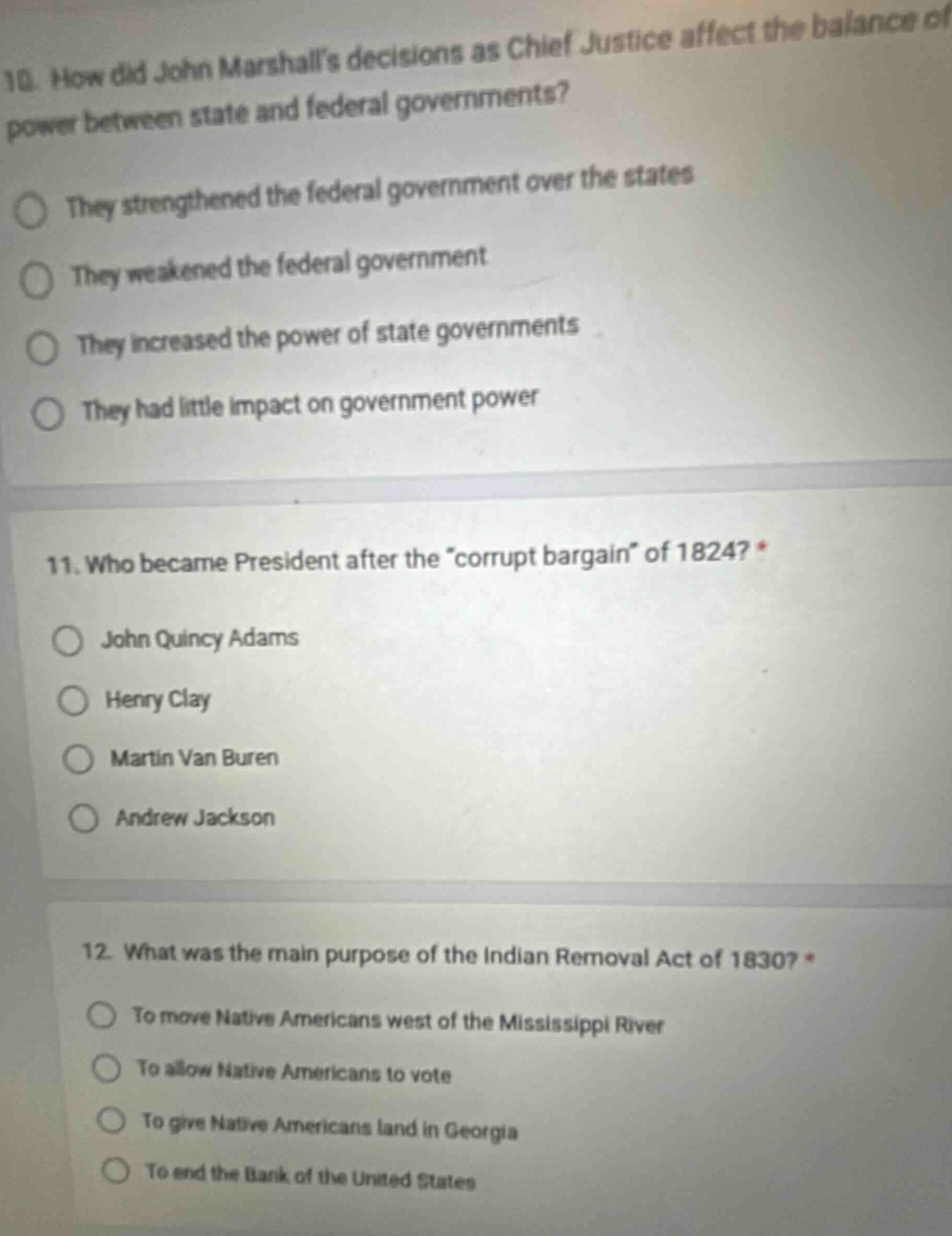
- how did john marshall’s decisions as chief justice affect the balance of power between state and federal governments?
○ they strengthened the federal government over the states
○ they weakened the federal government
○ they increased the power of state governments
○ they had little impact on government power
- who became president after the \corrupt bargain\ of 1824? *
○ john quincy adams
○ henry clay
○ martin van buren
○ andrew jackson
- what was the main purpose of the indian removal act of 1830? *
○ to move native americans west of the mississippi river
○ to allow native americans to vote
○ to give native americans land in georgia
○ to end the bank of the united states
Question 10
John Marshall, as Chief Justice, made decisions (like in cases such as McCulloch v. Maryland, Gibbons v. Ogden) that expanded the power of the federal government relative to state governments. So his decisions strengthened the federal government over the states.
In the 1824 election, no candidate got a majority in the Electoral College. The House of Representatives decided the election, and John Quincy Adams became President, with the "corrupt bargain" allegation involving Henry Clay's support for Adams.
The Indian Removal Act of 1830 (note: the year in the question might be a typo, it's 1830) was intended to relocate Native American tribes from their lands in the Southeast to areas west of the Mississippi River, mainly to open up their lands for white settlement.

Snap & solve any problem in the app
Get step-by-step solutions on Sovi AI
Photo-based solutions with guided steps
Explore more problems and detailed explanations
A. They strengthened the federal government over the states