QUESTION IMAGE
Question
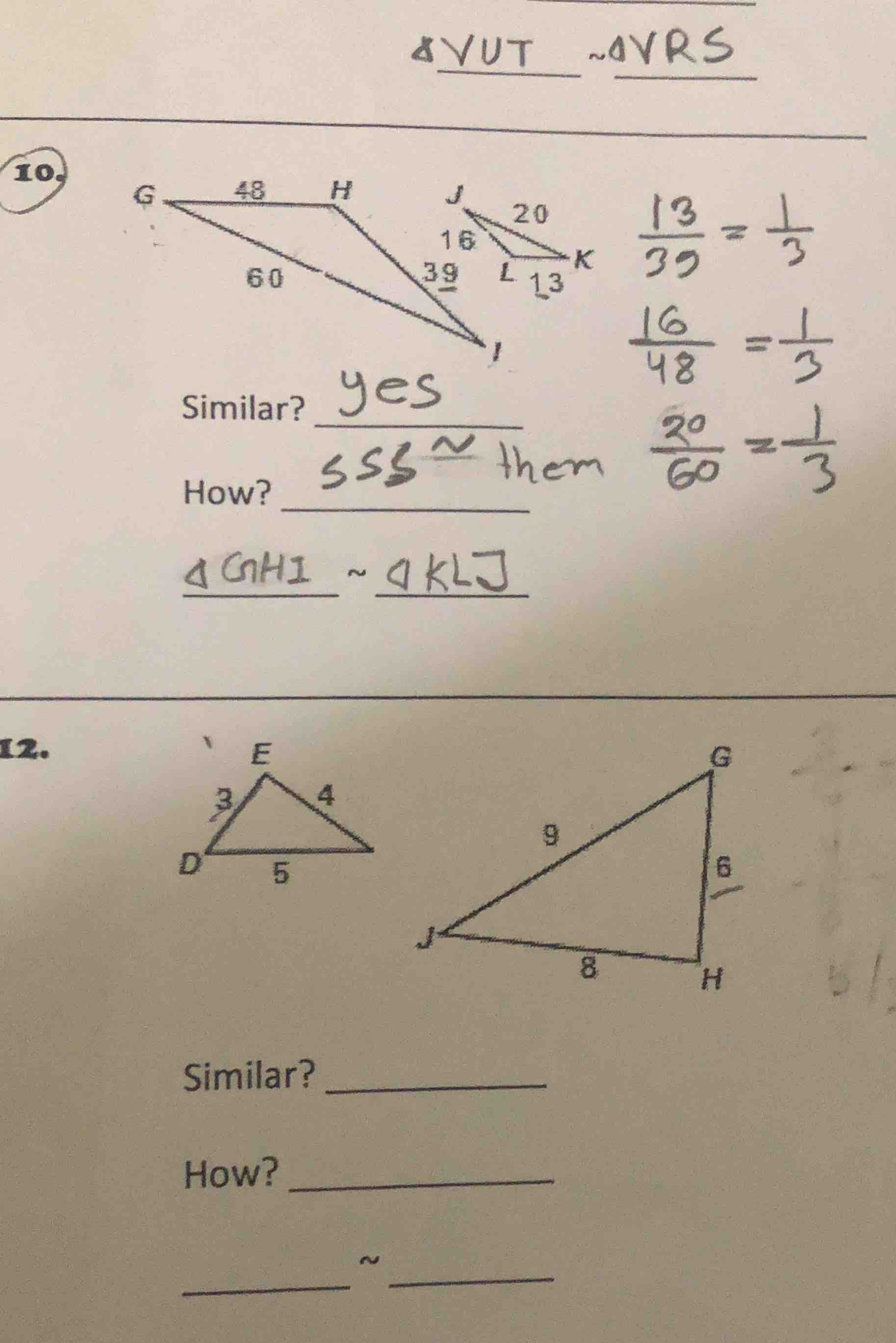
10.
similar?
how?
~
12.
similar?
how?
~
Problem 12:
Step 1: Identify side lengths
For $\triangle DEF$ (wait, actually $\triangle D E$? Wait, the first triangle is $\triangle D E$? Wait, the first triangle has vertices $D$, $E$, with sides $DE = 3$, $EF = 4$, $DF = 5$? Wait, no, the first triangle: $D$ to $E$ is 3, $E$ to the other vertex (let's say $F$) is 4, $D$ to $F$ is 5. The second triangle: $J$ to $G$ is 9, $G$ to $H$ is 6, $J$ to $H$ is 8? Wait, no, the second triangle: $J$, $G$, $H$: $JG = 9$, $GH = 6$, $JH = 8$? Wait, no, let's list the sides:
First triangle (let's call it $\triangle D E F$? Wait, the first triangle: $D$, $E$, and the base is 5, sides 3 and 4. So sides: 3, 4, 5.
Second triangle: $J$, $G$, $H$: sides are 8 (base), 6 (vertical), 9 (hypotenuse? Wait, no, 8, 6, 9? Wait, 8, 6, and 9? Wait, 3,4,5: check if the ratios match. Let's check the ratios of corresponding sides.
First, let's order the sides of each triangle from smallest to largest.
For $\triangle D E$ (wait, the first triangle: sides 3, 4, 5 (since 3 < 4 < 5).
Second triangle: sides 6, 8, 9? Wait, no, 6, 8, 9? Wait, 6 < 8 < 9? Wait, 3/6 = 1/2, 4/8 = 1/2, 5/9? Wait, 5/9 is not 1/2. Wait, maybe I got the sides wrong. Wait, the second triangle: $J$ to $H$ is 8, $H$ to $G$ is 6, $J$ to $G$ is 9. So sides: 6, 8, 9.
First triangle: 3, 4, 5.
Now, check the ratios:
3/6 = 1/2,
4/8 = 1/2,
5/9 ≈ 0.555..., which is not 1/2. Wait, that can't be. Wait, maybe the first triangle is a right triangle? 3-4-5 is a right triangle (3² + 4² = 9 + 16 = 25 = 5²). The second triangle: 6² + 8² = 36 + 64 = 100, and 9² = 81. 100 ≠ 81, so it's not a right triangle. Wait, but 3-4-5 is right, 6-8-9 is not. So the ratios: 3/6 = 1/2, 4/8 = 1/2, but 5/9 is not 1/2. So the sides are not proportional. Wait, maybe I mixed up the sides. Wait, maybe the second triangle's sides are 6, 8, and 10? Wait, no, the diagram shows 8, 6, 9. Wait, maybe the first triangle is 3,4,5 (right triangle), second triangle: 6, 8, 10 would be similar (ratio 2), but here it's 9. Wait, maybe the second triangle's hypotenuse is 10? Wait, no, the diagram says 9. Wait, maybe I made a mistake. Wait, let's check again.
Wait, the first triangle: sides 3, 4, 5 (right triangle, 3² + 4² = 5²).
Second triangle: sides 6, 8, 9. Let's check if 6² + 8² = 36 + 64 = 100, and 9² = 81. 100 ≠ 81, so not a right triangle. So the first is right, second is not, so they can't be similar. Wait, but maybe the sides are 6, 8, and 10? Wait, maybe the diagram has a typo, but according to the given, the second triangle has sides 8, 6, 9. So the ratios:
3/6 = 1/2,
4/8 = 1/2,
5/9 ≈ 0.555... ≠ 1/2. So the sides are not proportional. Therefore, the triangles are not similar.
Wait, but maybe I ordered the sides wrong. Let's check the correspondence. Let's see:
First triangle: $D$ to $E$: 3, $E$ to $F$: 4, $D$ to $F$: 5.
Second triangle: $J$ to $G$: 9, $G$ to $H$: 6, $J$ to $H$: 8.
So let's match $D$ to $J$, $E$ to $G$, $F$ to $H$? Then:
$DE = 3$, $JG = 9$: 3/9 = 1/3,
$EF = 4$, $GH = 6$: 4/6 = 2/3,
$DF = 5$, $JH = 8$: 5/8 ≈ 0.625. Not equal.
Another correspondence: $D$ to $H$, $E$ to $G$, $F$ to $J$:
$DE = 3$, $HG = 6$: 3/6 = 1/2,
$EF = 4$, $GJ = 9$: 4/9 ≈ 0.444,
$DF = 5$, $HJ = 8$: 5/8 = 0.625. Not equal.
Another way: check if it's SAS similarity. Wait, but we need angles. Wait, the first triangle is a right triangle (3-4-5, right-angled at $E$? Wait, 3² + 4² = 5², so right-angled at $E$. The second triangle: is it right-angled? 6² + 8² = 100, 9² = 81, so no. So one is right, one is not, so they can't be similar. Therefore, the answer is no, because the ratios of correspo…

Snap & solve any problem in the app
Get step-by-step solutions on Sovi AI
Photo-based solutions with guided steps
Explore more problems and detailed explanations
Similar? No
How? The ratios of corresponding sides are not equal (3/6 = 1/2, 4/8 = 1/2, but 5/9 ≠ 1/2), and one is a right triangle (3-4-5) while the other is not (6-8-9, not a right triangle), so they do not satisfy SSS or AA similarity.
Triangles: $\triangle DEF$ (wait, no, the first triangle is $\triangle D E$? Wait, the first triangle is $\triangle D E F$ with sides 3, 4, 5; the second is $\triangle J G H$ with sides 6, 8, 9. So $\triangle D E F$ ~ $\triangle J G H$? No, because ratios don't match. So the answer is no.