QUESTION IMAGE
Question
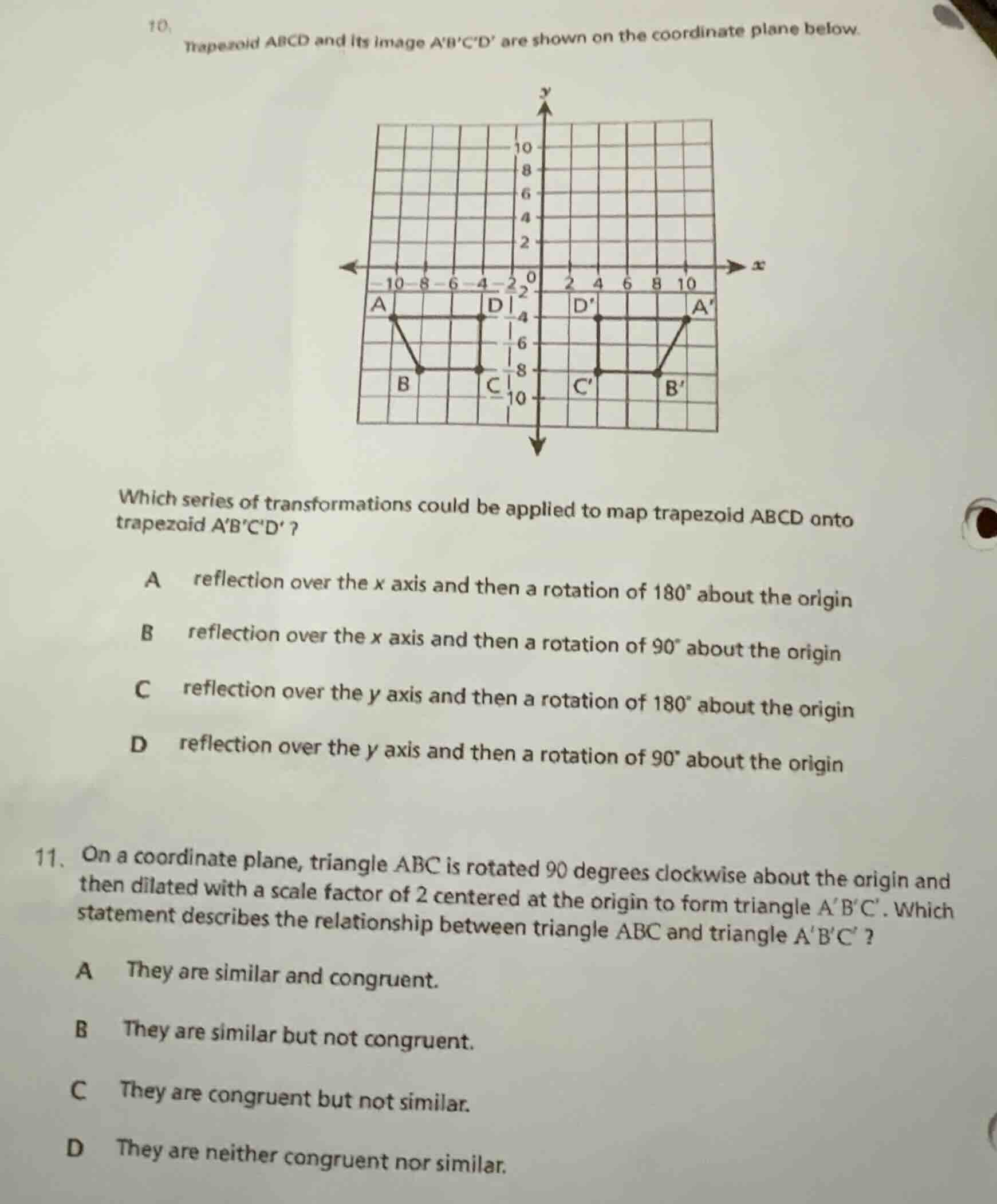
- trapezoid abcd and its image abcd are shown on the coordinate plane below. which series of transformations could be applied to map trapezoid abcd onto trapezoid abcd? a reflection over the x axis and then a rotation of 180° about the origin b reflection over the x axis and then a rotation of 90° about the origin c reflection over the y axis and then a rotation of 180° about the origin d reflection over the y axis and then a rotation of 90° about the origin 11. on a coordinate plane, triangle abc is rotated 90 degrees clockwise about the origin and then dilated with a scale factor of 2 centered at the origin to form triangle abc. which statement describes the relationship between triangle abc and triangle abc? a they are similar and congruent. b they are similar but not congruent. c they are congruent but not similar. d they are neither congruent nor similar.
Response
Question 10
Brief Explanations
- First, analyze the reflection: The trapezoid ABCD and A'B'C'D' seem to have a reflection over the y - axis as a first step. A reflection over the y - axis changes the sign of the x - coordinate of a point \((x,y)\) to \((-x,y)\).
- Then, analyze the rotation: A \(180^{\circ}\) rotation about the origin changes a point \((x,y)\) to \((-x,-y)\). If we first do a reflection over the y - axis (to get \((-x,y)\)) and then a \(180^{\circ}\) rotation (to get \((x,-y)\)), we can map ABCD to A'B'C'D'. Let's check the other options:
- Option A: Reflection over x - axis and \(180^{\circ}\) rotation will not give the correct mapping.
- Option B: Reflection over x - axis and \(90^{\circ}\) rotation will distort the shape.
- Option D: Reflection over y - axis and \(90^{\circ}\) rotation will not give the correct orientation.
Brief Explanations
- Rotation: A rotation of \(90^{\circ}\) clockwise about the origin is a rigid transformation. Rigid transformations (like rotation) preserve the shape and size of the figure, so the triangle after rotation is congruent to the original triangle ABC.
- Dilation: A dilation with a scale factor of 2 centered at the origin changes the size of the figure. The image of a point \((x,y)\) after dilation is \((2x,2y)\). Dilation preserves the shape (so the triangles are similar) but changes the size (so they are not congruent).
- Option A: They are not congruent because dilation changes the size.
- Option C: They are similar, so this is wrong.
- Option D: They are similar, so this is wrong.

Snap & solve any problem in the app
Get step-by-step solutions on Sovi AI
Photo-based solutions with guided steps
Explore more problems and detailed explanations
C. reflection over the \(y\) axis and then a rotation of \(180^{\circ}\) about the origin