QUESTION IMAGE
Question
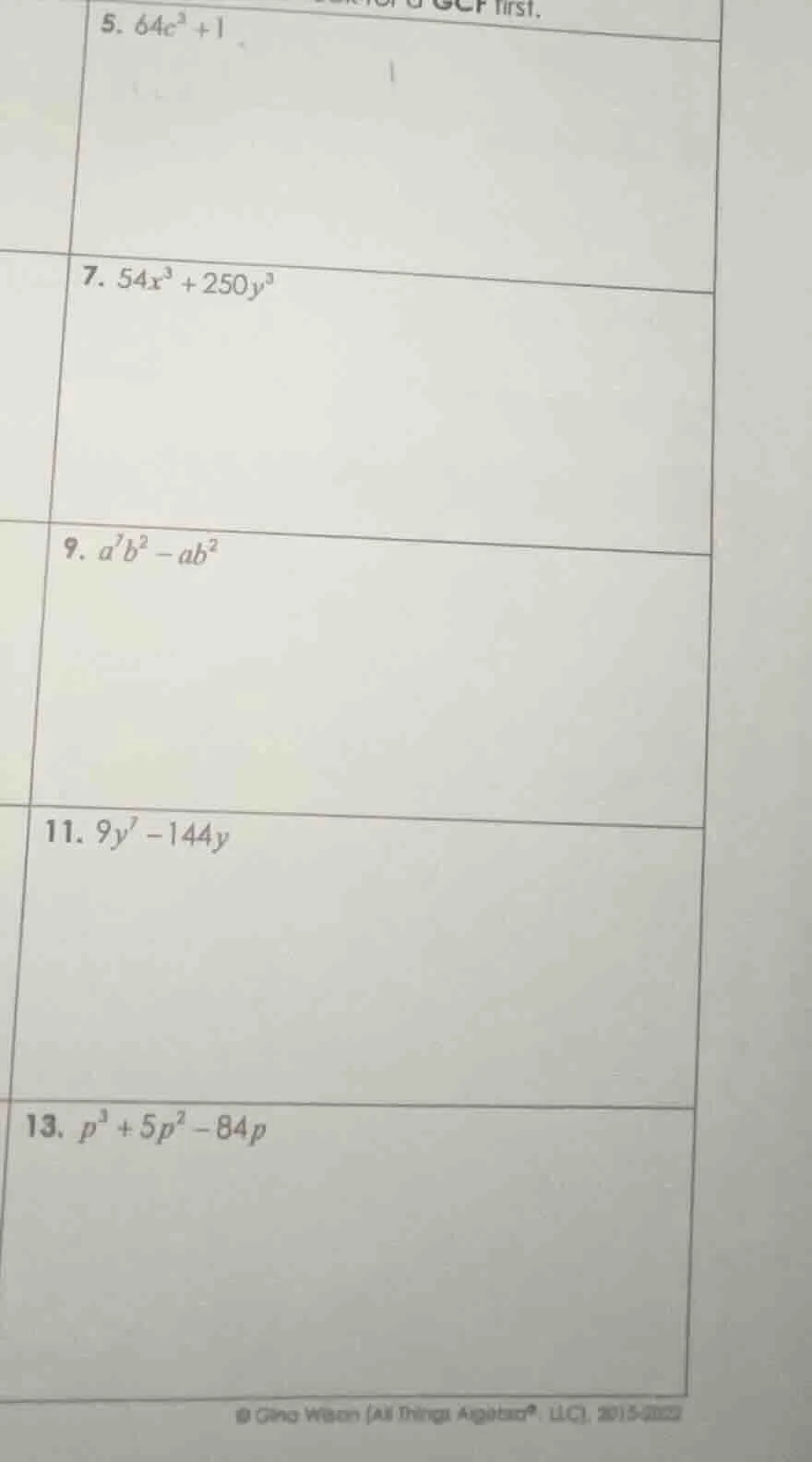
- $64c^{3}+1$
- $54x^{3}+250y^{3}$
- $a^{7}b^{2}-ab^{2}$
- $9y^{7}-144y$
- $p^{3}+5p^{2}-84p$
Problem 5: \(64c^2 + 1\)
Step 1: Check for GCF
The terms \(64c^2\) and \(1\) have no common factors other than \(1\), and it doesn't fit a standard factoring pattern (like difference of squares, sum/difference of cubes, etc.) in real numbers. In complex numbers, we could write it as \((8c + i)(8c - i)\) using the difference of squares formula \(a^2 - b^2=(a + b)(a - b)\) where \(a = 8c\) and \(b = i\) (\(i^2=-1\)), but typically for real - valued factoring, we say it is prime (doesn't factor over the real numbers).
Step 2: Conclusion
Since there are no common factors and it doesn't factor over the real numbers using standard factoring techniques, \(64c^2 + 1\) is prime (or factors as \((8c + i)(8c - i)\) over the complex numbers).
Step 1: Factor out the GCF
First, find the greatest common factor (GCF) of \(54\) and \(250\). The prime factorization of \(54 = 2\times3^3\) and \(250=2\times5^3\). So the GCF of \(54\) and \(250\) is \(2\).
Factor out \(2\) from the expression: \(54x^{3}+250y^{3}=2(27x^{3}+125y^{3})\)
Step 2: Recognize the sum of cubes
Notice that \(27x^{3}=(3x)^{3}\) and \(125y^{3}=(5y)^{3}\). The sum of cubes formula is \(a^{3}+b^{3}=(a + b)(a^{2}-ab + b^{2})\). Here, \(a = 3x\) and \(b = 5y\).
So, \(27x^{3}+125y^{3}=(3x + 5y)((3x)^{2}-(3x)(5y)+(5y)^{2})=(3x + 5y)(9x^{2}-15xy + 25y^{2})\)
Step 3: Combine the results
Substitute the factored form of \(27x^{3}+125y^{3}\) back into the expression: \(54x^{3}+250y^{3}=2(3x + 5y)(9x^{2}-15xy + 25y^{2})\)
Step 1: Factor out the GCF
The greatest common factor of \(a^{7}b^{2}\) and \(ab^{2}\) is \(ab^{2}\).
Factor out \(ab^{2}\) from the expression: \(a^{7}b^{2}-ab^{2}=ab^{2}(a^{6}-1)\)
Step 2: Factor \(a^{6}-1\)
Notice that \(a^{6}-1\) is a difference of squares: \(a^{6}-1=(a^{3})^{2}-1^{2}\). Using the difference of squares formula \(a^{2}-b^{2}=(a + b)(a - b)\), we get \((a^{3}+1)(a^{3}-1)\).
Now, \(a^{3}+1\) is a sum of cubes (\(a^{3}+1^{3}\)) and \(a^{3}-1\) is a difference of cubes (\(a^{3}-1^{3}\)).
The sum of cubes formula \(a^{3}+b^{3}=(a + b)(a^{2}-ab + b^{2})\) gives \(a^{3}+1=(a + 1)(a^{2}-a + 1)\).
The difference of cubes formula \(a^{3}-b^{3}=(a - b)(a^{2}+ab + b^{2})\) gives \(a^{3}-1=(a - 1)(a^{2}+a + 1)\).
So, \(a^{6}-1=(a + 1)(a^{2}-a + 1)(a - 1)(a^{2}+a + 1)\)
Step 3: Combine all factors
Putting it all together, \(a^{7}b^{2}-ab^{2}=ab^{2}(a - 1)(a + 1)(a^{2}-a + 1)(a^{2}+a + 1)\)

Snap & solve any problem in the app
Get step-by-step solutions on Sovi AI
Photo-based solutions with guided steps
Explore more problems and detailed explanations
Prime (or \((8c + i)(8c - i)\) over \(\mathbb{C}\))