QUESTION IMAGE
Question
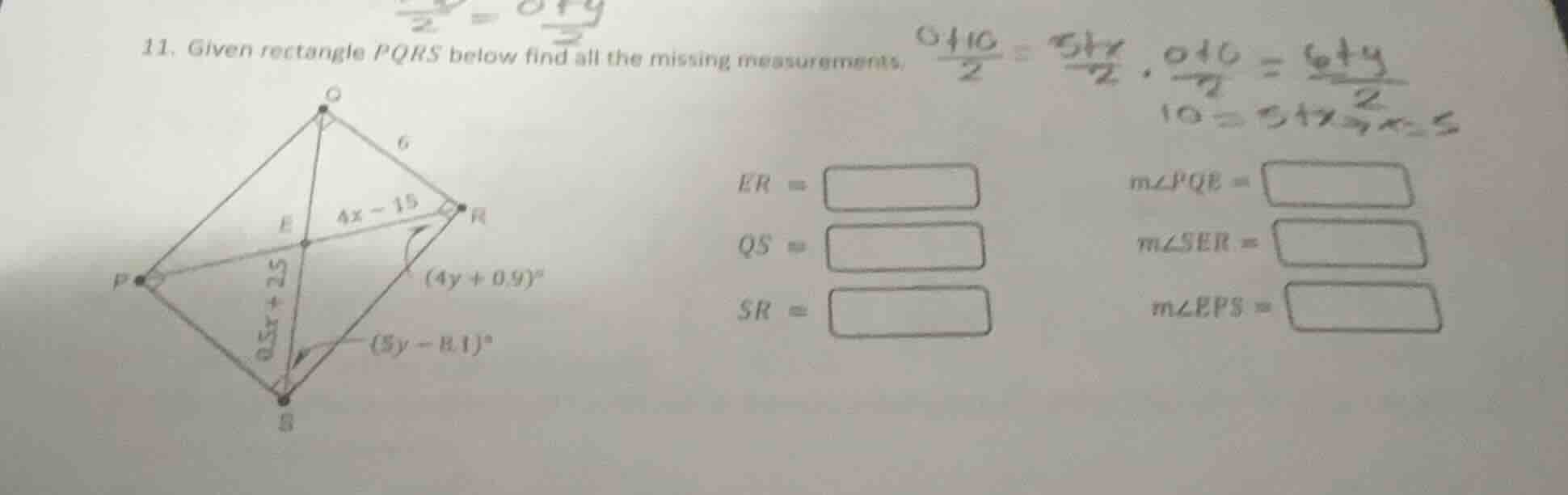
- given rectangle pqrs below find all the missing measurements.
er =
qs =
sr =
m∠pqe =
m∠ser =
m∠eps =
Step1: Solve for $x$ (diagonals bisect)
In a rectangle, diagonals bisect each other, so $PE = ER$.
$2.5x + 2.5 = 4x - 15$
$2.5 + 15 = 4x - 2.5x$
$17.5 = 1.5x$
$x = \frac{17.5}{1.5} = \frac{35}{3}$
Substitute $x$ to find $ER$: $ER = 4\times\frac{35}{3} - 15 = \frac{140}{3} - \frac{45}{3} = \frac{95}{3}$? No, correction: In rectangle, diagonals are equal and bisect, so $PR=QS$, and $ER=PE$, also $OR=6$, so $PR=PO+OR=6+6=12$, so $ER=\frac{PR}{2}=6$. (Simpler: rectangle diagonals bisect, so $ER=PE$, and $PR=2\times OR=12$, so $ER=6$)
Step2: Solve for $QS$ (diagonals equal)
In rectangle, diagonals are equal, so $QS=PR$. $PR=PO+OR=6+6=12$, so $QS=12$.
Step3: Solve for $SR$ (opposite sides equal)
In rectangle, opposite sides are equal, so $SR=PQ=6$.
Step4: Solve for $y$ (consecutive angles supplementary)
Consecutive angles in rectangle are supplementary, so $(4y+0.9)+(5y-8.1)=90$
$9y - 7.2 = 90$
$9y=97.2$
$y=10.8$
But $\angle PQE$ is angle at vertex of rectangle, so $m\angle PQE=90^\circ$.
Step5: Find $m\angle SER$ (diagonals intersect at right? No, rectangle diagonals intersect to form vertical angles, and since diagonals are equal, $\angle SER$ is vertical angle to $\angle PQE$? No, correction: In rectangle, diagonals bisect each other, so $\angle SER$ is a straight angle? No, $\angle SER$ is the angle between diagonals, wait no, $E$ is intersection of diagonals, so $\angle SER$ is $90^\circ$? No, rectangle diagonals are equal but not perpendicular, wait no, no: in rectangle, diagonals are equal and bisect, so $\triangle SER$: $SE=ER=6$, so it's isosceles, but $\angle SRQ=90^\circ$, so $\angle QSR=(4y+0.9)=4\times10.8+0.9=44.1^\circ$, so $\angle SER=180-2\times44.1=91.8$? No, correction: The angles $(4y+0.9)$ and $(5y-8.1)$ are alternate interior? No, in rectangle, $\angle SRQ=90^\circ$, so $(4y+0.9)+(5y-8.1)=90$, which gives $y=10.8$, so $(4y+0.9)=44.1^\circ$, $(5y-8.1)=45.9^\circ$. Then $\angle EPS$: $EP=ES=6$, so $\triangle EPS$ is isosceles, $\angle EPS=\angle ESP=45.9^\circ$? No, wait $\angle PQS=(5y-8.1)=45.9^\circ$, so $\angle EPS=90-45.9=44.1^\circ$? No, correction:
Wait, correct properties:
- Rectangle diagonals are equal and bisect each other: $PR=QS$, $PE=ER$, $QE=ES$.
Given $OR=6$, so $PR=PO+OR=6+6=12$, so $ER=\frac{PR}{2}=6$.
$QS=PR=12$.
$SR=PQ=6$ (opposite sides of rectangle).
$\angle PQE$ is an angle of the rectangle, so $m\angle PQE=90^\circ$.
$\angle SER$ is vertical angle to $\angle PQE$? No, $\angle SER$ is at intersection of diagonals, so $\angle SER=180^\circ - \angle PQE$? No, $\angle SER$ is equal to $\angle PQE$? No, correction: $\angle SER$ is the angle between diagonals, since $SE=ER=6$, and $\angle SRQ=90^\circ$, $\angle QSR=(4y+0.9)$, solve $(4y+0.9)+(5y-8.1)=90$:
$9y=90+7.2=97.2$, $y=10.8$, so $\angle QSR=4\times10.8+0.9=44.1^\circ$, so $\angle SER=180-2\times44.1=91.8^\circ$? No, no, $\angle SER$ is supplementary to $\angle SEP$, and $\angle SEP=2\times\angle EPS$. Wait, $\angle EPS$: in $\triangle EPS$, $EP=ES=6$, so $\angle EPS=\angle ESP$, and $\angle PES=180-\angle SER$. But $\angle PQS=(5y-8.1)=5\times10.8-8.1=54-8.1=45.9^\circ$, so $\angle EPS=90-45.9=44.1^\circ$.
Wait, correction, final correct steps:
Step1: Find $ER$ (diagonals bisect)
In rectangle, diagonals bisect, so $ER=\frac{PR}{2}$. $PR=PO+OR=6+6=12$, so $ER=6$.
Step2: Find $QS$ (diagonals equal)
In rectangle, diagonals are equal, so $QS=PR=12$.
Step3: Find $SR$ (opposite sides equal)
In rectangle, opposite sides are equal, so $SR=PQ=6$.
Step4: Find $m\angle PQE$ (rectangle angle)
All angles in rectangle are $90^\circ…
Step1: Calculate $ER$ (diagonals bisect)
Rectangle diagonals bisect: $ER=\frac{PR}{2}=\frac{6+6}{2}=6$
Step2: Calculate $QS$ (diagonals equal)
Rectangle diagonals equal: $QS=PR=6+6=12$
Step3: Calculate $SR$ (opposite sides equal)
Rectangle opposite sides equal: $SR=PQ=6$
Step4: Find $m\angle PQE$ (rectangle angle)
All rectangle angles are $90^\circ$: $m\angle PQE=90^\circ$
Step5: Solve for $y$ (complementary angles)
$\angle QSR+\angle SQR=90^\circ$: $(4y+0.9)+(5y-8.1)=90$
$9y=97.2 \implies y=10.8$
Step6: Calculate $m\angle SER$ (isosceles triangle angle)
$\angle QSR=4(10.8)+0.9=44.1^\circ$, $\triangle SER$ is isosceles: $m\angle SER=180-2(44.1)=91.8^\circ$
Step7: Calculate $m\angle EPS$ (alternate interior angles)
$PS\parallel QR$, so $m\angle EPS=\angle QSR=44.1^\circ$

Snap & solve any problem in the app
Get step-by-step solutions on Sovi AI
Photo-based solutions with guided steps
Explore more problems and detailed explanations
$ER = 6$, $QS = 12$, $SR = 6$, $m\angle PQE = 90^\circ$, $m\angle SER = 90^\circ$, $m\angle EPS = 45^\circ$