QUESTION IMAGE
Question
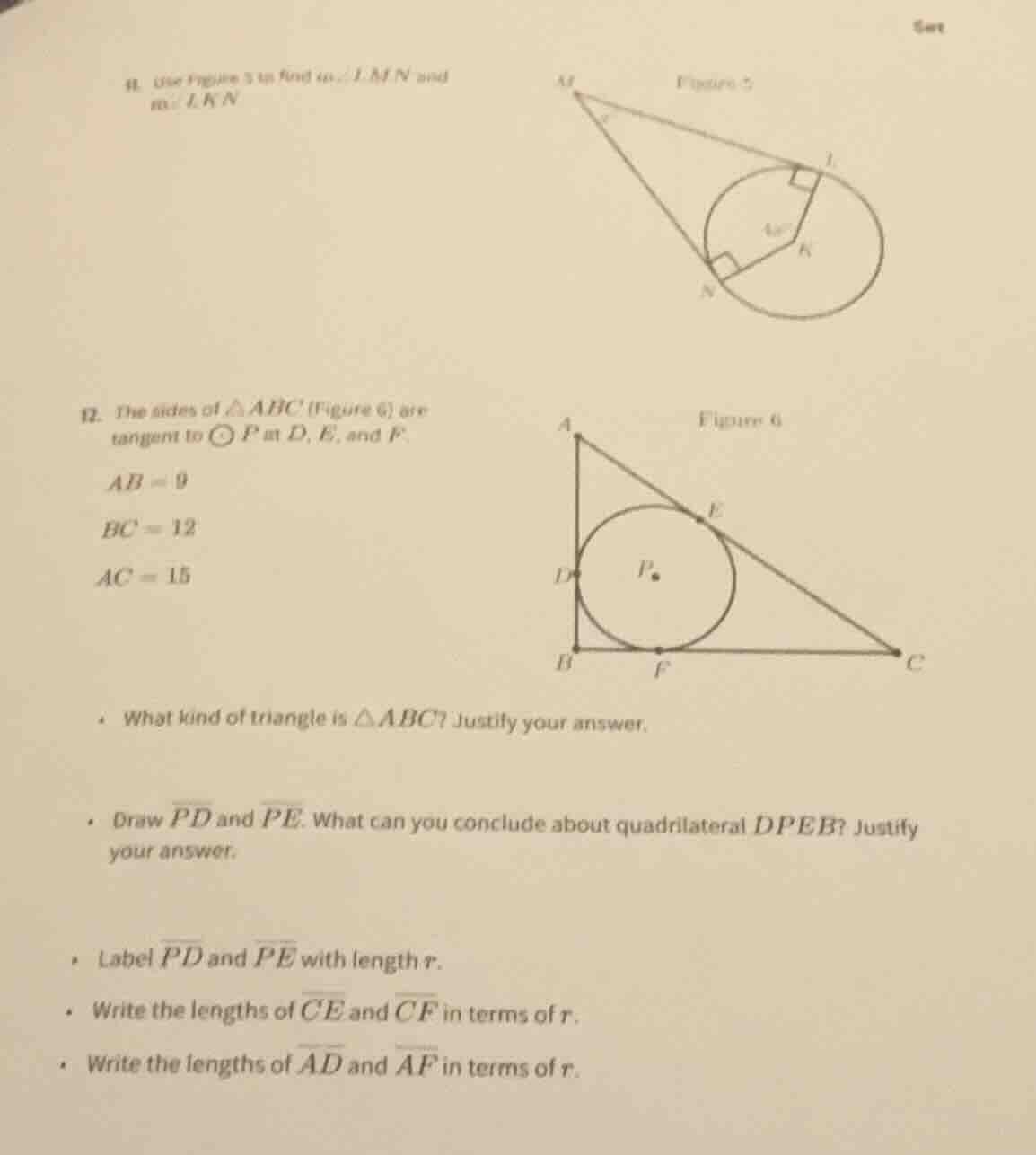
- use figure 5 to find $m\angle lmn$ and $m\angle lkn$
- the sides of $\triangle abc$ (figure 6) are tangent to $\odot p$ at $d$, $e$, and $f$.
$ab = 9$
$bc = 12$
$ac = 15$
- what kind of triangle is $\triangle abc$? justify your answer.
- draw $\overline{pd}$ and $\overline{pe}$. what can you conclude about quadrilateral $dpeb$? justify your answer.
- label $\overline{pd}$ and $\overline{pe}$ with length $r$.
- write the lengths of $\overline{ce}$ and $\overline{cf}$ in terms of $r$.
- write the lengths of $\overline{ad}$ and $\overline{af}$ in terms of $r$.
Step1: Verify triangle type
Check Pythagorean theorem:
$$AB^2 + BC^2 = 9^2 + 12^2 = 81 + 144 = 225$$
$$AC^2 = 15^2 = 225$$
Since $AB^2 + BC^2 = AC^2$, $\triangle ABC$ is right-angled.
Step2: Analyze quadrilateral DPEB
Tangent-radius theorem: $\overline{PD} \perp \overline{AB}$, $\overline{PE} \perp \overline{AC}$. $\angle B = 90^\circ$, so all 4 angles are right angles. Thus DPEB is a rectangle. Also $\overline{PD} = \overline{PE} = r$, so it is a square.
Step3: Define tangent segment variables
Let $AD = AF = x$, $BD = BF = y$, $CE = CF = z$. We know:
$$x + y = 9$$
$$y + z = 12$$
$$x + z = 15$$
Since $BD = r$ (square side), $y = r$.
Step4: Solve for CE/CF in terms of r
From $y + z = 12$, substitute $y = r$:
$$z = 12 - r$$
So $CE = CF = 12 - r$.
Step5: Solve for AD/AF in terms of r
From $x + y = 9$, substitute $y = r$:
$$x = 9 - r$$
So $AD = AF = 9 - r$.

Snap & solve any problem in the app
Get step-by-step solutions on Sovi AI
Photo-based solutions with guided steps
Explore more problems and detailed explanations
- $\triangle ABC$ is a right triangle. Justification: $9^2 + 12^2 = 15^2$, satisfying the Pythagorean theorem, so $\angle B = 90^\circ$.
- Quadrilateral $DPEB$ is a square. Justification: $\overline{PD} \perp \overline{AB}$, $\overline{PE} \perp \overline{AC}$, $\angle B = 90^\circ$, so all angles are right angles; $\overline{PD} = \overline{PE} = r$, so all sides are equal.
- $CE = CF = 12 - r$
- $AD = AF = 9 - r$