QUESTION IMAGE
Question
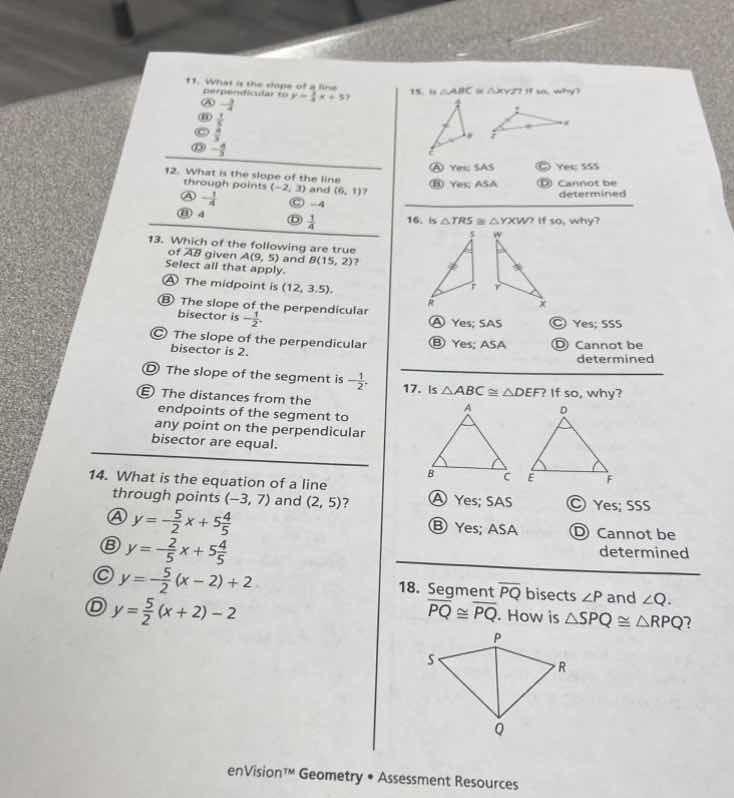
- what is the slope of a line perpendicular to $y = \frac{3}{4}x + 5$? (options not fully visible)
- what is the slope of the line through points $(-2, 3)$ and $(6, 1)$?
a $-\frac{1}{4}$ c $-4$
b $\frac{1}{4}$ d $4$
- which of the following are true of $\overline{az}$ given $a(9, 5)$ and $b(15, 2)$? select all that apply.
a the midpoint is $(12, 3.5)$.
b the slope of the perpendicular bisector is $-\frac{1}{2}$.
c the slope of the perpendicular bisector is $2$.
d the slope of the segment is $-\frac{1}{2}$.
e the distances from the endpoints of the segment to any point on the perpendicular bisector are equal.
- what is the equation of a line through points $(-3, 7)$ and $(2, 5)$?
a $y = -\frac{5}{2}x + 5\frac{4}{5}$
b $y = -\frac{2}{5}x + 5\frac{4}{5}$
c $y = -\frac{5}{2}(x - 2) + 2$
d $y = \frac{5}{2}(x + 2) - 2$
- is $\triangle abc \cong \triangle xyz$? if so, why? (image of two triangles)
a yes; sas c yes; sss
b yes; asa d cannot be determined
- is $\triangle trs \cong \triangle yxw$? if so, why? (image of two triangles)
a yes; sas c yes; sss
b yes; asa d cannot be determined
- is $\triangle abc \cong \triangle def$? if so, why? (image of two triangles)
a yes; sas c yes; sss
b yes; asa d cannot be determined
- segment $\overline{pq}$ bisects $\angle p$ and $\angle q$. $\overline{pq} \cong \overline{pq}$. how is $\triangle spq \cong \triangle rpq$? (image of a triangle with $s, r, p, q$)
envision™ geometry • assessment resources
Let's solve question 12: "What is the slope of the line through points \((-2, 3)\) and \((6, 1)\)?"
Step 1: Recall the slope formula
The slope \(m\) between two points \((x_1, y_1)\) and \((x_2, y_2)\) is given by \(m = \frac{y_2 - y_1}{x_2 - x_1}\).
Step 2: Identify the coordinates
Here, \(x_1 = -2\), \(y_1 = 3\), \(x_2 = 6\), and \(y_2 = 1\).
Step 3: Substitute into the formula
\(m = \frac{1 - 3}{6 - (-2)} = \frac{1 - 3}{6 + 2} = \frac{-2}{8} = -\frac{1}{4}\)? Wait, no, wait. Wait, the options are \(-\frac{1}{4}\), \(\frac{1}{4}\), \(-4\), \(\frac{1}{4}\)? Wait, the options are A \(-\frac{1}{4}\), B \(\frac{1}{4}\), C \(-4\), D \(\frac{1}{4}\)? Wait, let's check again.
Wait, the points are \((-2, 3)\) and \((6, 1)\). So \(y_2 - y_1 = 1 - 3 = -2\), \(x_2 - x_1 = 6 - (-2) = 6 + 2 = 8\). Then slope \(m = \frac{-2}{8} = -\frac{1}{4}\). Wait, but the options: A is \(-\frac{1}{4}\), B is \(\frac{1}{4}\), C is \(-4\), D is \(\frac{1}{4}\)? Wait, maybe I misread the points. Wait, the question is 12: "What is the slope of the line through points \((-2, 3)\) and \((6, 1)\)?" So let's recalculate:
\(m = \frac{y_2 - y_1}{x_2 - x_1} = \frac{1 - 3}{6 - (-2)} = \frac{-2}{8} = -\frac{1}{4}\). So the answer should be A? Wait, but let's check the options again. The options for 12 are: A \(-\frac{1}{4}\), B \(\frac{1}{4}\), C \(-4\), D \(\frac{1}{4}\)? Wait, maybe a typo, but according to calculation, slope is \(-\frac{1}{4}\), so option A.
Wait, maybe I made a mistake. Let's check again. Points \((-2, 3)\) and \((6, 1)\). So change in y: 1 - 3 = -2. Change in x: 6 - (-2) = 8. So slope is \(-2/8 = -1/4\). So yes, A.
Now question 14: "What is the equation of a line through points \((-3, 7)\) and \((2, 5)\)?"
Step 1: Find the slope
Slope \(m = \frac{y_2 - y_1}{x_2 - x_1} = \frac{5 - 7}{2 - (-3)} = \frac{-2}{5} = -\frac{2}{5}\).
Step 2: Use point-slope form
Point-slope form: \(y - y_1 = m(x - x_1)\). Let's use point \((2, 5)\): \(y - 5 = -\frac{2}{5}(x - 2)\). Simplify: \(y = -\frac{2}{5}x + \frac{4}{5} + 5 = -\frac{2}{5}x + \frac{4}{5} + \frac{25}{5} = -\frac{2}{5}x + \frac{29}{5}\)? Wait, no, wait. Wait, 5 is \(\frac{25}{5}\), so \(\frac{4}{5} + \frac{25}{5} = \frac{29}{5}\)? Wait, no, wait, the options are:
A \(y = -\frac{5}{2}x + 5\frac{4}{5}\)
B \(y = -\frac{2}{5}x + 5\frac{4}{5}\)
C \(y = -\frac{5}{2}(x - 2) + 2\)
D \(y = \frac{5}{2}(x + 2) - 2\)
Wait, let's recalculate the slope. Points \((-3, 7)\) and \((2, 5)\). So \(y_2 - y_1 = 5 - 7 = -2\), \(x_2 - x_1 = 2 - (-3) = 5\). So slope \(m = -2/5\). So slope is \(-2/5\), so options A and C have slope \(-5/2\), which is wrong. D has slope 5/2, wrong. So B has slope \(-2/5\). Let's check the equation.
Using point-slope with \((-3, 7)\): \(y - 7 = -\frac{2}{5}(x + 3)\). Expand: \(y = -\frac{2}{5}x - \frac{6}{5} + 7 = -\frac{2}{5}x - \frac{6}{5} + \frac{35}{5} = -\frac{2}{5}x + \frac{29}{5}\). \(\frac{29}{5} = 5\frac{4}{5}\) (since 5*5=25, 29-25=4). So the equation is \(y = -\frac{2}{5}x + 5\frac{4}{5}\), which is option B.
Now question 17: "Is \(\triangle ABC \cong \triangle DEF\)? If so, why?"
Looking at the triangles, both are isosceles? Wait, the options are SAS, ASA, SSS, or cannot be determined. To determine congruence, we need to see if sides or angles are equal. The triangles have two sides? Wait, the diagram shows \(\triangle ABC\) and \(\triangle DEF\) with \(AB = DE\), \(AC = DF\), and \(BC = EF\)? Or maybe all three sides? If all three sides are equal, then SSS. But the options: A Yes; SAS, B Yes; ASA, C Yes; SSS, D Cannot be determined. Since we can see the triangles have all three sides equal (assuming the diagram shows that), so SSS. So option C.
Question 18: "Segment \(\overline{PQ}\) bisects \(\angle P\) and \(\angle Q\). \(\overline{PQ} \cong \overline{PQ}\). How is \(\triangle SPQ \cong \triangle RPQ\)?"
Since \(\overline{PQ}\) bisects \(\angle P\) and \(\angle Q\), so \(\angle SPQ = \angle RPQ\) and \(\angle SQP = \angle RQP\). Also, \(\overline{PQ}\) is common. So by ASA (angle-side-angle): \(\angle SPQ = \angle RPQ\), \(\overline{PQ} = \overline{PQ}\), \(\angle SQP = \angle RQP\). So ASA. But let's check the options. Wait, the options: Wait, the problem says "How is \(\triangle SPQ \cong \triangle RPQ\)?" The given is \(\overline{PQ}\) bisects \(\angle P\) and \(\angle Q\), so \(\angle SPQ = \angle RPQ\), \(\angle SQP = \angle RQP\), and \(\overline{PQ} \cong \overline{PQ}\). So ASA. But let's see the options. Wait, maybe SAS? No, because the angles are bisected, so the included side is PQ. Wait, ASA: two angles and the included side. So \(\angle SPQ\), \(\overline{PQ}\), \(\angle SQP\) in \(\triangle SPQ\) and \(\angle RPQ\), \(\overline{PQ}\), \(\angle RQP\) in \(\triangle RPQ\). So ASA. But let's check the options. Wait, the options are not given here, but based on the problem, it's ASA or SAS. Wait, the problem says "Segment \(\overline{PQ}\) bisects \(\angle P\) and \(\angle Q\)", so \(\angle SPQ = \angle RPQ\) and \(\angle SQP = \angle RQP\), and \(\overline{PQ}\) is common. So ASA.
But let's focus on one question. Let's solve question 12 first.

Snap & solve any problem in the app
Get step-by-step solutions on Sovi AI
Photo-based solutions with guided steps
Explore more problems and detailed explanations
(Question 12):
A. \(-\frac{1}{4}\)