QUESTION IMAGE
Question
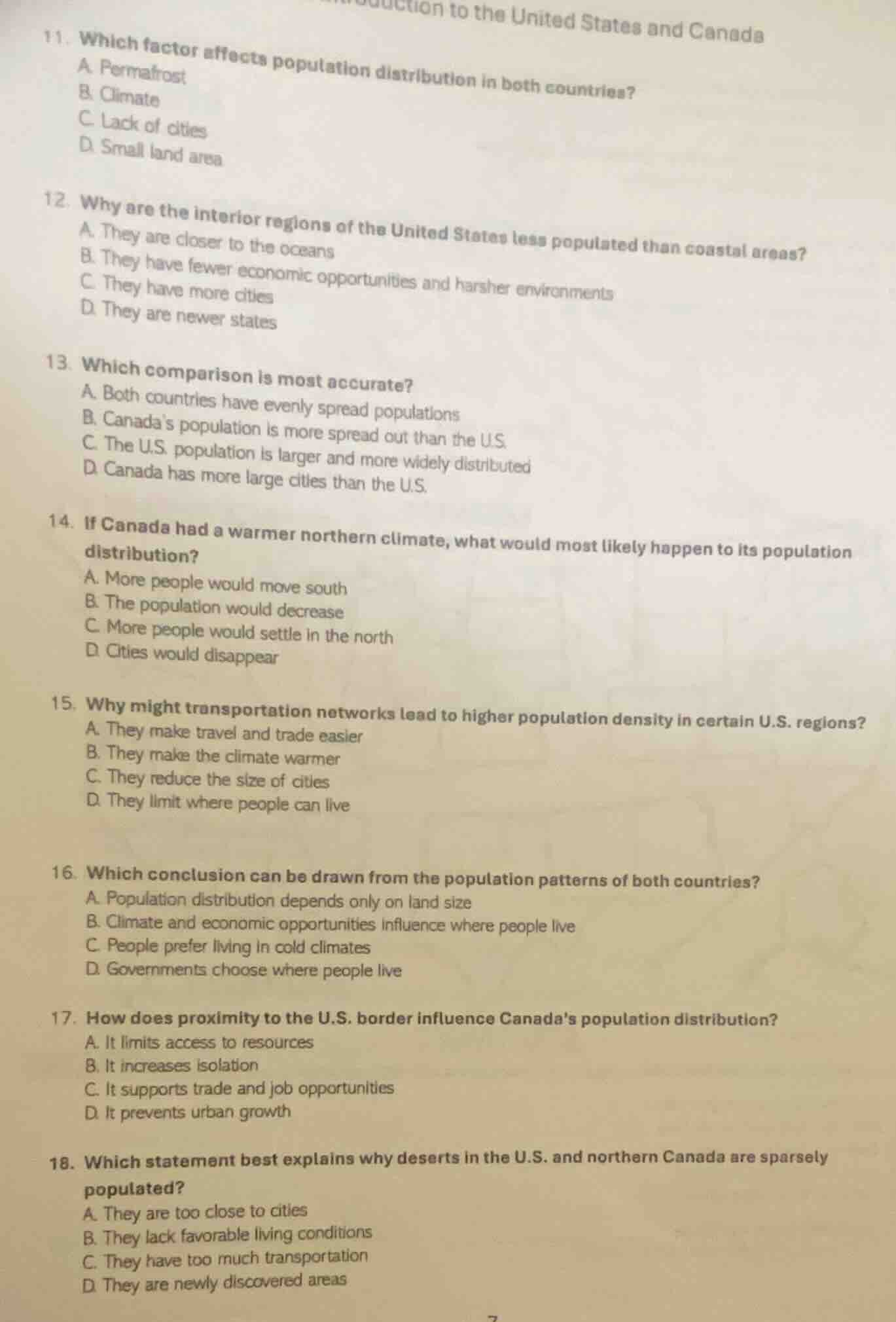
- which factor affects population distribution in both countries?
a. permafrost
b. climate
c. lack of cities
d. small land area
- why are the interior regions of the united states less populated than coastal areas?
a. they are closer to the oceans
b. they have fewer economic opportunities and harsher environments
c. they have more cities
d. they are newer states
- which comparison is most accurate?
a. both countries have evenly spread populations
b. canadas population is more spread out than the u.s.
c. the u.s. population is larger and more widely distributed
d. canada has more large cities than the u.s.
- if canada had a warmer northern climate, what would most likely happen to its population distribution?
a. more people would move south
b. the population would decrease
c. more people would settle in the north
d. cities would disappear
- why might transportation networks lead to higher population density in certain u.s. regions?
a. they make travel and trade easier
b. they make the climate warmer
c. they reduce the size of cities
d. they limit where people can live
- which conclusion can be drawn from the population patterns of both countries?
a. population distribution depends only on land size
b. climate and economic opportunities influence where people live
c. people prefer living in cold climates
d. governments choose where people live
- how does proximity to the u.s. border influence canadas population distribution?
a. it limits access to resources
b. it increases isolation
c. it supports trade and job opportunities
d. it prevents urban growth
- which statement best explains why deserts in the u.s. and northern canada are sparsely populated?
a. they are too close to cities
b. they lack favorable living conditions
c. they have too much transportation
d. they are newly discovered areas
- Permafrost only affects northern Canada; both countries have large land areas and many cities, while climate shapes where people settle in both.
- U.S. interior has harsher environments and fewer economic opportunities than coasts, leading to lower population.
- The U.S. has a larger total population and its population is distributed more widely across its territory compared to Canada's concentrated southern population.
- A warmer northern Canada would make the region more habitable, so more people would settle there.
- Transportation networks facilitate travel and trade, supporting economic activity that draws more people to an area.
- Population patterns in both countries show that climate (livability) and economic opportunities (jobs, resources) are key factors in where people live.
- Proximity to the U.S. border for Canada enables cross-border trade and access to job opportunities, drawing population to the southern border region.
- Deserts (U.S.) and northern Canada's cold regions lack favorable living conditions like water, mild temperatures, and arable land, making them sparsely populated.

Snap & solve any problem in the app
Get step-by-step solutions on Sovi AI
Photo-based solutions with guided steps
Explore more problems and detailed explanations
- B. Climate
- B. They have fewer economic opportunities and harsher environments
- C. The U.S. population is larger and more widely distributed
- C. More people would settle in the north
- A. They make travel and trade easier
- B. Climate and economic opportunities influence where people live
- C. It supports trade and job opportunities
- B. They lack favorable living conditions