QUESTION IMAGE
Question
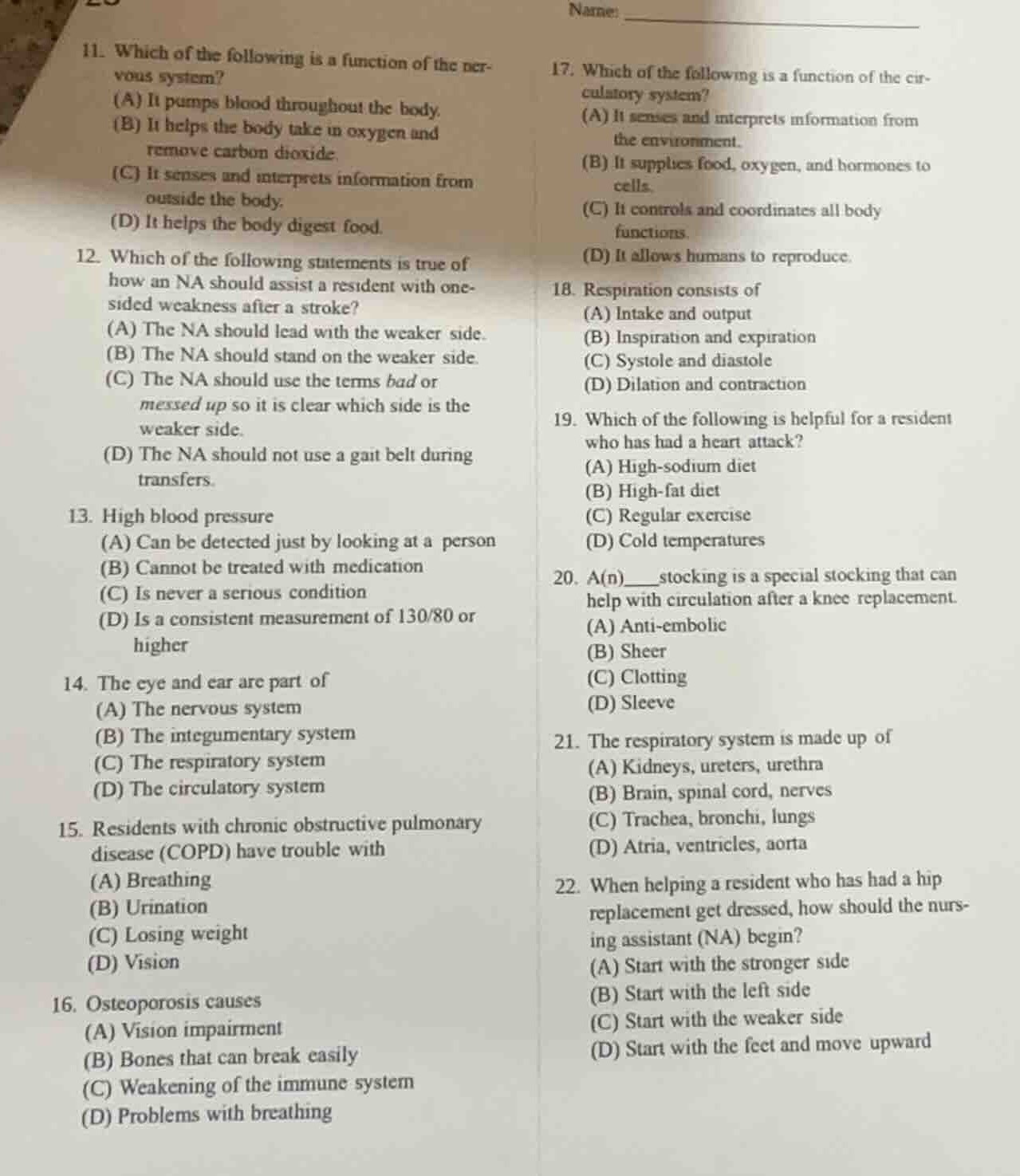
- which of the following is a function of the nervous system?
(a) it pumps blood throughout the body.
(b) it helps the body take in oxygen and remove carbon dioxide.
(c) it senses and interprets information from outside the body.
(d) it helps the body digest food.
- which of the following statements is true of how an na should assist a resident with one - sided weakness after a stroke?
(a) the na should lead with the weaker side.
(b) the na should stand on the weaker side.
(c) the na should use the terms bad or messed up so it is clear which side is the weaker side.
(d) the na should not use a gait belt during transfers.
- high blood pressure
(a) can be detected just by looking at a person
(b) cannot be treated with medication
(c) is never a serious condition
(d) is a consistent measurement of 130/80 or higher
- the eye and ear are part of
(a) the nervous system
(b) the integumentary system
(c) the respiratory system
(d) the circulatory system
- residents with chronic obstructive pulmonary disease (copd) have trouble with
(a) breathing
(b) urination
(c) losing weight
(d) vision
- osteoporosis causes
(a) vision impairment
(b) bones that can break easily
(c) weakening of the immune system
(d) problems with breathing
- which of the following is a function of the circulatory system?
(a) it senses and interprets information from the environment.
(b) it supplies food, oxygen, and hormones to cells.
(c) it controls and coordinates all body functions.
(d) it allows humans to reproduce.
- respiration consists of
(a) intake and output
(b) inspiration and expiration
(c) systole and diastole
(d) dilation and contraction
- which of the following is helpful for a resident who has had a heart attack?
(a) high - sodium diet
(b) high - fat diet
(c) regular exercise
(d) cold temperatures
- a(n)____stocking is a special stocking that can help with circulation after a knee replacement.
(a) anti - embolic
(b) sheer
(c) clotting
(d) sleeve
- the respiratory system is made up of
(a) kidneys, ureters, urethra
(b) brain, spinal cord, nerves
(c) trachea, bronchi, lungs
(d) atria, ventricles, aorta
- when helping a resident who has had a hip replacement get dressed, how should the nursing assistant (na) begin?
(a) start with the stronger side
(b) start with the left side
(c) start with the weaker side
(d) start with the feet and move upward
- The nervous system processes environmental input.
- For stroke-related one-sided weakness, NA stands on weaker side for support.
- Hypertension is defined as ≥130/80 mmHg consistently.
- Eyes/ears are sensory organs of the nervous system.
- COPD is a chronic lung disorder impairing breathing.
- Osteoporosis weakens bones, making them fragile.
- Circulatory system delivers nutrients/oxygen/hormones to cells.
- Respiration includes inhalation (inspiration) and exhalation (expiration).
- Regular exercise supports heart health post-attack.
- Anti-embolic stockings prevent clots and aid circulation post-surgery.
- Respiratory system includes trachea, bronchi, lungs.
- For hip replacement dressing, start with the weaker side to avoid straining it.

Snap & solve any problem in the app
Get step-by-step solutions on Sovi AI
Photo-based solutions with guided steps
Explore more problems and detailed explanations
- C) It senses and interprets information from outside the body.
- B) The NA should stand on the weaker side.
- D) Is a consistent measurement of 130/80 or higher
- A) The nervous system
- A) Breathing
- B) Bones that can break easily
- B) It supplies food, oxygen, and hormones to cells.
- B) Inspiration and expiration
- C) Regular exercise
- A) Anti-embolic
- C) Trachea, bronchi, lungs
- C) Start with the weaker side