QUESTION IMAGE
Question
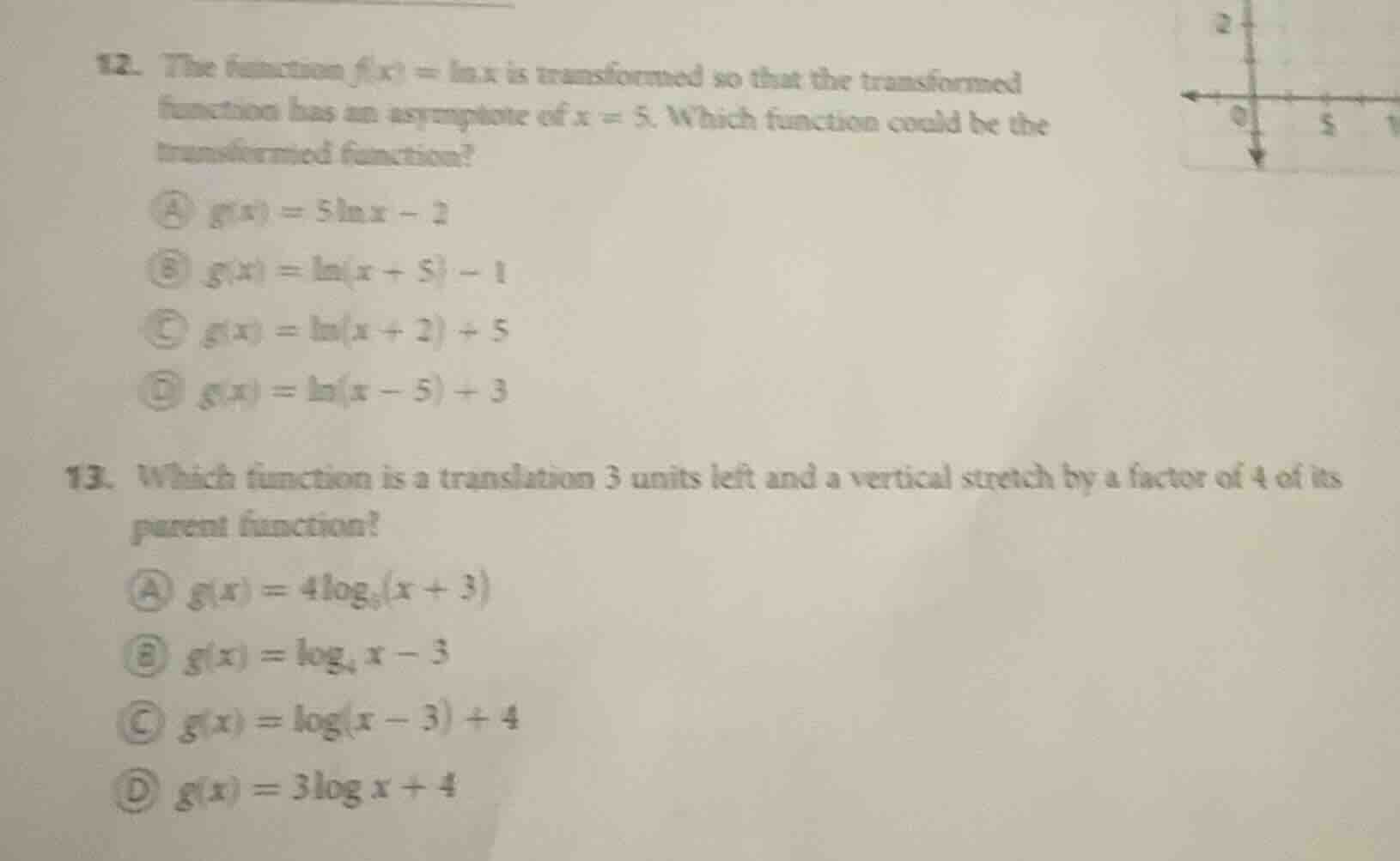
- the function ( f(x)=ln x ) is transformed so that the transformed function has an asymptote of ( x = 5 ). which function could be the transformed function?
a ( g(x)=5ln x - 2 )
b ( g(x)=ln(x + 5)-1 )
c ( g(x)=ln(x + 2)+5 )
d ( g(x)=ln(x - 5)+3 )
- which function is a translation 3 units left and a vertical stretch by a factor of 4 of its parent function?
a ( g(x)=4log_6(x + 3) )
b ( g(x)=log_4 x - 3 )
c ( g(x)=log(x - 3)+4 )
d ( g(x)=3log x + 4 )
For Question 12:
Step1: Recall asymptote of $\ln x$
The parent function $f(x)=\ln x$ has a vertical asymptote at $x=0$.
Step2: Horizontal shift rule
A horizontal shift of $h$ units right gives $\ln(x-h)$, with asymptote $x=h$.
Step3: Match target asymptote $x=5$
We need $h=5$, so the function is $\ln(x-5)+k$ (vertical shifts don't affect asymptotes).
Step1: Vertical stretch rule
A vertical stretch by factor $a$ multiplies the parent function by $a$: $a\cdot f(x)$.
Step2: Left translation rule
A shift 3 units left replaces $x$ with $x+3$: $f(x+3)$.
Step3: Combine transformations
For parent logarithmic function $f(x)=\log_b x$, the transformed function is $4\log_b(x+3)$.

Snap & solve any problem in the app
Get step-by-step solutions on Sovi AI
Photo-based solutions with guided steps
Explore more problems and detailed explanations
D. $g(x) = \ln(x - 5) + 3$
---