QUESTION IMAGE
Question
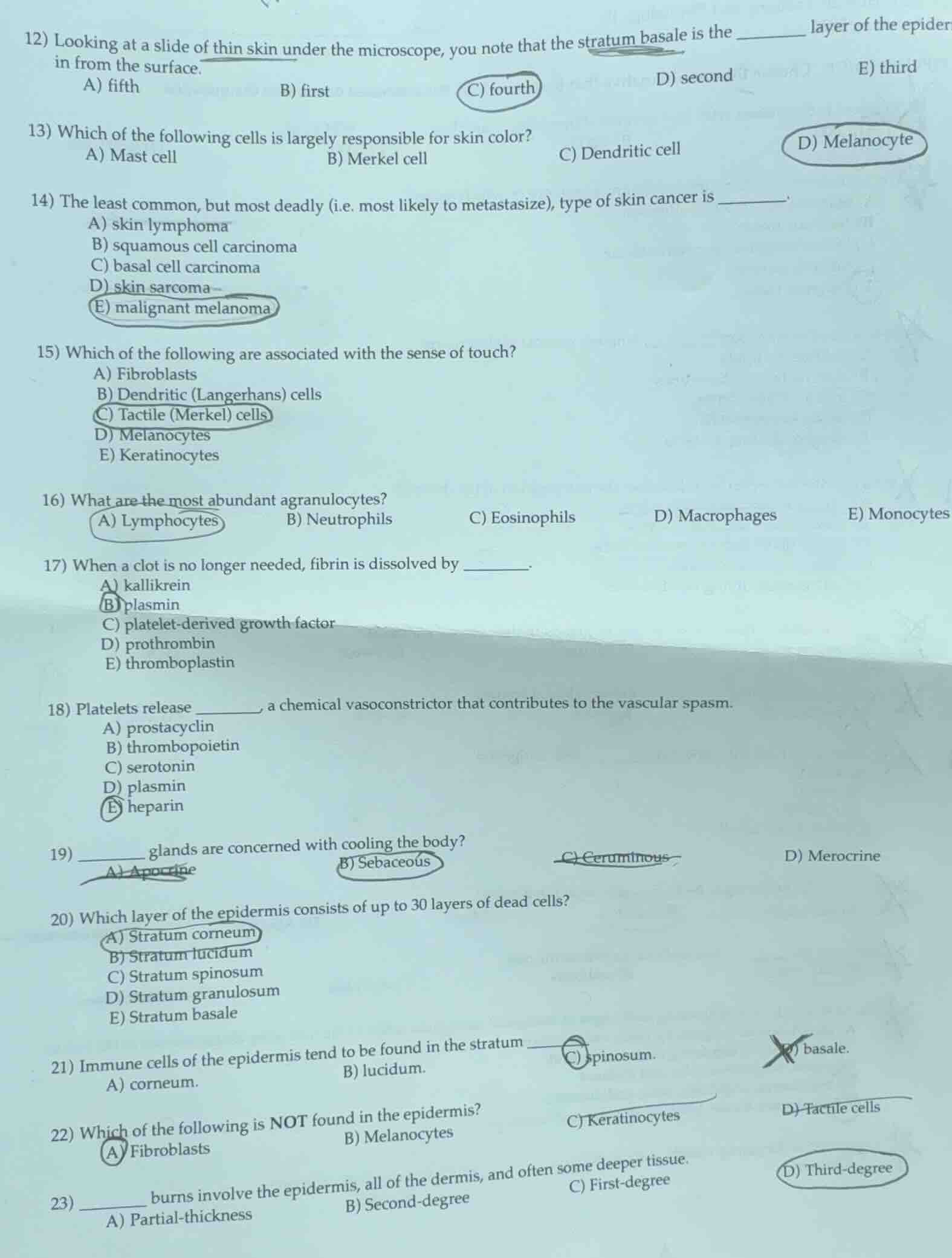
- looking at a slide of thin skin under the microscope, you note that the stratum basale is the ______ layer of the epider in from the surface.
a) fifth b) first c) fourth d) second e) third
- which of the following cells is largely responsible for skin color?
a) mast cell b) merkel cell c) dendritic cell d) melanocyte
- the least common, but most deadly (i.e. most likely to metastasize), type of skin cancer is ______.
a) skin lymphoma
b) squamous cell carcinoma
c) basal cell carcinoma
d) skin sarcoma
e) malignant melanoma
- which of the following are associated with the sense of touch?
a) fibroblasts
b) dendritic (langerhans) cells
c) tactile (merkel) cells
d) melanocytes
e) keratinocytes
- what are the most abundant agranulocytes?
a) lymphocytes b) neutrophils c) eosinophils d) macrophages e) monocytes
- when a clot is no longer needed, fibrin is dissolved by ______.
a) kallikrein
b) plasmin
c) platelet-derived growth factor
d) prothrombin
e) thromboplastin
- platelets release ______, a chemical vasoconstrictor that contributes to the vascular spasm.
a) prostacyclin
b) thrombopoietin
c) serotonin
d) plasmin
e) heparin
- ______ glands are concerned with cooling the body?
a) apocrine b) sebaceous c) ceruminous d) merocrine
- which layer of the epidermis consists of up to 30 layers of dead cells?
a) stratum corneum
b) stratum lucidum
c) stratum spinosum
d) stratum granulosum
e) stratum basale
- immune cells of the epidermis tend to be found in the stratum ______.
a) corneum. b) lucidum. c) spinosum. d) basale.
- which of the following is not found in the epidermis?
a) fibroblasts b) melanocytes c) keratinocytes d) tactile cells
- ______ burns involve the epidermis, all of the dermis, and often some deeper tissue.
a) partial-thickness b) second-degree c) first-degree d) third-degree
- Thin skin's epidermis layers from surface inward: stratum corneum (1st), stratum granulosum (2nd), stratum spinosum (3rd), stratum basale (4th).
- Melanocytes produce melanin, the pigment that determines skin color.
- Malignant melanoma is the rarest skin cancer but spreads most easily, making it the deadliest.
- Tactile (Merkel) cells are specialized for detecting light touch sensations.
- Lymphocytes are the most numerous agranulocytes, key to adaptive immunity.
- Plasmin is the enzyme that breaks down fibrin to dissolve blood clots when they are no longer needed.
- Serotonin is a vasoconstrictor released by platelets to help with vascular spasm during hemostasis.
- Merocrine (eccrine) sweat glands secrete watery sweat that evaporates to cool the body.
- The stratum corneum is the outermost epidermal layer, made of up to 30 layers of dead, keratinized cells.
- Dendritic (Langerhans) cells, the immune cells of the epidermis, are primarily located in the stratum spinosum.
- Fibroblasts are connective tissue cells found in the dermis, not the epidermis.
- Third-degree burns destroy the entire epidermis, full dermis, and often extend into deeper underlying tissues.

Snap & solve any problem in the app
Get step-by-step solutions on Sovi AI
Photo-based solutions with guided steps
Explore more problems and detailed explanations
- C) fourth
- D) Melanocyte
- E) malignant melanoma
- C) Tactile (Merkel) cells
- A) Lymphocytes
- B) plasmin
- C) serotonin
- D) Merocrine
- A) Stratum corneum
- C) spinosum
- A) Fibroblasts
- D) Third-degree