QUESTION IMAGE
Question
12.
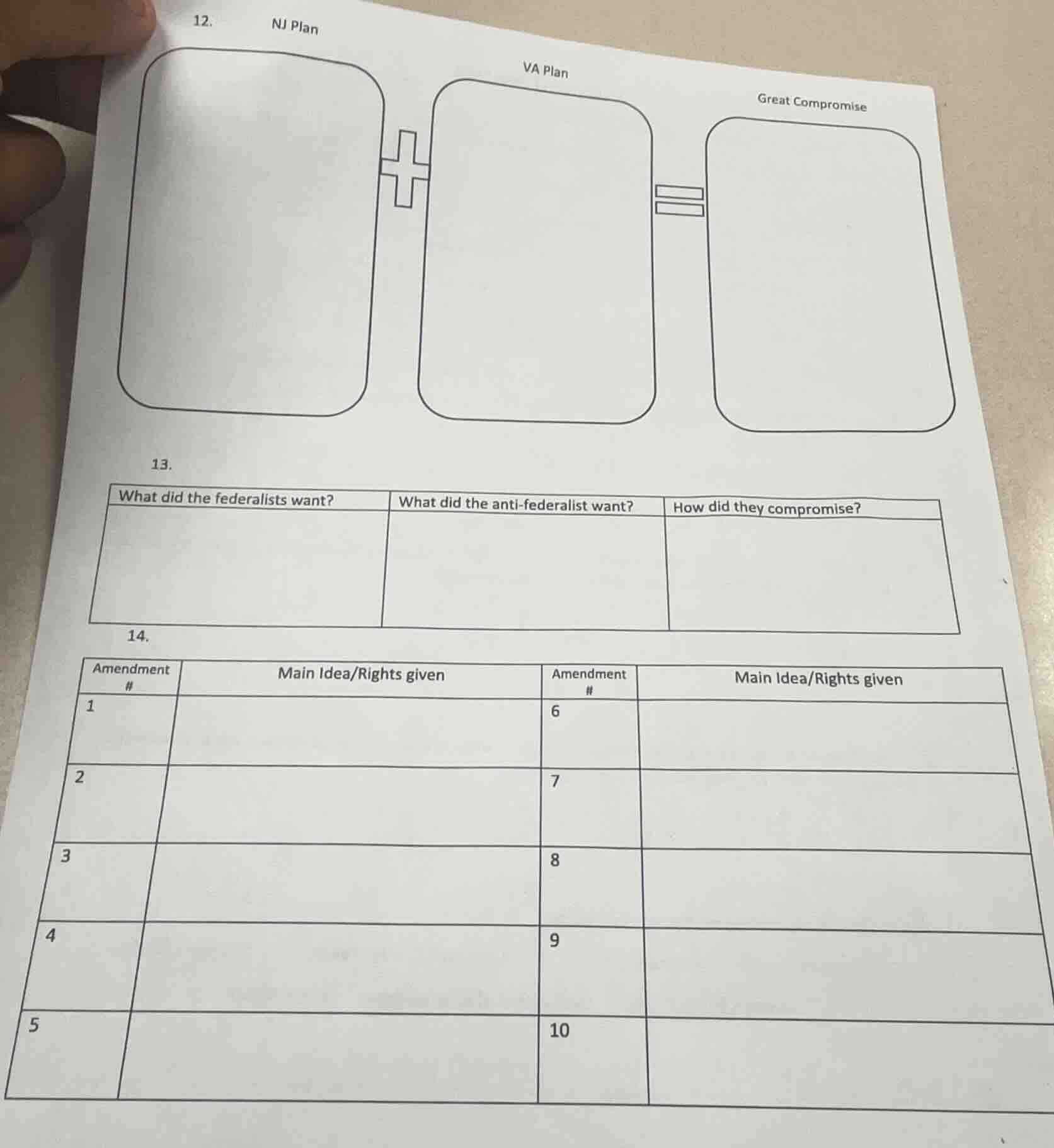
nj plan
va plan
great compromise
13.
what did the federalists want? \twhat did the anti - federalist want? \thow did they compromise?
14.
amendment # \tmain idea/rights given \tamendment # \tmain idea/rights given
1 \t \t6 \t
2 \t \t7 \t
3 \t \t8 \t
4 \t \t9 \t
5 \t \t10 \t
Brief Explanations
For Question 12:
- NJ Plan: A proposal for the U.S. legislature that favored small states, calling for a unicameral legislature with equal representation for all states, regardless of population.
- VA Plan: A proposal that favored large states, calling for a bicameral legislature where representation in both chambers was based on state population or wealth.
- Great Compromise: Merged the two plans to create the U.S. Congress: a Senate with equal representation (2 per state, from NJ Plan) and a House of Representatives with representation based on state population (from VA Plan).
For Question 13:
- Federalists: Supported ratifying the U.S. Constitution, wanted a strong central government to unify the states and address weaknesses of the Articles of Confederation.
- Anti-Federalists: Opposed ratifying the Constitution without protections for individual liberties, feared a strong central government would become tyrannical and threaten state and individual rights.
- Compromise: The Federalists agreed to add a Bill of Rights (the first 10 amendments to the Constitution) to protect individual freedoms, which led to the Constitution's ratification.
For Question 14:
This table covers the U.S. Bill of Rights, with the core purpose of each amendment:
- Protects freedoms of religion, speech, press, assembly, and petition.
- Protects the right to keep and bear arms.
- Prohibits quartering of soldiers in private homes without consent.
- Prohibits unreasonable searches and seizures, requires warrants based on probable cause.
- Protects against self-incrimination, double jeopardy, and ensures due process; protects private property.
- Guarantees a speedy, public trial, right to an attorney, and right to confront witnesses in criminal cases.
- Provides for a jury trial in civil cases involving claims over a certain value.
- Prohibits excessive bail, excessive fines, and cruel and unusual punishment.
- States that the listing of rights in the Constitution does not deny or disparage other rights held by the people.
- Powers not delegated to the federal government, nor prohibited to the states, are reserved to the states or the people.

Snap & solve any problem in the app
Get step-by-step solutions on Sovi AI
Photo-based solutions with guided steps
Explore more problems and detailed explanations
Question 12
- NJ Plan Box: A unicameral legislature with equal state representation (no population-based voting power, favoring small states)
- VA Plan Box: A bicameral legislature with representation based on state population/wealth (favoring large states)
- Great Compromise Box: Bicameral Congress: Senate (2 seats per state, equal representation) + House of Representatives (representation based on state population)
Question 13
| What did the federalists want? | What did the anti-federalist want? | How did they compromise? |
|---|
Question 14
| Amendment # | Main Idea/Rights given | Amendment # | Main Idea/Rights given |
|---|---|---|---|
| 2 | Right to keep and bear arms | 7 | Jury trial for civil cases over a set value |
| 3 | No forced quartering of soldiers in homes | 8 | No excessive bail/fines, no cruel/unusual punishment |
| 4 | No unreasonable searches/seizures; warrants need probable cause | 9 | Unlisted rights of people are still protected |
| 5 | No self-incrimination/double jeopardy; due process; protect private property | 10 | Unfederalized powers go to states/people |