QUESTION IMAGE
Question
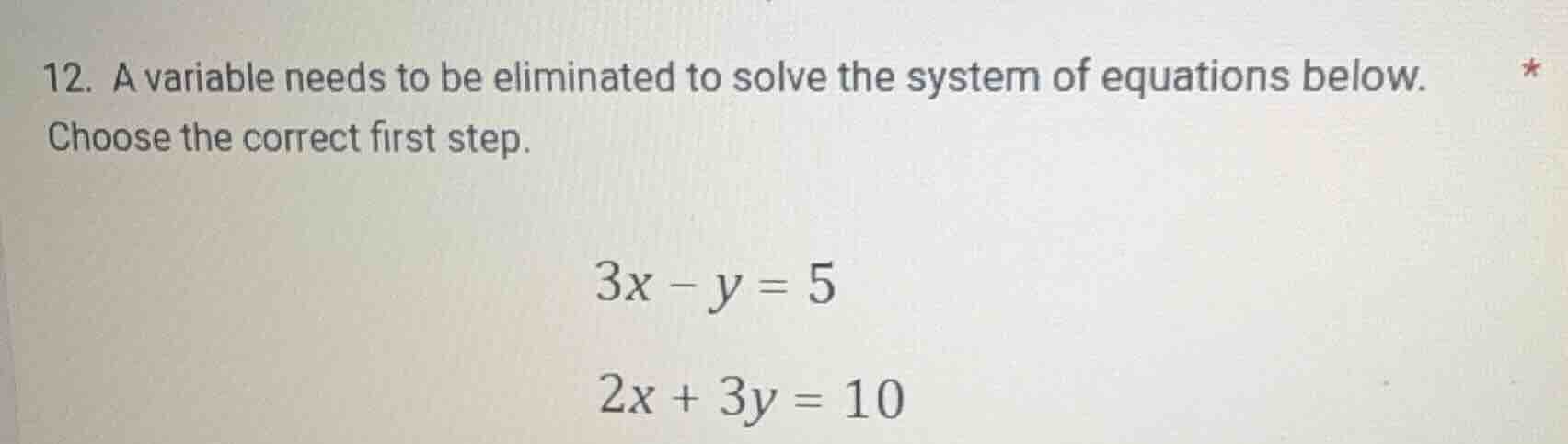
- a variable needs to be eliminated to solve the system of equations below. choose the correct first step. $3x - y = 5$ $2x + 3y = 10$
To solve the system of equations by elimination, we want to make the coefficients of one variable opposites (or the same) so that when we add or subtract the equations, that variable is eliminated. Let's analyze the \( y \)-terms first. The coefficient of \( y \) in the first equation is \( -1 \), and in the second equation is \( 3 \). If we multiply the first equation by \( 3 \), the coefficient of \( y \) will become \( -3 \), which is the opposite of \( 3 \) (the coefficient of \( y \) in the second equation).
Step 1: Multiply the first equation by 3
The first equation is \( 3x - y = 5 \). Multiplying each term by \( 3 \) gives:
\[
3(3x - y) = 3(5)
\]
\[
9x - 3y = 15
\]
Now, if we add this new equation (\( 9x - 3y = 15 \)) to the second equation (\( 2x + 3y = 10 \)), the \( y \)-terms (\( -3y \) and \( +3y \)) will cancel out, eliminating the \( y \)-variable.
(Note: Another possible first step could be to solve one equation for a variable and substitute, but since the question specifies elimination, we focus on that method. If we wanted to eliminate \( x \) instead, we would need to find a common multiple of \( 3 \) and \( 2 \) (like \( 6 \)) and adjust the coefficients, but eliminating \( y \) is simpler here with a smaller multiplier.)
So the correct first step (for elimination) is to multiply the first equation \( 3x - y = 5 \) by \( 3 \) to get \( 9x - 3y = 15 \), which will allow us to eliminate \( y \) when we add the equations.
If we were to present this as a multiple-choice option (assuming options like "Multiply the first equation by 3", "Multiply the second equation by 1", "Add the two equations as is", etc.), the correct first step for elimination (to eliminate \( y \)) is multiplying the first equation by \( 3 \).

Snap & solve any problem in the app
Get step-by-step solutions on Sovi AI
Photo-based solutions with guided steps
Explore more problems and detailed explanations
To solve the system of equations by elimination, we want to make the coefficients of one variable opposites (or the same) so that when we add or subtract the equations, that variable is eliminated. Let's analyze the \( y \)-terms first. The coefficient of \( y \) in the first equation is \( -1 \), and in the second equation is \( 3 \). If we multiply the first equation by \( 3 \), the coefficient of \( y \) will become \( -3 \), which is the opposite of \( 3 \) (the coefficient of \( y \) in the second equation).
Step 1: Multiply the first equation by 3
The first equation is \( 3x - y = 5 \). Multiplying each term by \( 3 \) gives:
\[
3(3x - y) = 3(5)
\]
\[
9x - 3y = 15
\]
Now, if we add this new equation (\( 9x - 3y = 15 \)) to the second equation (\( 2x + 3y = 10 \)), the \( y \)-terms (\( -3y \) and \( +3y \)) will cancel out, eliminating the \( y \)-variable.
(Note: Another possible first step could be to solve one equation for a variable and substitute, but since the question specifies elimination, we focus on that method. If we wanted to eliminate \( x \) instead, we would need to find a common multiple of \( 3 \) and \( 2 \) (like \( 6 \)) and adjust the coefficients, but eliminating \( y \) is simpler here with a smaller multiplier.)
So the correct first step (for elimination) is to multiply the first equation \( 3x - y = 5 \) by \( 3 \) to get \( 9x - 3y = 15 \), which will allow us to eliminate \( y \) when we add the equations.
If we were to present this as a multiple-choice option (assuming options like "Multiply the first equation by 3", "Multiply the second equation by 1", "Add the two equations as is", etc.), the correct first step for elimination (to eliminate \( y \)) is multiplying the first equation by \( 3 \).