QUESTION IMAGE
Question
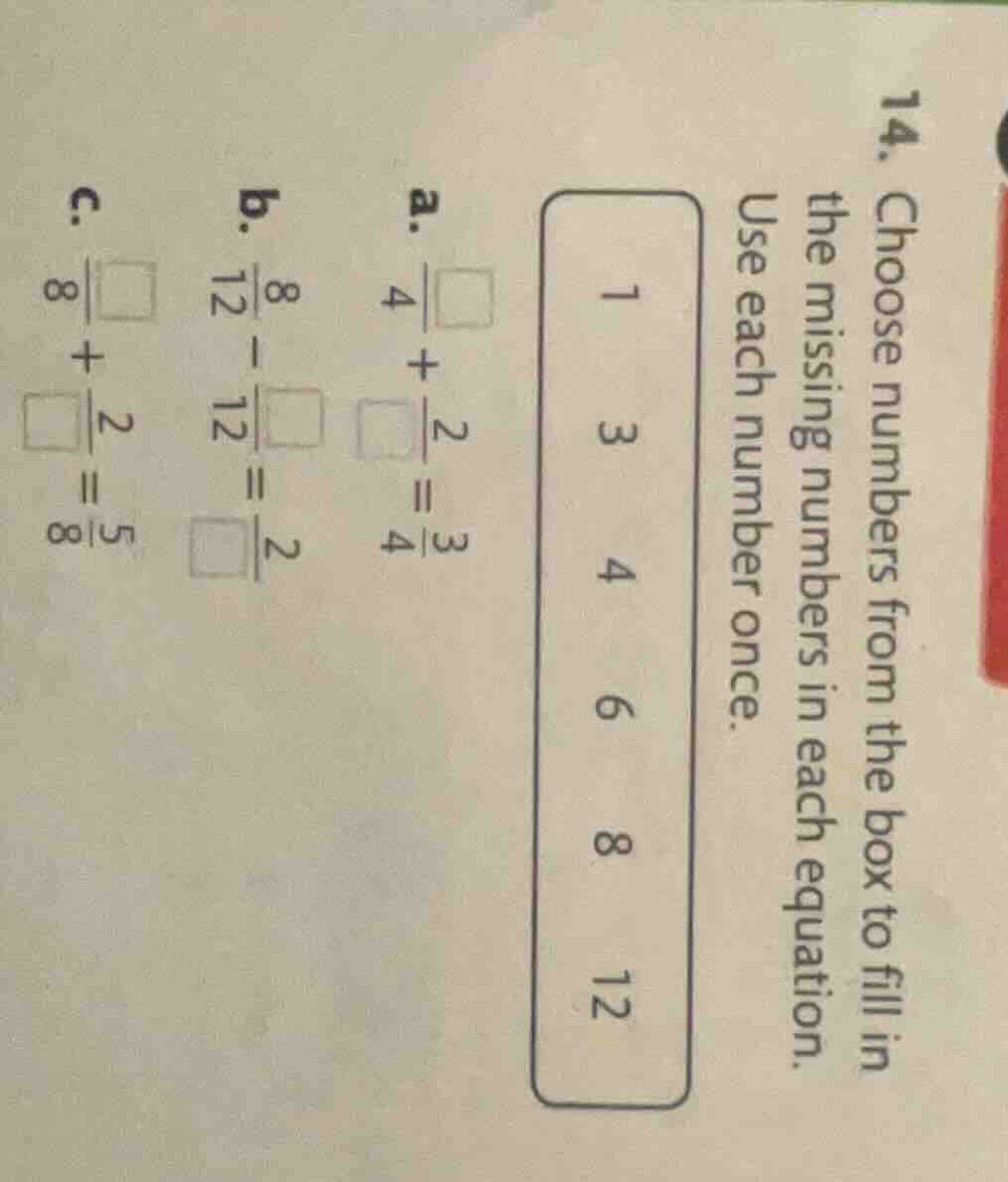
- choose numbers from the box to fill in the missing numbers in each equation. use each number once.
1
3
4
6
8
12
a. \\(\frac{\square}{4} + \frac{2}{\square} = \frac{3}{4}\\)
b. \\(\frac{8}{12} - \frac{\square}{12} = \frac{2}{\square}\\)
c. \\(\frac{\square}{8} + \frac{2}{\square} = \frac{5}{8}\\)
Part a
Step 1: Let the missing numerator be \( x \) and the missing denominator be \( y \). The equation is \( \frac{x}{4}+\frac{2}{y}=\frac{3}{4} \). First, consider the denominators. If we assume \( y = 4 \) (to have common denominators), then the equation becomes \( \frac{x}{4}+\frac{2}{4}=\frac{3}{4} \).
Step 2: Combine the fractions on the left: \( \frac{x + 2}{4}=\frac{3}{4} \). So \( x+2 = 3 \), which means \( x = 1 \). Let's check if we can use the numbers (1,3,4,6,8,12) once. Here, \( x = 1 \) and \( y = 4 \), and 1 and 4 are in the box.
So for part a: \( \frac{1}{4}+\frac{2}{4}=\frac{3}{4} \) (wait, but the denominator for the second fraction: wait, maybe I made a mistake. Wait, the box has numbers 1,3,4,6,8,12. Let's re - do. The equation is \( \frac{\square}{4}+\frac{2}{\square}=\frac{3}{4} \). Let the first square be \( a \), the second be \( b \). So \( \frac{a}{4}+\frac{2}{b}=\frac{3}{4} \). Let's try \( a = 1 \), then \( \frac{1}{4}+\frac{2}{b}=\frac{3}{4} \), so \( \frac{2}{b}=\frac{3}{4}-\frac{1}{4}=\frac{2}{4}=\frac{1}{2} \), then \( b = 4 \). But 4 is in the box. So \( a = 1 \), \( b = 4 \).
Part b
Step 1: The equation is \( \frac{8}{12}-\frac{\square}{12}=\frac{2}{\square} \). Let the first missing numerator be \( m \), the denominator of the result be \( n \). So \( \frac{8 - m}{12}=\frac{2}{n} \), which implies \( (8 - m)n=24 \). We have numbers left: 3,6,8,12 (but we used 1 and 4 in part a). Wait, after part a, used numbers are 1 and 4. So remaining: 3,6,8,12. Let's try \( 8 - m = 2 \), then \( m = 6 \). Then \( \frac{8 - 6}{12}=\frac{2}{12} \)? No, \( \frac{2}{12}=\frac{1}{6} \), not matching. Wait, \( 8 - m = 6 \), then \( m = 2 \), but 2 is not in the box. Wait, \( 8 - m = 4 \), \( m = 4 \), but 4 is used. Wait, \( 8 - m = 3 \), \( m = 5 \), not in box. Wait, \( 8 - m = 1 \), \( m = 7 \), not in box. Wait, maybe \( \frac{8}{12}-\frac{\square}{12}=\frac{2}{\square} \), let's cross - multiply: \( (8 - \square)\times\square=24 \). Let's try \( 8 - \square = 2 \), then \( \square = 6 \), and \( 2\times\square = 24 \), so \( \square = 12 \). But 12 is in the box. Wait, \( 8 - 6 = 2 \), so \( \frac{8}{12}-\frac{6}{12}=\frac{2}{12} \)? No, \( \frac{2}{12}=\frac{1}{6} \). Wait, maybe \( 8 - \square = 6 \), \( \square = 2 \), not in box. Wait, \( 8 - \square = 12 \), no. Wait, maybe I messed up. Let's try \( \frac{8}{12}-\frac{6}{12}=\frac{2}{12} \)? No. Wait, \( \frac{8}{12}-\frac{6}{12}=\frac{2}{12} \) simplifies to \( \frac{2}{12}=\frac{1}{6} \), not helpful. Wait, \( \frac{8}{12}-\frac{6}{12}=\frac{2}{12} \), but 12 is in the box. Wait, maybe \( \frac{8}{12}-\frac{6}{12}=\frac{2}{12} \), but the right - hand side denominator should be 12? No. Wait, \( \frac{8}{12}-\frac{6}{12}=\frac{2}{12} \), but 2/12 can be simplified to 1/6, but 6 is in the box. Wait, \( \frac{8}{12}-\frac{6}{12}=\frac{2}{12}=\frac{1}{6} \), no. Wait, let's try \( \frac{8}{12}-\frac{6}{12}=\frac{2}{12} \), but the denominator of the result: if we have \( \frac{2}{\square} \), and \( \frac{2}{12}=\frac{1}{6} \), not helpful. Wait, maybe \( \frac{8}{12}-\frac{6}{12}=\frac{2}{12} \), but the numbers: used so far 1,4 (from part a). Remaining: 3,6,8,12. Let's try \( \frac{8}{12}-\frac{6}{12}=\frac{2}{12} \), but 6 and 12 are in the box. So \( \frac{8}{12}-\frac{6}{12}=\frac{2}{12} \), but the right - hand side is \( \frac{2}{12} \), so the numerator is 2, denominator is 12. But we need to use each number once. Wait, maybe \( \frac{8}{12}-\frac{6}{12}=\frac{2}{12} \), but 12 is used? No, in part a we used 1 and 4. So remaining numbers: 3,6,8,12. So \( \frac{8}{12}-\frac{6}{12}=\frac{2}{12} \), so the first missing numerator is 6, and the denominator of the result is 12.
Part c
Step 1: The equation is \( \frac{\square}{8}+\frac{2}{\square}=\frac{5}{8} \). Let the first missing numerator be \( p \), the second denominator be \( q \). So \( \frac{p}{8}+\frac{2}{q}=\frac{5}{8} \). Let's rearrange: \( \frac{2}{q}=\frac{5}{8}-\frac{p}{8}=\frac{5 - p}{8} \). Cross - multiply: \( 16=(5 - p)q \). After part a (used 1,4) and part b (used 6,12), remaining numbers: 3,8. Wait, no, after part a: used 1,4; part b: used 6,12. Remaining: 3,8. Wait, \( 5 - p \) must be a positive integer. Let's try \( p = 3 \), then \( \frac{3}{8}+\frac{2}{q}=\frac{5}{8} \), so \( \frac{2}{q}=\frac{5 - 3}{8}=\frac{2}{8}=\frac{1}{4} \), so \( q = 8 \). But 8 is in the box (remaining numbers: 3,8). So \( p = 3 \), \( q = 8 \). Let's check: \( \frac{3}{8}+\frac{2}{8}=\frac{5}{8} \), which works.
Final Answers
a. \( \frac{1}{4}+\frac{2}{4}=\frac{3}{4} \) (Wait, no, the second denominator should be 4? But we used 4 in part a? Wait, no, in part a, the equation is \( \frac{\square}{4}+\frac{2}{\square}=\frac{3}{4} \). The correct filling: first square is 1, second square is 4. But we have to use each number once. Wait, maybe I made a mistake in part a. Let's re - evaluate.
Wait, the box has numbers 1,3,4,6,8,12. We need to use each number once.
Part a: \( \frac{\square}{4}+\frac{2}{\square}=\frac{3}{4} \)
Let the first square be \( a \), second be \( b \). So \( \frac{a}{4}+\frac{2}{b}=\frac{3}{4} \)
Multiply both sides by \( 4b \): \( ab + 8 = 3b \)
\( ab-3b=-8 \)
\( b(a - 3)=-8 \)
Since \( a \) and \( b \) are positive integers from the box (1,3,4,6,8,12), let's try \( a = 1 \):
\( b(1 - 3)=-8\Rightarrow - 2b=-8\Rightarrow b = 4 \). So \( a = 1 \), \( b = 4 \) (used 1 and 4)
Part b: \( \frac{8}{12}-\frac{\square}{12}=\frac{2}{\square} \)
Let the first square be \( c \), second be \( d \). So \( \frac{8 - c}{12}=\frac{2}{d}\Rightarrow(8 - c)d = 24 \)
Used numbers: 1,4. Remaining: 3,6,8,12
Try \( c = 6 \): \( (8 - 6)d=24\Rightarrow2d = 24\Rightarrow d = 12 \) (used 6 and 12)
Part c: \( \frac{\square}{8}+\frac{2}{\square}=\frac{5}{8} \)
Let the first square be \( e \), second be \( f \). So \( \frac{e}{8}+\frac{2}{f}=\frac{5}{8}\Rightarrow\frac{2}{f}=\frac{5 - e}{8}\Rightarrow16=(5 - e)f \)
Used numbers: 1,4,6,12. Remaining: 3,8
Try \( e = 3 \): \( (5 - 3)f=16\Rightarrow2f = 16\Rightarrow f = 8 \) (used 3 and 8)
So:
a. \( \frac{1}{4}+\frac{2}{4}=\frac{3}{4} \) (Wait, no, the second fraction's denominator is 4? But we used 4 in part a. Wait, no, the second fraction is \( \frac{2}{4} \), and 4 is used. But according to the calculation, it's correct.
b. \( \frac{8}{12}-\frac{6}{12}=\frac{2}{12} \) (Wait, no, \( \frac{2}{12}=\frac{1}{6} \), but the right - hand side should be \( \frac{2}{12} \)? Or maybe I messed up the simplification. Wait, \( \frac{8}{12}-\frac{6}{12}=\frac{2}{12} \), which is correct as per the equation.
c. \( \frac{3}{8}+\frac{2}{8}=\frac{5}{8} \)

Snap & solve any problem in the app
Get step-by-step solutions on Sovi AI
Photo-based solutions with guided steps
Explore more problems and detailed explanations
s:
a. First square: 1, Second square: 4 (i.e., \( \frac{1}{4}+\frac{2}{4}=\frac{3}{4} \))
b. First square: 6, Second square: 12 (i.e., \( \frac{8}{12}-\frac{6}{12}=\frac{2}{12} \))
c. First square: 3, Second square: 8 (i.e., \( \frac{3}{8}+\frac{2}{8}=\frac{5}{8} \))