QUESTION IMAGE
Question
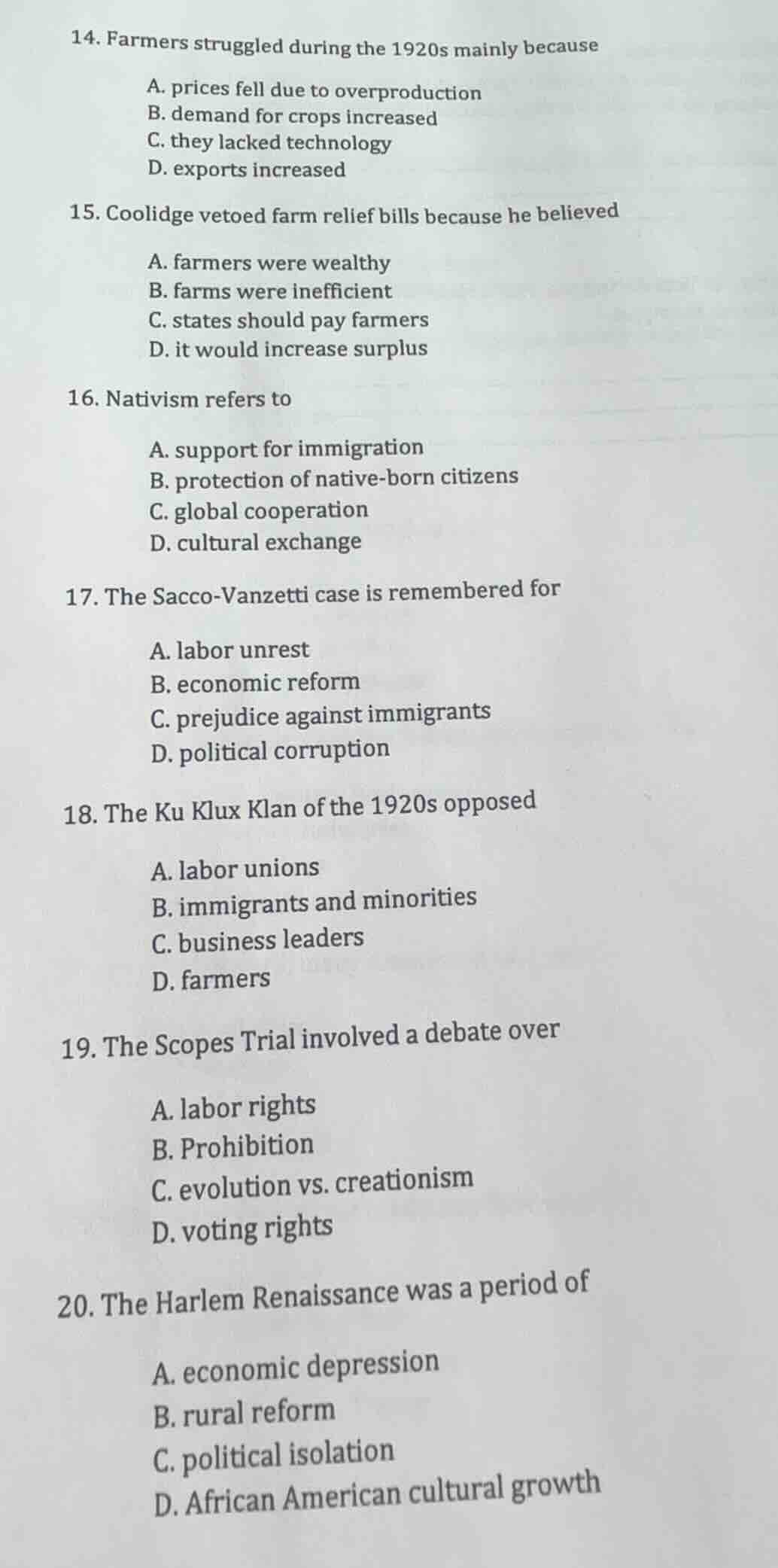
- farmers struggled during the 1920s mainly because
a. prices fell due to overproduction
b. demand for crops increased
c. they lacked technology
d. exports increased
- coolidge vetoed farm relief bills because he believed
a. farmers were wealthy
b. farms were inefficient
c. states should pay farmers
d. it would increase surplus
- nativism refers to
a. support for immigration
b. protection of native - born citizens
c. global cooperation
d. cultural exchange
- the sacco - vanzetti case is remembered for
a. labor unrest
b. economic reform
c. prejudice against immigrants
d. political corruption
- the ku klux klan of the 1920s opposed
a. labor unions
b. immigrants and minorities
c. business leaders
d. farmers
- the scopes trial involved a debate over
a. labor rights
b. prohibition
c. evolution vs. creationism
d. voting rights
- the harlem renaissance was a period of
a. economic depression
b. rural reform
c. political isolation
d. african american cultural growth
- In the 1920s, farmers expanded production, leading to a surplus that drove crop prices down, causing financial struggle.
- President Coolidge favored laissez-faire economics, believing farm relief bills would keep inefficient farms operating instead of letting the market correct itself.
- Nativism centers on prioritizing and protecting the interests of native-born citizens over immigrants.
- The Sacco-Vanzetti case was marked by widespread belief that the two Italian immigrant defendants were targeted and convicted due to anti-immigrant prejudice, not just evidence.
- The 1920s Ku Klux Klan promoted white supremacy, targeting immigrants, Black Americans, and other minority groups.
- The Scopes Trial was a high-profile case where a teacher was prosecuted for teaching evolution, sparking a national debate between evolution and creationism.
- The Harlem Renaissance was a flourishing movement of African American art, literature, music, and intellectual life in Harlem, New York.

Snap & solve any problem in the app
Get step-by-step solutions on Sovi AI
Photo-based solutions with guided steps
Explore more problems and detailed explanations
- A. prices fell due to overproduction
- B. farms were inefficient
- B. protection of native-born citizens
- C. prejudice against immigrants
- B. immigrants and minorities
- C. evolution vs. creationism
- D. African American cultural growth