QUESTION IMAGE
Question
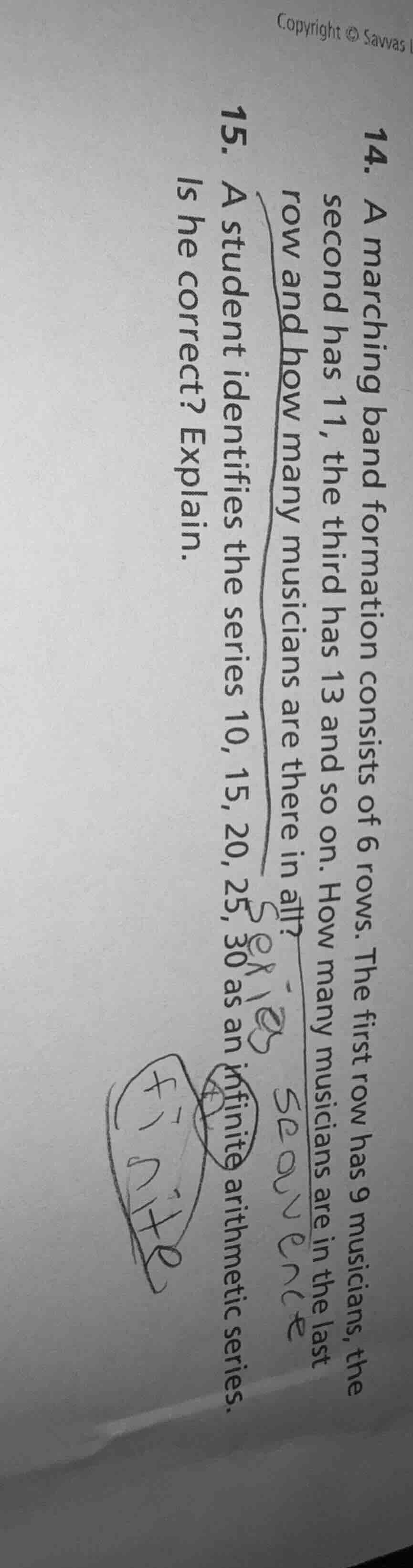
- a marching band formation consists of 6 rows. the first row has 9 musicians, the second has 11, the third has 13 and so on. how many musicians are in the last row and how many musicians are there in all? 15. a student identifies the series 10, 15, 20, 25, 30 as an infinite arithmetic series. is he correct? explain.
Problem 14:
Step1: Identify the arithmetic sequence
The number of musicians in each row forms an arithmetic sequence with first term \(a_1 = 9\), common difference \(d = 2\) (since \(11 - 9 = 2\), \(13 - 11 = 2\), etc.), and number of terms \(n = 6\).
Step2: Find the last term (\(a_n\))
The formula for the \(n\)-th term of an arithmetic sequence is \(a_n = a_1 + (n - 1)d\).
Substitute \(a_1 = 9\), \(d = 2\), \(n = 6\):
\(a_6 = 9 + (6 - 1) \times 2 = 9 + 10 = 19\)
Step3: Calculate the sum of the sequence
The sum of the first \(n\) terms of an arithmetic sequence is \(S_n=\frac{n(a_1 + a_n)}{2}\).
Substitute \(n = 6\), \(a_1 = 9\), \(a_n = 19\):
\(S_6=\frac{6(9 + 19)}{2}=\frac{6\times28}{2}= 84\)
An arithmetic sequence has a common difference between consecutive terms. For the series \(10, 15, 20, 25, 30, \dots\), the common difference \(d = 15 - 10 = 5\), \(20 - 15 = 5\), etc. An infinite arithmetic series is a sequence of numbers in an arithmetic progression that continues indefinitely (has no last term). Since this series can continue by adding 5 each time without end, it is an infinite arithmetic series. So the student is correct.

Snap & solve any problem in the app
Get step-by-step solutions on Sovi AI
Photo-based solutions with guided steps
Explore more problems and detailed explanations
The number of musicians in the last row is 19, and the total number of musicians is 84.