QUESTION IMAGE
Question
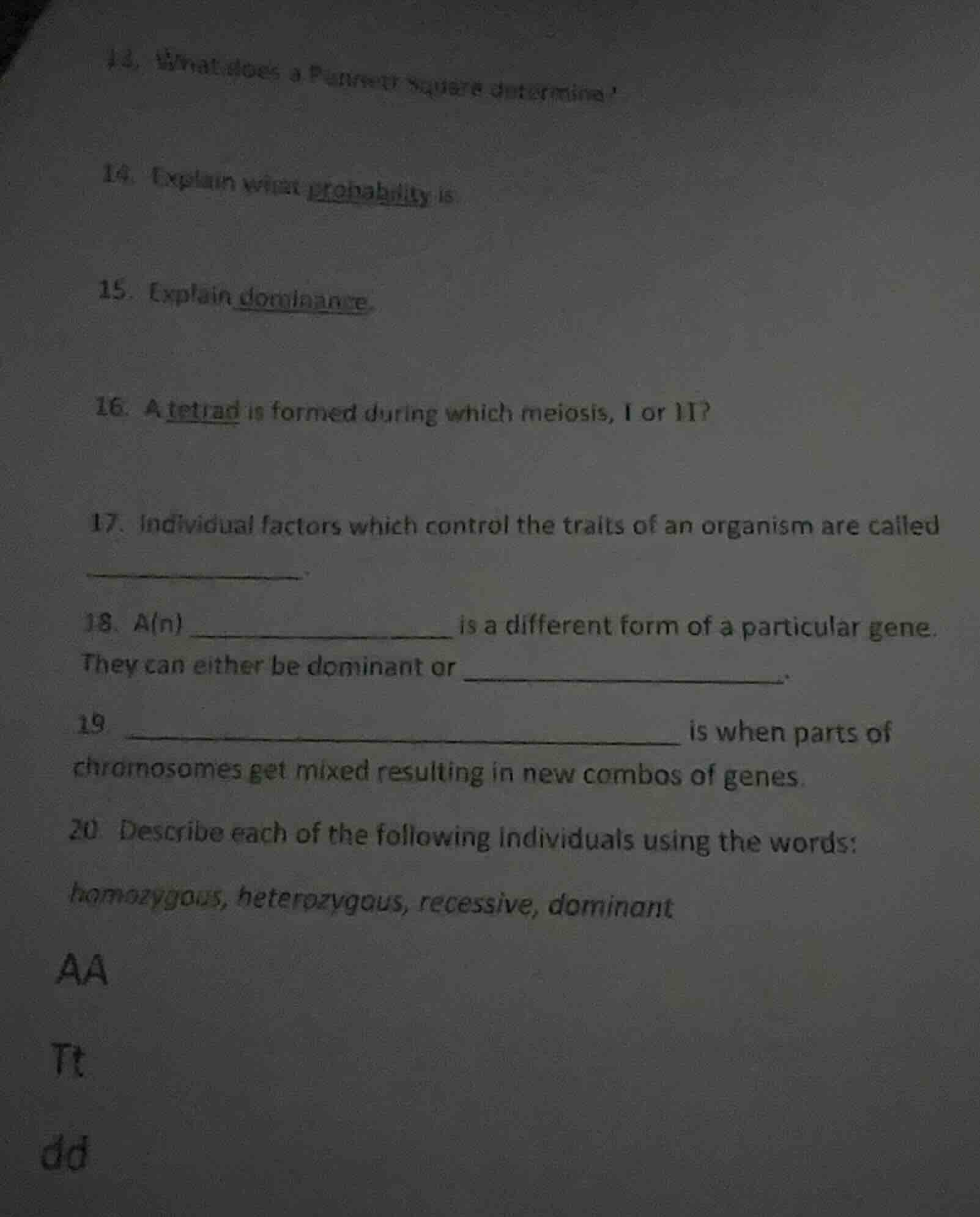
- what does a punnett square determine?
- explain what probability is
- explain dominance.
- a tetrad is formed during which meiosis, i or ii?
- individual factors which control the traits of an organism are called __________.
- a(n) _____________ is a different form of a particular gene. they can either be dominant or __________________.
19 ______________________________ is when parts of chromosomes get mixed resulting in new combos of genes.
- describe each of the following individuals using the words:
homozygous, heterozygous, recessive, dominant
aa
tt
dd
Brief Explanations
- Probability is the measure of the likelihood that a specific genetic outcome (like an offspring inheriting a trait) will occur, expressed as a ratio or percentage.
- Dominance is a genetic relationship where one allele (dominant) masks the phenotypic expression of another allele (recessive) in a heterozygous organism.
- Tetrads form when homologous chromosomes pair up, which happens in Prophase I of meiosis.
- These heritable factors that control specific traits are defined as genes.
- Alleles are variant forms of a single gene, and they are categorized as dominant or recessive based on their expression.
- Crossing over is the process where homologous chromosomes exchange genetic segments, creating new gene combinations.
20.
- AA: Has two identical dominant alleles, so it is homozygous dominant.
- Tt: Has one dominant and one recessive allele, so it is heterozygous.
- dd: Has two identical recessive alleles, so it is homozygous recessive.

Snap & solve any problem in the app
Get step-by-step solutions on Sovi AI
Photo-based solutions with guided steps
Explore more problems and detailed explanations
- Probability is the measure of the likelihood that a specific genetic event or trait inheritance will occur, often expressed as a fraction, decimal, or percentage.
- Dominance is a genetic principle where one allele (dominant) masks the phenotypic expression of a contrasting recessive allele in a heterozygous individual.
- Meiosis I
- genes
- allele; recessive
- Crossing over
20.
- AA: Homozygous dominant
- Tt: Heterozygous
- dd: Homozygous recessive