QUESTION IMAGE
Question
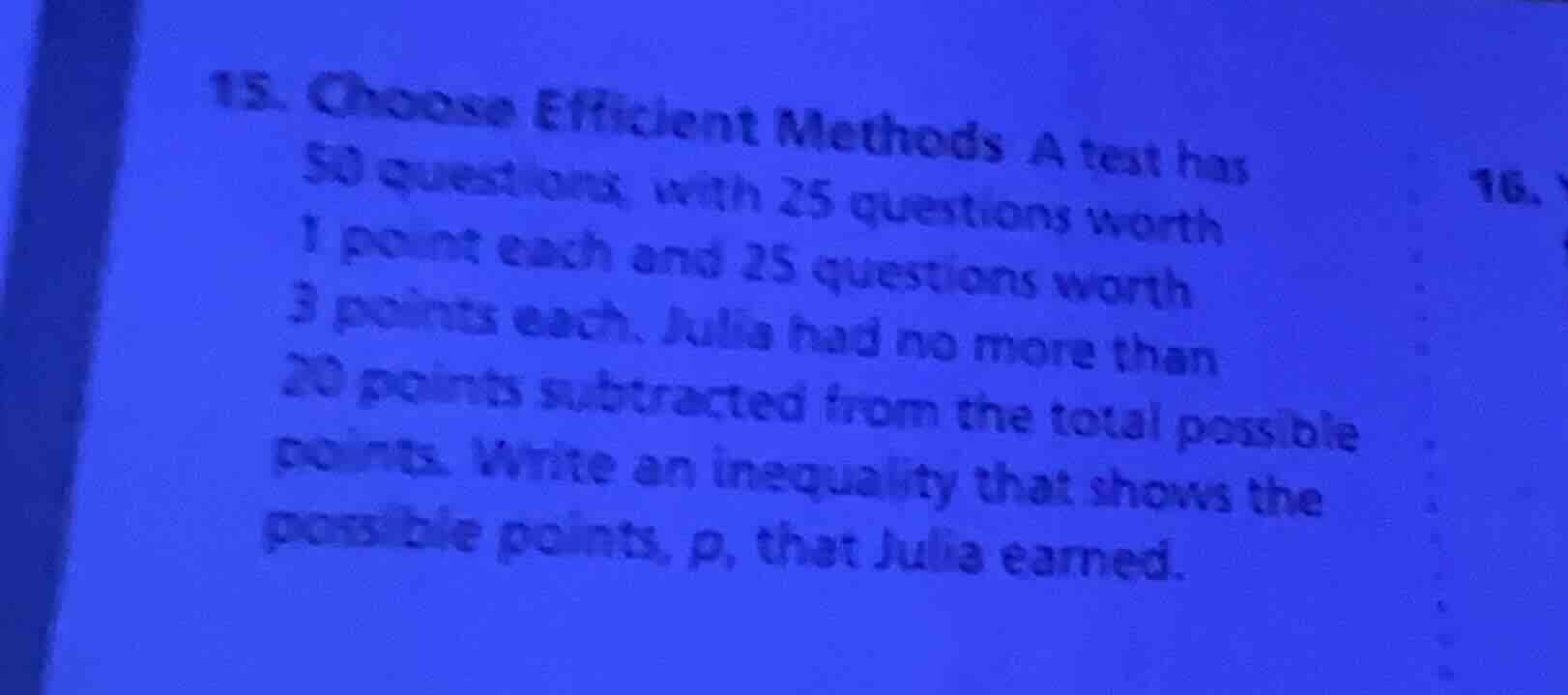
- choose efficient methods a test has 50 questions, with 25 questions worth 1 point each and 25 questions worth 3 points each. julia had no more than 20 points subtracted from the total possible points. write an inequality that shows the possible points, p, that julia earned.
Step1: Calculate total possible points
First, find the total possible points from the test. There are 25 questions worth 1 point each and 25 questions worth 3 points each. So the total possible points is \(25\times1 + 25\times3\).
\(25\times1 = 25\), \(25\times3 = 75\), so \(25 + 75 = 100\).
Step2: Set up the inequality for Julia's points
Julia had no more than 20 points subtracted from the total possible points. Let \(p\) be the points Julia earned. Then the number of points subtracted is \(100 - p\), and this is no more than 20. So the inequality is \(100 - p\leq20\). We can also rewrite this as \(p\geq100 - 20\), which simplifies to \(p\geq80\). But we can also express it directly from the subtraction: \(p\geq100 - 20\) or starting from the total and subtraction: \(100 - p\leq20\) can be rearranged to \(p\geq80\), but also, since the minimum she could earn is when she loses 20, so \(p\geq100 - 20\), and the maximum is 100 (if she loses 0). But the problem says "no more than 20 points subtracted", so \(100 - p\leq20\), which is equivalent to \(p\geq80\). However, we can also write the inequality as \(p\geq(25\times1 + 25\times3)- 20\), which simplifies to \(p\geq100 - 20\), so \(p\geq80\). But let's check the initial setup: total points is 100, points subtracted is \(100 - p\), and this is \(\leq20\), so \(100 - p\leq20\), which can be written as \(p\geq80\). But also, since she can't earn more than 100, \(p\leq100\), but the problem is about the possible points she earned with no more than 20 subtracted, so the main inequality is \(p\geq80\) (since \(100 - p\leq20\) implies \(p\geq80\)) and \(p\leq100\), but the question is to write an inequality that shows the possible points. So combining, \(80\leq p\leq100\), but let's see the steps again.
Wait, let's do it step by step:
- Calculate total possible points: \(25\times1 + 25\times3 = 25 + 75 = 100\).
- Let \(p\) be Julia's score. The number of points subtracted is \(100 - p\).
- The problem states she had no more than 20 points subtracted, so \(100 - p\leq20\).
- Solving for \(p\): subtract 100 from both sides: \(-p\leq20 - 100\), \(-p\leq - 80\), multiply both sides by -1 (remember to reverse the inequality sign): \(p\geq80\).
But also, since she can't earn more than the total possible points, \(p\leq100\). So the inequality is \(80\leq p\leq100\), but the problem might just want the lower bound with the subtraction. Wait, let's check the problem statement: "Write an inequality that shows the possible points, \(p\), that Julia earned."
So total possible points: \(25(1) + 25(3) = 100\). Points subtracted: \(100 - p\). No more than 20 subtracted: \(100 - p\leq20\). So the inequality is \(p\geq100 - 20\), which is \(p\geq80\), and also \(p\leq100\) (since she can't earn more than total). But maybe the problem expects the inequality based on the subtraction: \(100 - p\leq20\), which can be written as \(p\geq80\). Alternatively, \(p\geq(25\times1 + 25\times3)-20\), so \(p\geq80\).

Snap & solve any problem in the app
Get step-by-step solutions on Sovi AI
Photo-based solutions with guided steps
Explore more problems and detailed explanations
\(p \geq 80\) (or \(100 - p \leq 20\) which is equivalent, but \(p \geq 80\) is a more direct inequality for her earned points)