QUESTION IMAGE
Question
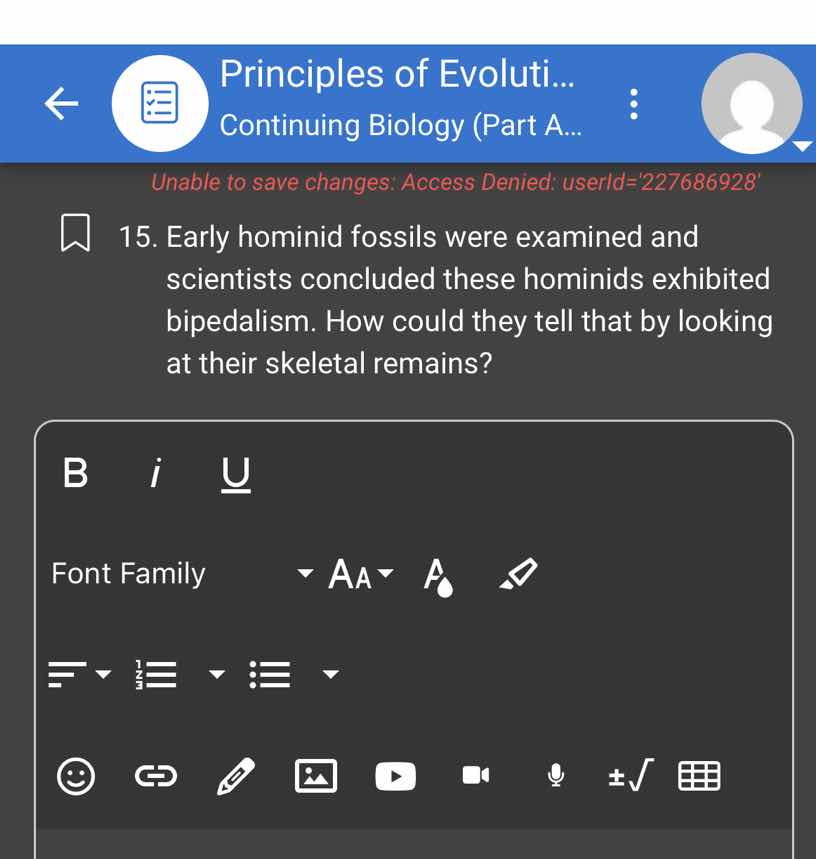
- early hominid fossils were examined and scientists concluded these hominids exhibited bipedalism. how could they tell that by looking at their skeletal remains?
Brief Explanations
To determine bipedalism from skeletal remains, key skeletal features are examined:
- Foramen Magnum Position: In bipedal hominids, the foramen magnum (opening where the spinal cord enters the skull) is centered underneath the skull (vs. towards the back in quadrupeds), allowing the spine to align vertically for upright posture.
- Pelvis Shape: Bipedal hominids have a short, broad, bowl - shaped pelvis (vs. long and narrow in quadrupeds) to support the upper body’s weight when standing upright.
- Femur (Thigh Bone) Angulation: The femur angles inward from the hip to the knee (valgus angle), which helps center the body’s weight over the feet during walking.
- Foot Structure: Features like a non - opposable big toe (aligned with other toes, for propulsion) and an arched foot (for shock absorption and efficient bipedal movement) are indicative.
By analyzing these skeletal traits, scientists infer bipedal locomotion.

Snap & solve any problem in the app
Get step-by-step solutions on Sovi AI
Photo-based solutions with guided steps
Explore more problems and detailed explanations
Scientists determine bipedalism from skeletal remains by examining:
- A centered foramen magnum (under the skull, aligning the spine for upright posture).
- A bowl - shaped pelvis (short, broad, supporting upper - body weight).
- A valgus - angled femur (inward - angled thigh bone, centering weight over feet).
- A human - like foot (non - opposable big toe, arched structure for bipedal movement).