QUESTION IMAGE
Question
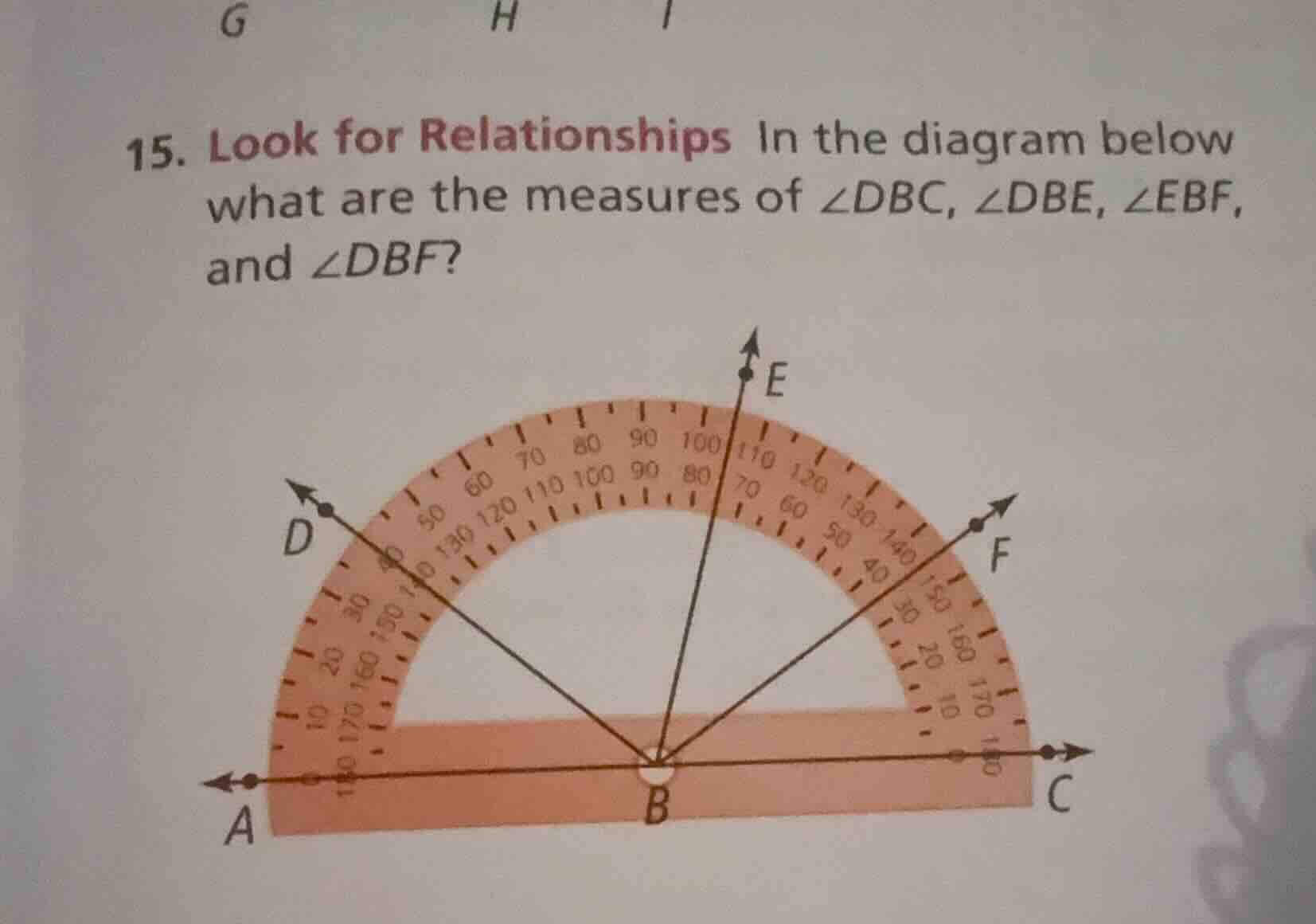
- look for relationships in the diagram below what are the measures of ∠dbc, ∠dbe, ∠ebf, and ∠dbf?
Step1: Measure ∠DBC
∠DBC is a straight - line related angle? No, looking at the protractor, the ray BD and ray BC. The straight line is AC, so ∠ABC is 180°. The angle of BD with BA: from the protractor, BD is at 40° from BA (since the protractor has markings, and BA is the left - most ray). Wait, actually, to find ∠DBC, we can see that the angle between BD and BC. Since ∠ABC = 180°, and the angle between BD and BA is 40° (from the protractor, the lower scale: BA is 180°/0°, BD is at 40° from BA towards BC? Wait, no. The protractor is a semicircle, with center at B. The ray BA is at 180° (left) and BC is at 0° (right). So the angle between BA and BC is 180°. Now, ray BD: looking at the protractor, the lower scale (the one with 0 - 180° from left to right). The mark for BD: the line BD passes through the 40° mark on the lower scale (since from BA (180°) moving towards BC (0°), the angle of BD with BA is 40°? Wait, no. Wait, the protractor has two scales: one going clockwise (from 0° at BC to 180° at BA) and one counter - clockwise (from 0° at BA to 180° at BC). Wait, in the diagram, the protractor is placed with center at B, and the straight edge along AC (BA to BC). So for ∠DBC: the angle between BD and BC. Since BC is at 0° (right), and BD is at 180°−40° = 140°? Wait, no. Wait, let's look at the upper scale. Wait, the upper scale: the numbers are 70, 80, 90, 100, 110, 120, 130, 140, 150, 160, 170, 180 on the left and 70, 80, 90, 100, 110, 120, 130, 140, 150, 160, 170, 180 on the right? No, the protractor has a semicircle, so from left (BA) to right (BC), the lower scale is 0° (at BC) to 180° (at BA), and the upper scale is 180° (at BA) to 0° (at BC). Wait, maybe a better way: ∠DBC is the angle between BD and BC. Since BC is along the positive x - axis (right), and BD is at an angle of 180°−40° = 140° from BC? Wait, no. Wait, looking at the diagram, the ray BD: the lower scale (the one with 0 at BC) – no, the lower scale has 0 at BA? Wait, I think I made a mistake. Let's re - examine. The protractor is a semicircular protractor, with center at B. The line AC is a straight line, with A on the left and C on the right. So BA is the left - most ray, BC is the right - most ray. The angle between BA and BC is 180°. Now, the ray BD: when we look at the protractor, the mark for BD on the lower scale (the scale that goes from BA (left) to BC (right), 0° at BC and 180° at BA) – no, the lower scale is from 0° (BC) to 180° (BA) clockwise. The upper scale is from 180° (BA) to 0° (BC) counter - clockwise. Wait, the ray BD: the line BD passes through the 40° mark on the lower scale? No, the lower scale: at BC (right) it's 0°, then moving towards BA (left), it's 10°, 20°, 30°, 40°, 50°,... 180°. Wait, the ray BD: the angle between BD and BA is 40° (since the mark on the lower scale at BD is 40° from BA). So ∠ABD = 40°, then ∠DBC=180°−∠ABD = 180°−40° = 140°.
Step2: Measure ∠DBE
∠DBE is the angle between BD and BE. Let's find the angle between BD and BE. From the protractor, the ray BE: looking at the upper scale, the mark for BE is at 110°? Wait, no. Wait, the upper scale: the numbers on the upper part. The ray BE: the upper scale (the one that goes from 0° at BC to 180° at BA counter - clockwise). Wait, the angle between BD and BE: ∠DBE. Since ∠ABD = 40°, and ∠ABE: from the protractor, the angle between BA and BE. Let's see, the ray BE: the upper scale mark. The upper scale at BE: the number is 110°? Wait, no. Wait, the lower scale: BA is 180°, BC is 0°. The ray BE: looking at the lower scale, the angle between BA and BE is 180°−110° = 70°? Wa…

Snap & solve any problem in the app
Get step-by-step solutions on Sovi AI
Photo-based solutions with guided steps
Explore more problems and detailed explanations
$\angle DBC = 140^\circ$, $\angle DBE = 70^\circ$, $\angle EBF = 30^\circ$, $\angle DBF = 100^\circ$