QUESTION IMAGE
Question
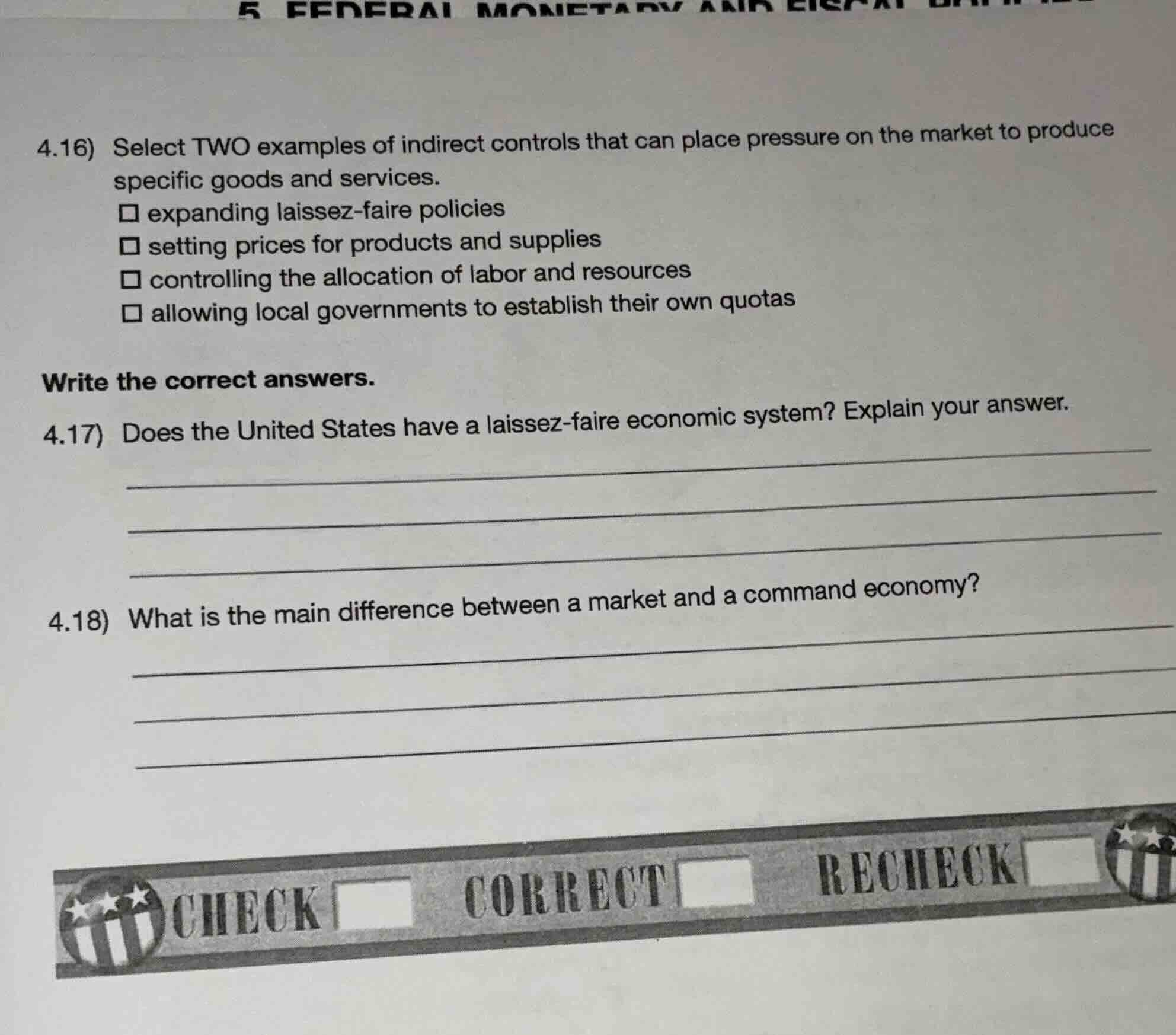
4.16) select two examples of indirect controls that can place pressure on the market to produce specific goods and services.
□ expanding laissez - faire policies
□ setting prices for products and supplies
□ controlling the allocation of labor and resources
□ allowing local governments to establish their own quotas
write the correct answers.
4.17) does the united states have a laissez - faire economic system? explain your answer.
4.18) what is the main difference between a market and a command economy?
For 4.16:
Indirect controls influence markets without direct mandates. Expanding laissez-faire reduces restrictions, letting market pressures drive production. Allowing local quotas sets indirect production targets via local rules, not direct government resource control. Direct controls are price-setting and labor allocation, which are direct mandates.
For 4.17:
Laissez-faire means no government intervention, but the U.S. has regulations, taxes, and public services that shape the economy, so it is a mixed system, not pure laissez-faire.
For 4.18:
The core difference lies in who makes key economic decisions: private actors in market economies, central authorities in command economies.

Snap & solve any problem in the app
Get step-by-step solutions on Sovi AI
Photo-based solutions with guided steps
Explore more problems and detailed explanations
4.16)
- expanding laissez-faire policies
- allowing local governments to establish their own quotas
4.17) No, the United States does not have a laissez-faire economic system. It has a mixed economic system, where the government intervenes through regulations, taxes, public goods provision, and social welfare programs, rather than leaving all economic activity entirely unregulated.
4.18) The main difference is the entity that makes core economic decisions: in a market economy, private individuals and businesses decide what to produce, how to produce it, and who gets goods/services based on supply and demand; in a command economy, a central government authority makes all these key economic decisions.