QUESTION IMAGE
Question
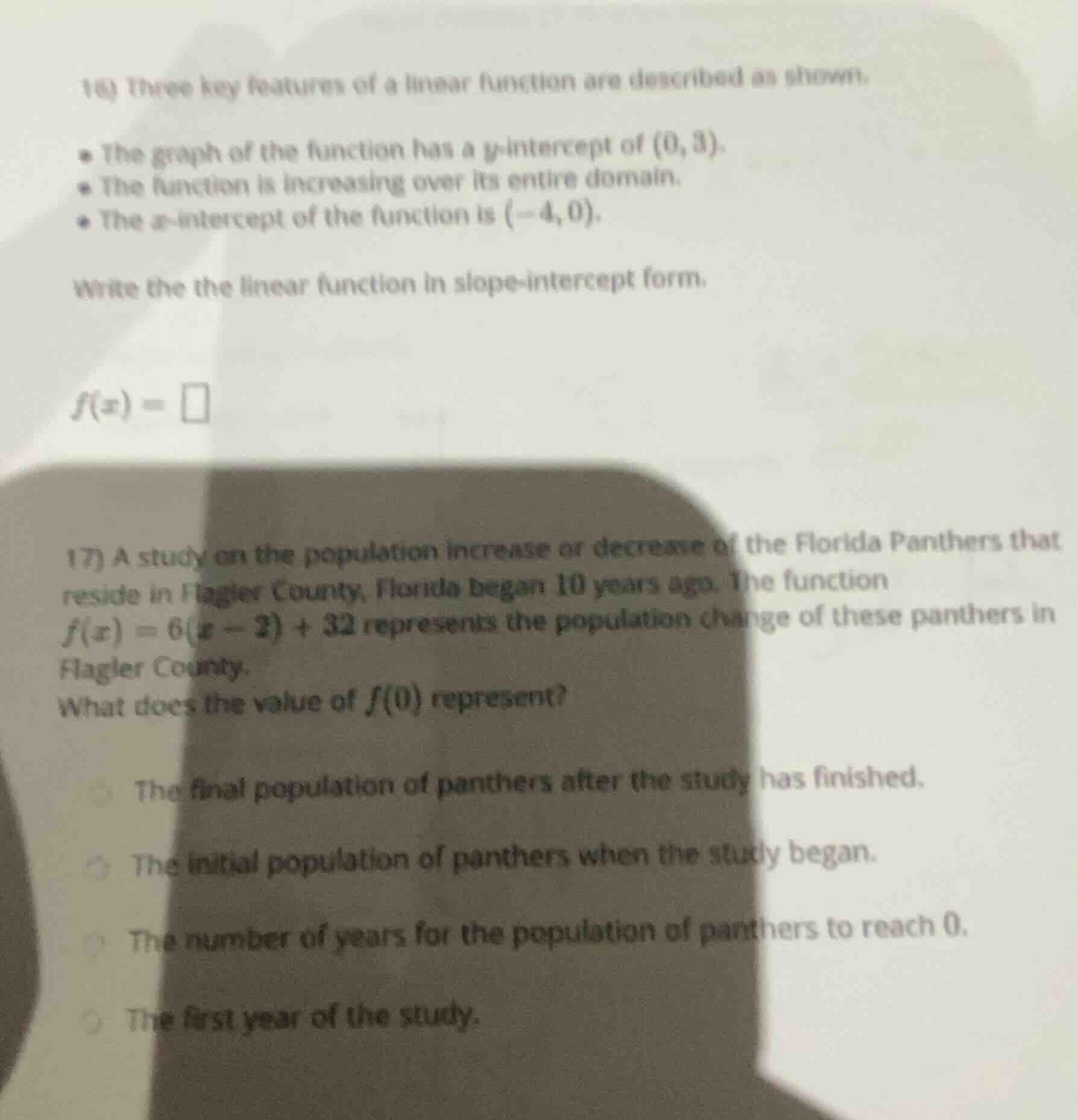
- three key features of a linear function are described as shown. - the graph of the function has a y - intercept of (0, 3). - the function is increasing over its entire domain. - the x - intercept of the function is (-4, 0). write the the linear function in slope - intercept form. f(x) = \square 17) a study on the population increase or decrease of the florida panthers that reside in flagler county, florida began 10 years ago. the function f(x) = 6(x - 2) + 32 represents the population change of these panthers in flagler county. what does the value of f(0) represent? - the final population of panthers after the study has finished. - the initial population of panthers when the study began. - the number of years for the population of panthers to reach 0. - the first year of the study.
Question 16
Step1: Recall slope-intercept form
The slope-intercept form of a linear function is \( f(x) = mx + b \), where \( m \) is the slope and \( b \) is the \( y \)-intercept. We know the \( y \)-intercept is \( (0, 3) \), so \( b = 3 \).
Step2: Calculate the slope
We have two points: \( (0, 3) \) (the \( y \)-intercept) and \( (-4, 0) \) (the \( x \)-intercept). The slope \( m \) is calculated using the formula \( m=\frac{y_2 - y_1}{x_2 - x_1} \). Substituting \( (x_1,y_1)=(0,3) \) and \( (x_2,y_2)=(-4,0) \), we get \( m=\frac{0 - 3}{-4 - 0}=\frac{-3}{-4}=\frac{3}{4} \). Since the function is increasing, the slope should be positive, which \( \frac{3}{4} \) is.
Step3: Write the function
Substitute \( m=\frac{3}{4} \) and \( b = 3 \) into the slope-intercept form: \( f(x)=\frac{3}{4}x + 3 \).
The function \( f(x)=6(x - 2)+32 \) represents the population change of panthers, and the study began 10 years ago. When \( x = 0 \), it represents the start of the study (the initial time of the study). Let's analyze each option:
- Option 1: The final population would be at the end of the study (not \( x = 0 \)).
- Option 2: If \( x = 0 \), we are looking at the population when the study began (since \( x \) likely represents years into the study, \( x = 0 \) is the start). Let's calculate \( f(0)=6(0 - 2)+32=-12 + 32 = 20 \), which would be the initial population.
- Option 3: \( f(0) \) is a population value, not a number of years.
- Option 4: \( x = 0 \) is the start, not the first year (the first year might be \( x = 1 \)).

Snap & solve any problem in the app
Get step-by-step solutions on Sovi AI
Photo-based solutions with guided steps
Explore more problems and detailed explanations
\( f(x)=\frac{3}{4}x + 3 \)