QUESTION IMAGE
Question
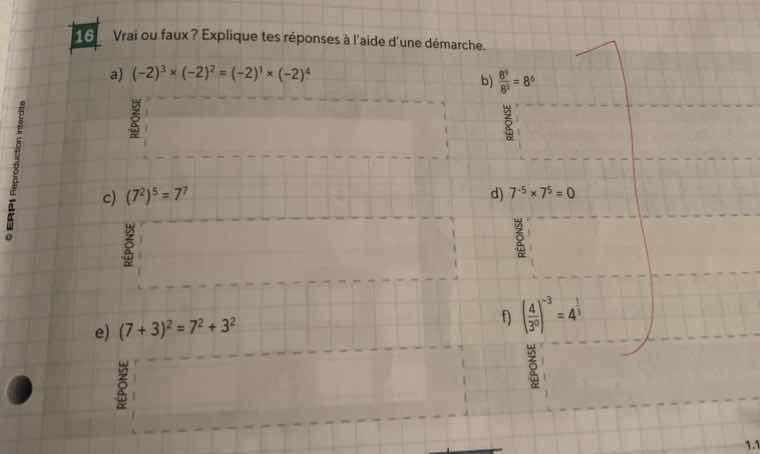
16 vrai ou faux ? explique tes réponses à l’aide d’une démarche.
a) $(-2)^3 \times (-2)^2 = (-2)^1 \times (-2)^4$
b) $\frac{8^7}{8^9} = 8^2$
c) $(7^2)^5 = 7^7$
d) $7^{-5} \times 7^5 = 0$
e) $(7 + 3)^2 = 7^2 + 3^2$
f) $\left( \frac{4}{32} \
ight)^{-3} = 4^{\frac{1}{3}}$
Part (a)
Step 1: Apply exponent rule \(a^m \times a^n = a^{m+n}\) on LHS
Left - Hand Side (LHS): \((-2)^3\times(-2)^2=(-2)^{3 + 2}=(-2)^5\)
Step 2: Apply exponent rule on RHS
Right - Hand Side (RHS): \((-2)^1\times(-2)^4=(-2)^{1+4}=(-2)^5\)
Step 3: Compare LHS and RHS
Since LHS \(= (-2)^5\) and RHS \(= (-2)^5\), LHS = RHS.
Part (b)
Step 1: Apply exponent rule \(\frac{a^m}{a^n}=a^{m - n}\)
\(\frac{8^7}{8^9}=8^{7-9}=8^{-2}\)
Step 2: Compare with \(8^2\)
\(8^{-2}
eq8^2\) (because \(8^{-2}=\frac{1}{8^2}\) and \(8^2 = 64\), \(\frac{1}{64}
eq64\)).
Part (c)
Step 1: Apply exponent rule \((a^m)^n=a^{m\times n}\)
\((7^2)^5 = 7^{2\times5}=7^{10}\)
Step 2: Compare with \(7^7\)
\(7^{10}
eq7^7\) (since the exponents 10 and 7 are different).
Part (d)

Snap & solve any problem in the app
Get step-by-step solutions on Sovi AI
Photo-based solutions with guided steps
Explore more problems and detailed explanations
s:
a) Vrai (True)
b) Faux (False)
c) Faux (False)
d) Faux (False)
e) Faux (False)
f) Faux (False)