QUESTION IMAGE
Question
6.16) ______ what does the graphic describe?
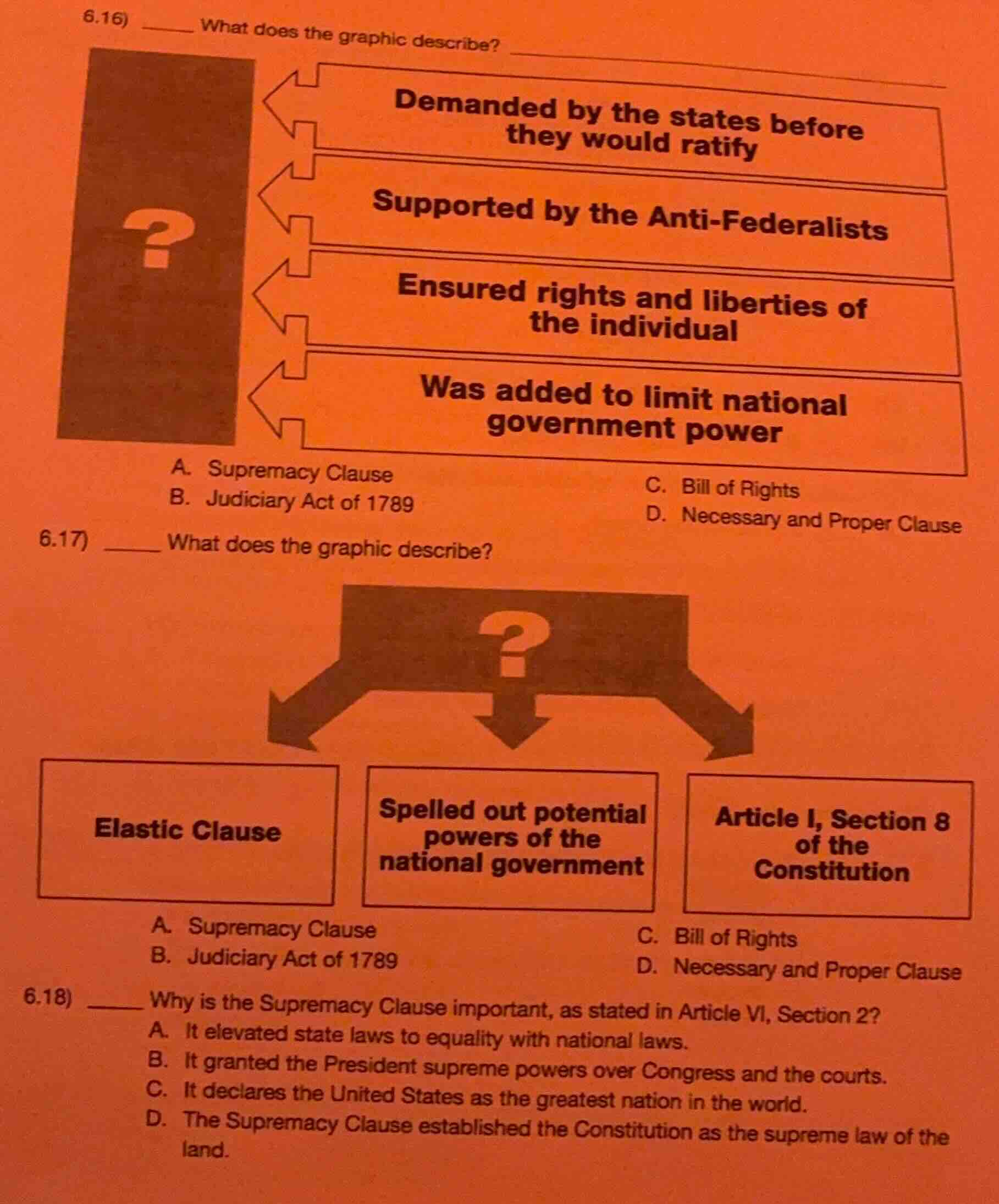
graphic with a question mark box and arrows pointing to text: demanded by the states before they would ratify; supported by the anti - federalists; ensured rights and liberties of the individual; was added to limit national government power
a. supremacy clause
b. judiciary act of 1789
c. bill of rights
d. necessary and proper clause
6.17) ______ what does the graphic describe?
graphic with a question mark box and arrows pointing to text: elastic clause; spelled out potential powers of the national government; article i, section 8 of the constitution
a. supremacy clause
b. judiciary act of 1789
c. bill of rights
d. necessary and proper clause
6.18) ______ why is the supremacy clause important, as stated in article vi, section 2?
a. it elevated state laws to equality with national laws.
b. it granted the president supreme powers over congress and the courts.
c. it declares the united states as the greatest nation in the world.
d. the supremacy clause established the constitution as the supreme law of the land.
For 6.16:
The described features match the Bill of Rights: states demanded it for ratification, Anti-Federalists supported it, it protects individual rights, and it limits federal power.
For 6.17:
The Elastic Clause is another name for the Necessary and Proper Clause, which is part of Article I, Section 8, and outlines implied powers of the national government.
For 6.18:
The Supremacy Clause in Article VI, Section 2 establishes the U.S. Constitution, federal laws, and treaties as the supreme law of the land, overriding state laws.

Snap & solve any problem in the app
Get step-by-step solutions on Sovi AI
Photo-based solutions with guided steps
Explore more problems and detailed explanations
6.16: C. Bill of Rights
6.17: D. Necessary and Proper Clause
6.18: D. The Supremacy Clause established the Constitution as the supreme law of the land.