QUESTION IMAGE
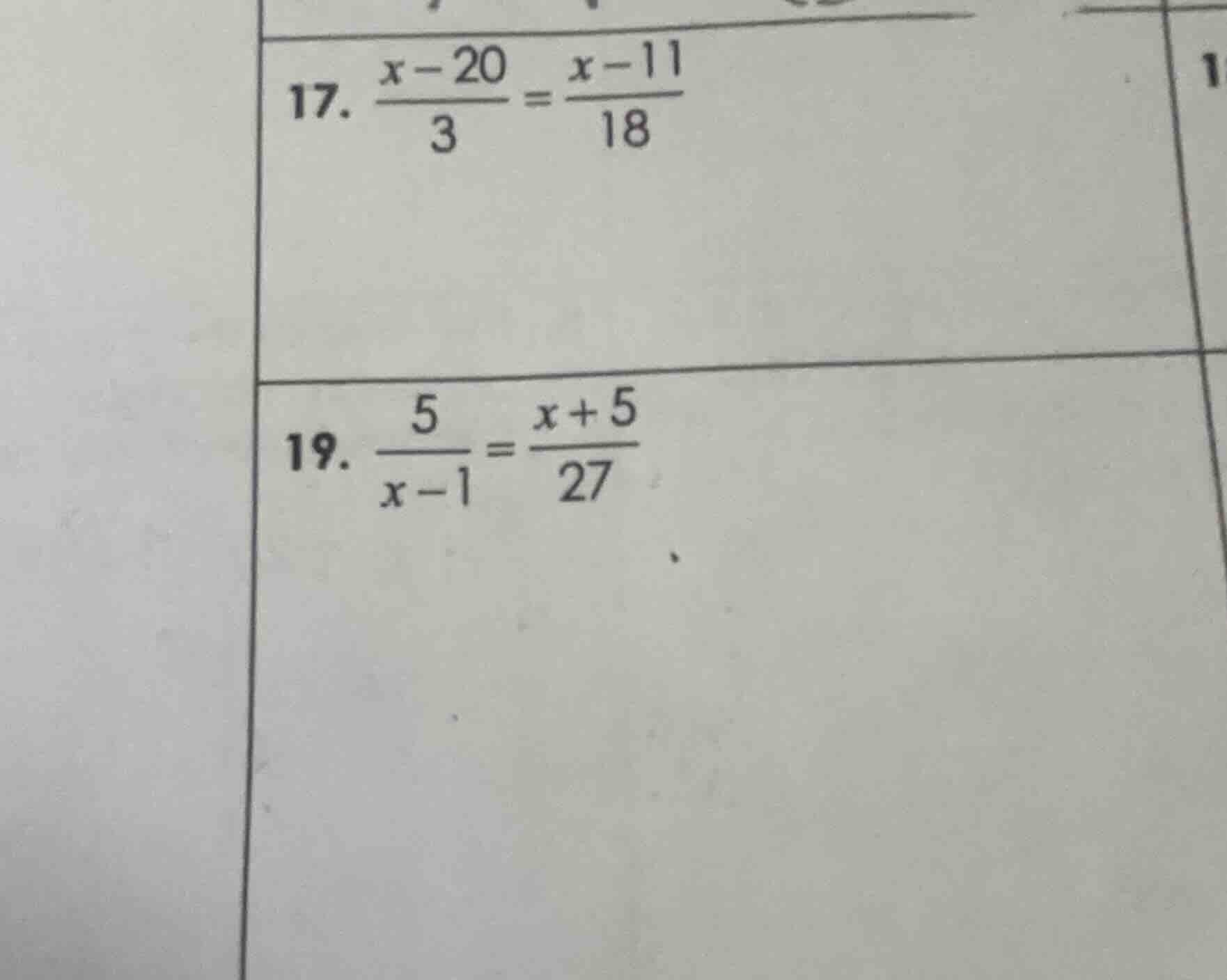
Question
- \\(\frac{x - 20}{3} = \frac{x - 11}{18}\\)\
- \\(\frac{5}{x - 1} = \frac{x + 5}{27}\\)
Problem 17: $\boldsymbol{\frac{x - 20}{3}=\frac{x - 11}{18}}$
Step1: Cross - multiply to eliminate fractions
To solve the equation $\frac{x - 20}{3}=\frac{x - 11}{18}$, we cross - multiply. That is, we multiply the numerator of the left - hand side by the denominator of the right - hand side and set it equal to the numerator of the right - hand side multiplied by the denominator of the left - hand side.
So, $18\times(x - 20)=3\times(x - 11)$
Step2: Expand both sides
Using the distributive property $a(b + c)=ab+ac$, we expand both sides of the equation.
For the left - hand side: $18\times x-18\times20 = 18x-360$
For the right - hand side: $3\times x-3\times11 = 3x - 33$
Our equation becomes $18x-360 = 3x-33$
Step3: Subtract $3x$ from both sides
Subtract $3x$ from both sides of the equation $18x-360 = 3x-33$ to get:
$18x-3x-360=3x - 3x-33$
$15x-360=-33$
Step4: Add 360 to both sides
Add 360 to both sides of the equation $15x-360=-33$:
$15x-360 + 360=-33 + 360$
$15x=327$
Step5: Divide both sides by 15
Divide both sides of the equation $15x = 327$ by 15:
$x=\frac{327}{15}=\frac{109}{5}=21.8$ (or we can simplify $\frac{327}{15}$ by dividing numerator and denominator by 3, getting $\frac{109}{5}$)
Problem 19: $\boldsymbol{\frac{5}{x - 1}=\frac{x + 5}{27}}$
Step1: Cross - multiply to eliminate fractions
Cross - multiply the equation $\frac{5}{x - 1}=\frac{x + 5}{27}$. We get $5\times27=(x - 1)\times(x + 5)$
Step2: Expand both sides
First, calculate the left - hand side: $5\times27 = 135$
Then, expand the right - hand side using the formula $(a + b)(c + d)=ac+ad+bc+bd$. Here, $a=x$, $b=-1$, $c=x$, $d = 5$. So, $(x - 1)(x + 5)=x^{2}+5x-x - 5=x^{2}+4x-5$
Our equation becomes $x^{2}+4x-5 = 135$
Step3: Rearrange to form a quadratic equation
Subtract 135 from both sides of the equation $x^{2}+4x-5 = 135$:
$x^{2}+4x-5-135=0$
$x^{2}+4x-140 = 0$
Step4: Solve the quadratic equation
We can solve the quadratic equation $x^{2}+4x - 140=0$ using the quadratic formula $x=\frac{-b\pm\sqrt{b^{2}-4ac}}{2a}$, where $a = 1$, $b = 4$, and $c=-140$.
First, calculate the discriminant $\Delta=b^{2}-4ac=(4)^{2}-4\times1\times(-140)=16 + 560 = 576$
Then, $x=\frac{-4\pm\sqrt{576}}{2\times1}=\frac{-4\pm24}{2}$
We have two solutions:
- When we take the plus sign: $x=\frac{-4 + 24}{2}=\frac{20}{2}=10$
- When we take the minus sign: $x=\frac{-4-24}{2}=\frac{-28}{2}=-14$
We need to check for extraneous solutions. For the original equation $\frac{5}{x - 1}=\frac{x + 5}{27}$, the denominator $x-1
eq0$, so $x
eq1$. Both $x = 10$ and $x=-14$ do not make the denominator zero. So both are valid solutions.

Snap & solve any problem in the app
Get step-by-step solutions on Sovi AI
Photo-based solutions with guided steps
Explore more problems and detailed explanations
s:
- For problem 17: $x=\frac{109}{5}$ (or $x = 21.8$)
- For problem 19: $x = 10$ or $x=-14$