QUESTION IMAGE
Question
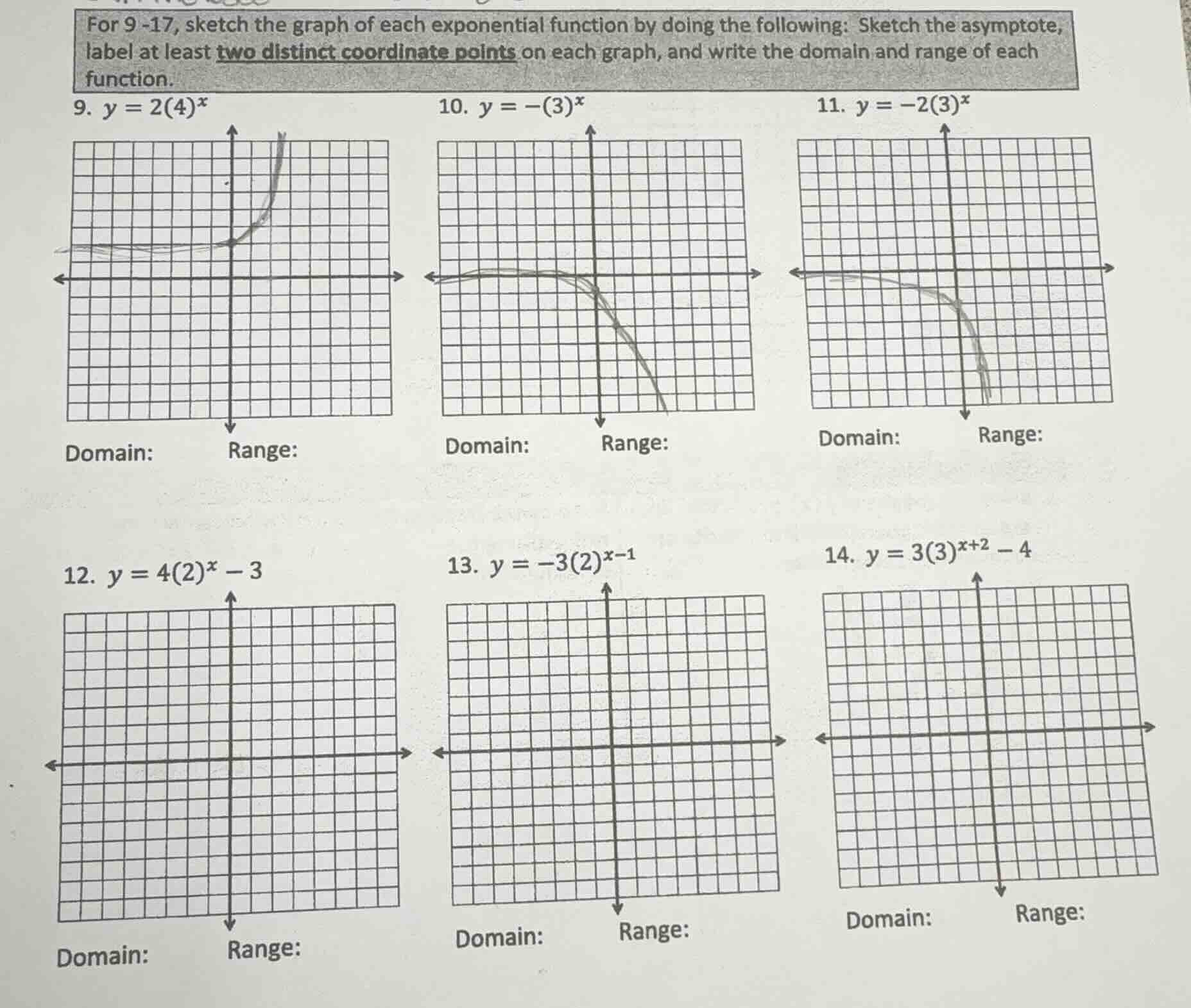
for 9 -17, sketch the graph of each exponential function by doing the following: sketch the asymptote, label at least two distinct coordinate points on each graph, and write the domain and range of each function. 9. $y = 2(4)^x$ 10. $y = -(3)^x$ 11. $y = -2(3)^x$ domain: range: domain: range: domain: range: 12. $y = 4(2)^x - 3$ 13. $y = -3(2)^{x - 1}$ 14. $y = 3(3)^{x + 2} - 4$ domain: range: domain: range: domain: range:
Problem 9: \( y = 2(4)^x \)
Step 1: Find the Asymptote
For an exponential function of the form \( y = ab^x + k \), the horizontal asymptote is \( y = k \). Here, \( k = 0 \), so the asymptote is \( y = 0 \) (the x - axis).
Step 2: Find Coordinate Points
- When \( x = 0 \):
\( y=2(4)^0=2\times1 = 2 \), so the point is \( (0, 2) \).
- When \( x = 1 \):
\( y = 2(4)^1=2\times4=8 \), so the point is \( (1, 8) \).
Step 3: Determine Domain and Range
- Domain: Exponential functions of the form \( y = ab^x \) have a domain of all real numbers, so Domain: \( (-\infty, \infty) \)
- Range: Since \( 4^x>0 \) for all real \( x \), then \( 2(4)^x>0 \). So Range: \( (0, \infty) \)
Step 1: Find the Asymptote
For \( y = - 3^x \), the form is \( y=ab^x + k \) with \( k = 0 \), so the horizontal asymptote is \( y = 0 \) (the x - axis).
Step 2: Find Coordinate Points
- When \( x = 0 \):
\( y=-(3)^0=- 1\times1=-1 \), so the point is \( (0, - 1) \)
- When \( x = 1 \):
\( y=-(3)^1=-3 \), so the point is \( (1, - 3) \)
Step 3: Determine Domain and Range
- Domain: For \( y=-3^x \), the domain is all real numbers, so Domain: \( (-\infty, \infty) \)
- Range: Since \( 3^x>0 \) for all real \( x \), then \( - 3^x<0 \). So Range: \( (-\infty, 0) \)
Step 1: Find the Asymptote
For \( y=-2(3)^x \), the form is \( y = ab^x+k \) with \( k = 0 \), so the horizontal asymptote is \( y = 0 \) (the x - axis).
Step 2: Find Coordinate Points
- When \( x = 0 \):
\( y=-2(3)^0=-2\times1=-2 \), so the point is \( (0, - 2) \)
- When \( x = 1 \):
\( y=-2(3)^1=-2\times3 = - 6 \), so the point is \( (1, - 6) \)
Step 3: Determine Domain and Range
- Domain: All real numbers, so Domain: \( (-\infty, \infty) \)
- Range: Since \( 3^x>0 \), then \( - 2(3)^x<0 \). So Range: \( (-\infty, 0) \)

Snap & solve any problem in the app
Get step-by-step solutions on Sovi AI
Photo-based solutions with guided steps
Explore more problems and detailed explanations
Asymptote: \( y = 0 \)
Points: \( (0, 2) \), \( (1, 8) \)
Domain: \( (-\infty, \infty) \)
Range: \( (0, \infty) \)