QUESTION IMAGE
Question
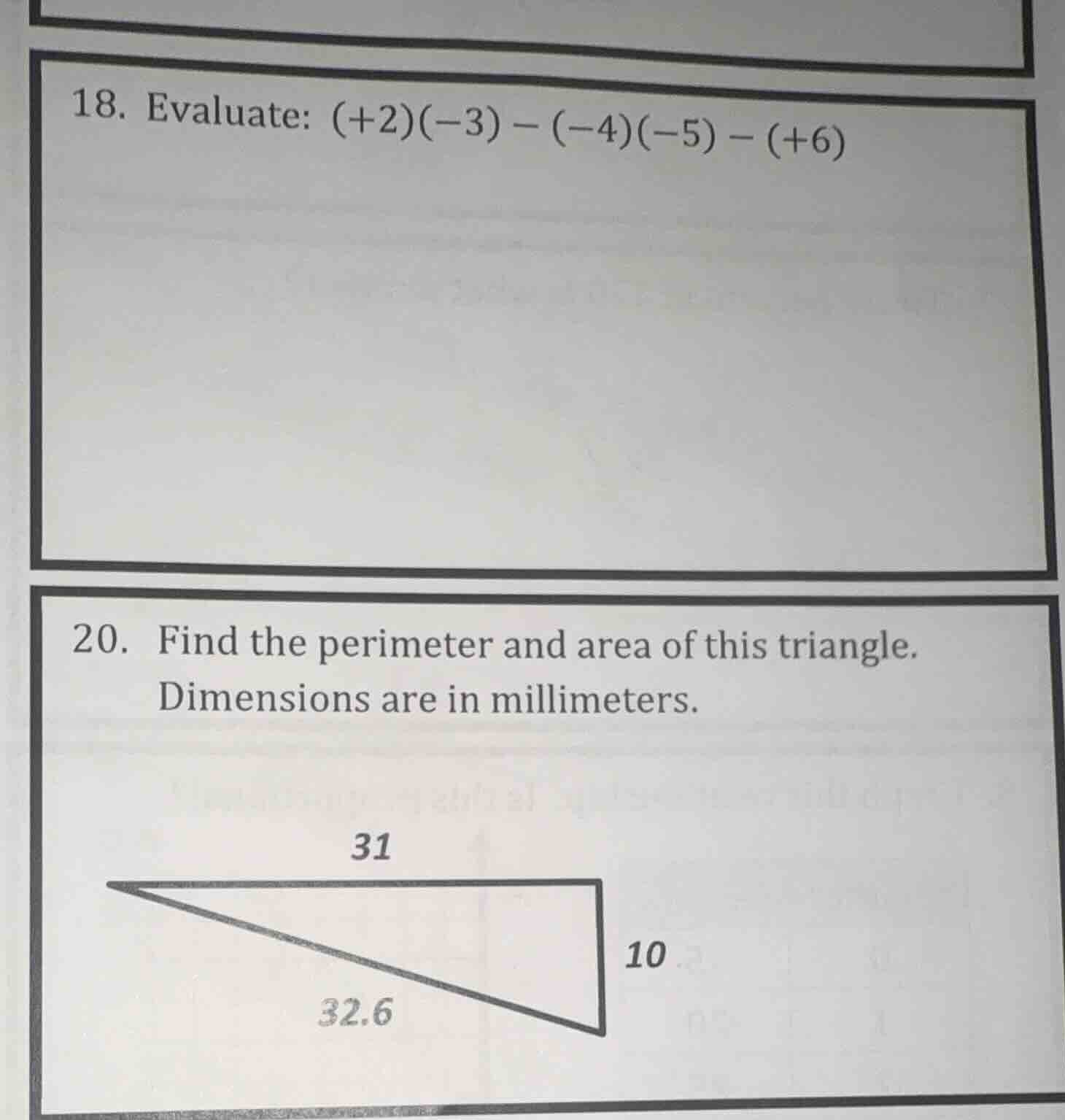
- evaluate: (+2)(-3) - (-4)(-5) - (+6)
- find the perimeter and area of this triangle.
dimensions are in millimeters.
31
10
32.6
Question 18
Step 1: Multiply the first two terms
We know that the product of a positive number and a negative number is negative. So, \((+2)(-3) = -6\)
Step 2: Multiply the next two terms
The product of two negative numbers is positive. So, \((-4)(-5) = 20\)
Step 3: Substitute the values back into the expression
The original expression is \((+2)(-3) - (-4)(-5) - (+6)\). Substituting the values we found, we get: \(-6 - 20 - 6\)
Step 4: Perform the subtraction operations
First, \(-6 - 20 = -26\). Then, \(-26 - 6 = -32\)
Step 1: Find the perimeter of the triangle
The perimeter of a triangle is the sum of the lengths of its three sides. The sides are \(31\) mm, \(10\) mm, and \(32.6\) mm. So, perimeter \(P = 31 + 10 + 32.6\)
Step 2: Calculate the perimeter
\(31 + 10 = 41\), and \(41 + 32.6 = 73.6\) mm.
Step 3: Find the area of the triangle
The triangle is a right triangle (since one angle is a right angle, as seen from the diagram with the right angle between the sides of length \(10\) mm and the base which we can calculate or assume from the right angle). The area of a right triangle is given by \(\frac{1}{2} \times \text{base} \times \text{height}\). Here, the base can be found using the Pythagorean theorem or we can see that the two legs (the sides forming the right angle) are \(10\) mm and let's find the other leg. Wait, actually, from the diagram, it's a right triangle with hypotenuse \(32.6\) mm, one leg \(10\) mm, and the other leg (let's call it \(b\)) can be found using Pythagoras: \(b = \sqrt{32.6^{2}-10^{2}}\)? Wait, no, actually, looking at the diagram, the horizontal side is \(31\) mm? Wait, no, maybe it's a right triangle with legs \(10\) mm and \(31\) mm? Wait, no, the sides are \(31\), \(10\), and \(32.6\). Let's check if \(31^{2}+10^{2}=32.6^{2}\). \(31^{2}=961\), \(10^{2}=100\), so \(961 + 100 = 1061\). \(32.6^{2}= (32 + 0.6)^{2}=32^{2}+2\times32\times0.6 + 0.6^{2}=1024+38.4 + 0.36 = 1062.76\). Hmm, close enough, maybe due to rounding. So, the legs are approximately \(31\) mm and \(10\) mm. So, area \(A=\frac{1}{2}\times31\times10\)
Step 4: Calculate the area
\(\frac{1}{2}\times31\times10 = 155\) mm². Wait, but let's check again. Wait, if the sides are \(31\), \(10\), and \(32.6\), and \(31^{2}+10^{2}=961 + 100 = 1061\), and \(32.6^{2}=1062.76\), which is very close, so maybe the base is \(31\) mm and height is \(10\) mm. So, area is \(\frac{1}{2}\times31\times10 = 155\) mm².

Snap & solve any problem in the app
Get step-by-step solutions on Sovi AI
Photo-based solutions with guided steps
Explore more problems and detailed explanations
\(-32\)