QUESTION IMAGE
Question
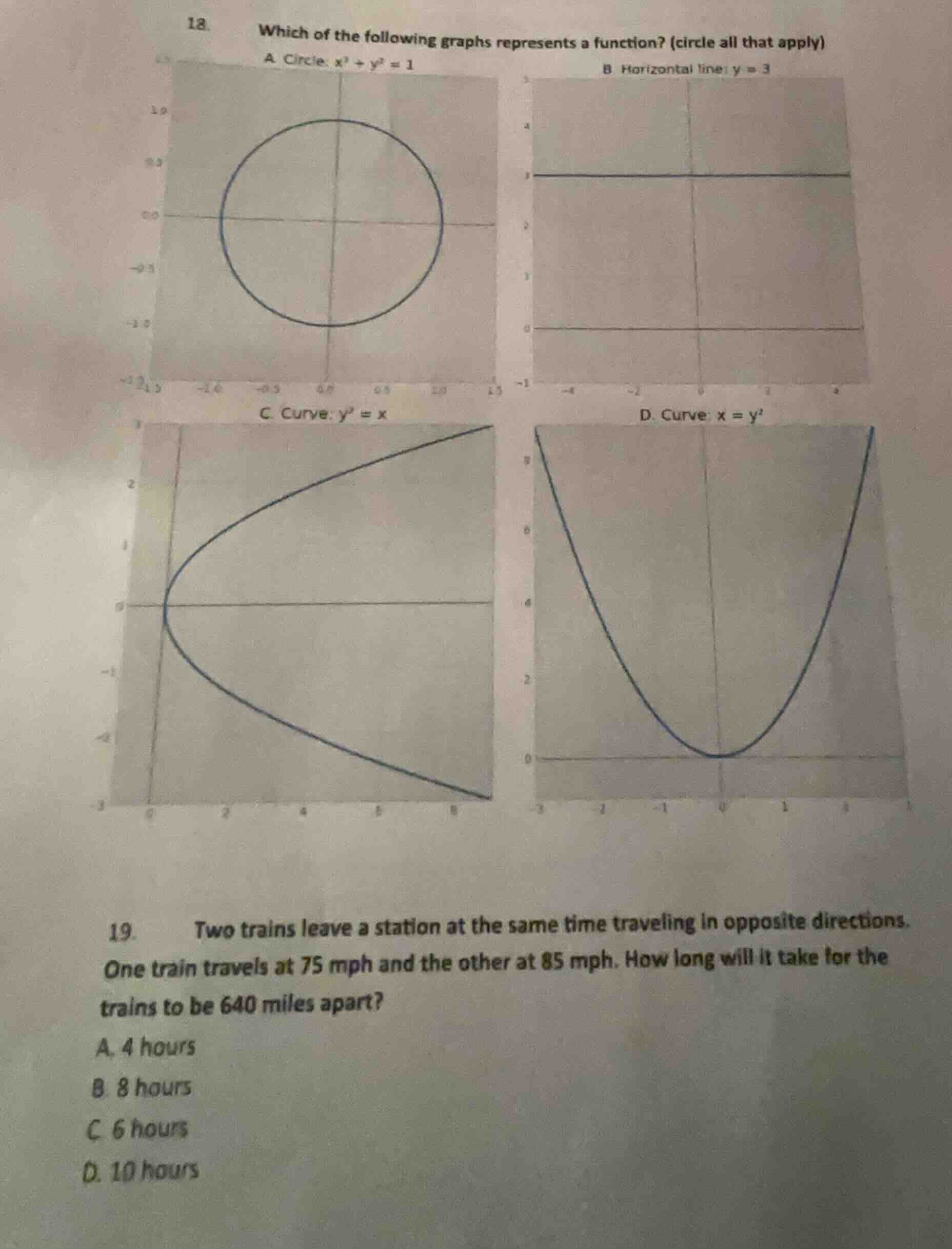
- which of the following graphs represents a function? (circle all that apply)
a. circle: $x^2 + y^2 = 1$
b. horizontal line: $y = 3$
c. curve: $y^2 = x$
d. curve: $x = y^2$
- two trains leave a station at the same time traveling in opposite directions. one train travels at 75 mph and the other at 85 mph. how long will it take for the trains to be 640 miles apart?
a. 4 hours
b. 8 hours
c. 6 hours
d. 10 hours
Question 18
To determine if a graph represents a function, we use the vertical line test: a graph is a function if no vertical line intersects it more than once.
- Option A (Circle \(x^2 + y^2 = 1\)): A vertical line will intersect the circle at two points (e.g., \(x = 0\) intersects at \((0, 1)\) and \((0, -1)\)), so it is not a function.
- Option B (Horizontal line \(y = 3\)): Any vertical line intersects this horizontal line at exactly one point (since \(y\) is always 3, regardless of \(x\)), so it passes the vertical line test and is a function.
- Option C (Curve \(y^2 = x\)): For \(x > 0\), a vertical line will intersect the curve at two points (e.g., \(x = 4\) intersects at \((4, 2)\) and \((4, -2)\)), so it is not a function.
- Option D (Curve \(x = y^2\)): Similar to Option C, for \(x > 0\), a vertical line intersects at two points (e.g., \(x = 4\) intersects at \((4, 2)\) and \((4, -2)\)), so it is not a function.
Step 1: Define Variables and Relationship
Let \(t\) = time (in hours) until the trains are 640 miles apart. Since the trains travel in opposite directions, their combined distance equals the total separation. The distance formula is \(d = vt\) (distance = speed × time).
Total distance = (Speed of Train 1 × \(t\)) + (Speed of Train 2 × \(t\))
So, \(75t + 85t = 640\).
Step 2: Combine Like Terms
Combine the speeds: \(75t + 85t = (75 + 85)t = 160t\).
Equation: \(160t = 640\).
Step 3: Solve for \(t\)
Divide both sides by 160: \(t = \frac{640}{160} = 4\).

Snap & solve any problem in the app
Get step-by-step solutions on Sovi AI
Photo-based solutions with guided steps
Explore more problems and detailed explanations
B. Horizontal line: \(y = 3\)