QUESTION IMAGE
Question
in 1850, with civil war storm clouds build - ing, americans did what they do every ten years: they counted themselves. the census revealed a national population of 31,400,000. most of this population was white, but about 14%, or four and one - half million, were african american. not all of this black population was slave. in 1860, 476,000 blacks were free: 250,000 of these lived in the south, another 221,000 lived in the north. the remaining 4,000 free african americans lived in the west.
the free - black population in the south was mostly ex - slaves, or their children, who had been freed by their masters. free southern blacks lived a very restricted life but could work for wages, own property, and legally marry. however, free southern blacks could not vote and were not welcome to mix equally with the southern white population.
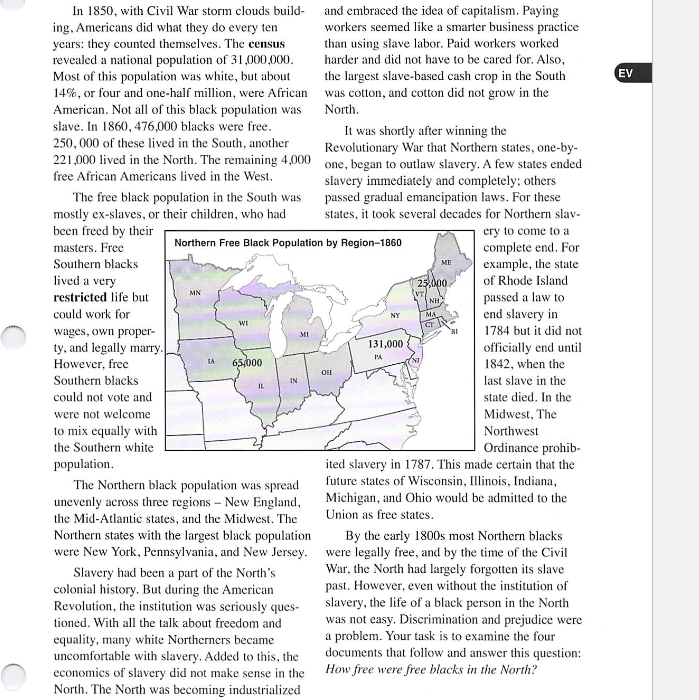
the northern black population was spread unevenly across three regions – new england, the mid - atlantic states, and the midwest. the northern states with the largest black population were new york, pennsylvania, and new jersey.
slavery had been a part of the north’s colonial history, but during the american revolution, the institution was seriously ques - tioned. with all the talk about freedom and equality, many white northerners became uncomfortable with slavery. added to this, the economics of slavery did not make sense in the north. the north was becoming industrialized and embraced the idea of capitalism. paying workers seemed a smarter business practice than using slave labor. paid workers worked harder and did not have to be cared for. also, the largest slave - based cash crop in the south was cotton, and cotton did not grow in the north.
it was shortly after winning the revolutionary war that northern states, one - by - one, began to outlaw slavery. a few states ended slavery immediately and completely; others passed gradual emancipation laws. for these states, it took several decades for northern slav - ery to come to a complete end. for example, the state of rhode island passed an law to end slavery in 1784 but it did not officially end until 1842, when the last slave in the state died. in the midwest, the northwest ordinance prohib - ited slavery in 1787. this made certain that the future states of wisconsin, illinois, indiana, michigan, and ohio would be admitted to the union as free states.
by the early 1800s most northern blacks were legally free, and by the time of the civil war, the north had largely forgotten its slave past. however, even without the institution of slavery, the life of a black person in the north was not easy. discrimination and prejudice were a problem. your task is to examine the four documents that follow and answer this question: how free were free blacks in the north?
chart: northern free black population by region - 1860 (with data like 125,000, 131,000, 65,000 for different regions)
To determine how free free blacks were in the North, we analyze the text and map:
1. Legal Status
- By the early 1800s, most Northern blacks were legally free (e.g., Rhode Island ended slavery in 1784, though the last slave died in 1842). Northern states like those in the Northwest (Wisconsin, Illinois, Indiana, Michigan, Ohio) prohibited slavery in 1787, ensuring future free - state admission.
2. Economic and Social Restrictions
- Economic: Free Southern blacks had restricted lives (could work for wages, own property, marry legally), but free Northern blacks still faced discrimination. The text implies economic challenges (though not explicitly detailed, the context of “life was not easy” suggests limited economic opportunities due to prejudice).
- Social: Discrimination and prejudice were prevalent. Even without slavery, black people in the North were not treated equally. For example, the free black population in the North (e.g., New York, Pennsylvania, New Jersey had large populations) still faced social barriers to full integration.
Free blacks in the North were legally free (with most states abolishing slavery or prohibiting it), but they were not fully free socially or economically. Discrimination, prejudice, and limited opportunities (e.g., in jobs, social mixing) meant their freedom was restricted despite the absence of chattel slavery.

Snap & solve any problem in the app
Get step-by-step solutions on Sovi AI
Photo-based solutions with guided steps
Explore more problems and detailed explanations
Free blacks in the North were legally free (most Northern states had abolished or prohibited slavery), but faced social (discrimination, prejudice) and economic restrictions, so their freedom was limited (not full social or economic equality with white Northerners).