QUESTION IMAGE
Question
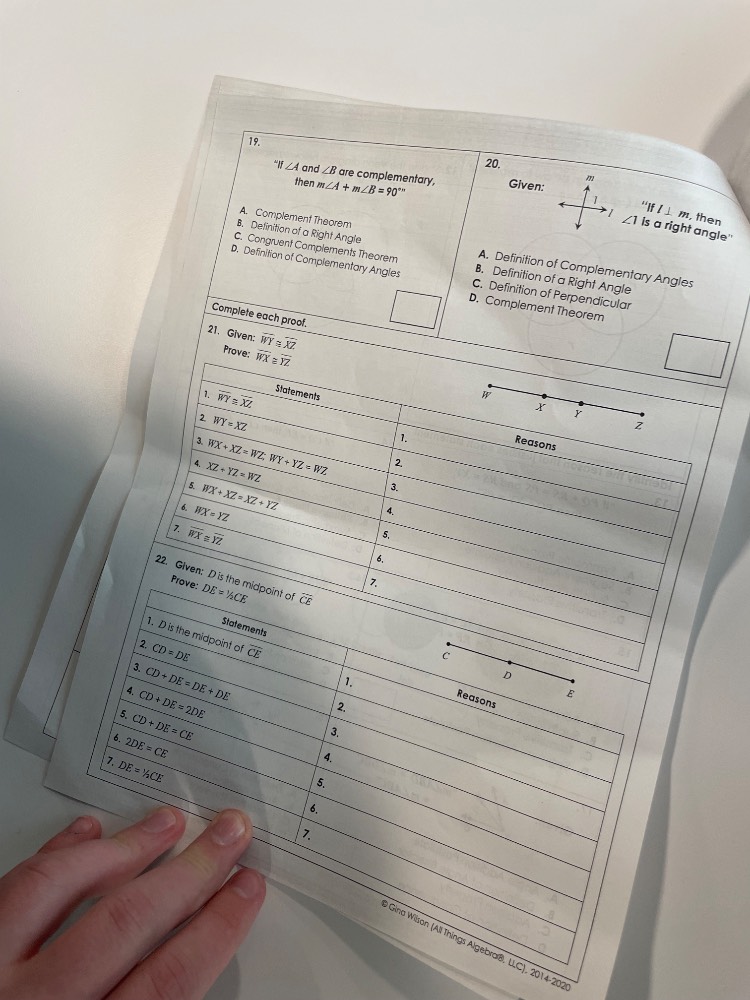
- \if $angle a$ and $angle b$ are complementary, then $mangle a + mangle b = 90^circ$\ a. complement theorem b. definition of a right angle c. congruent complements theorem d. definition of complementary angles 20. given: \if $l perp m$, then $angle 1$ is a right angle\ a. definition of a right angle b. definition of complementary angles c. definition of perpendicular d. complement theorem complete each proof. 21. given: $overline{wy} cong overline{xz}$ prove: $overline{wx} cong overline{yz}$ statements 1. $overline{wy} cong overline{xz}$ 2. $wy = xz$ 3. $wx + xz = wz\\ wy + yz = wz$ 4. $xz + yz = wz$ 5. $wx + xz = xz + yz$ 6. $wx = yz$ 7. $overline{wx} cong overline{yz}$ reasons 1. 2. 3. 4. 5. 6. 7. 22. given: $d$ is the midpoint of $overline{ce}$ prove: $de = \frac{1}{2}ce$ statements 1. $d$ is the midpoint of $overline{ce}$ 2. $cd = de$ 3. $cd + de = de + de$ 4. $cd + de = 2de$ 5. $cd + de = ce$ 6. $2de = ce$ 7. $de = \frac{1}{2}ce$ reasons 1. 2. 3. 4. 5. 6. 7. © gina wilson (all things algebra®, llc), 2014-2020
Response
Questions 19-20 (Multiple Choice)
Brief Explanations
- The statement defines the core property of complementary angles: their measures add to 90°.
- The statement describes the defining characteristic of perpendicular lines: they form a right angle.
Step1: State given information
$\overline{WY} \cong \overline{XZ}$
Step2: Congruent segments have equal length
$WY = XZ$
Step3: Segment Addition Postulate (W-X-Y-Z)
$WX + XZ = WZ; WY + YZ = WZ$
Step4: Transitive Property of Equality
$WX + XZ = WY + YZ$
Step5: Substitute $WY=XZ$ (from Step2)
$WX + XZ = XZ + YZ$
Step6: Subtract $XZ$ from both sides
$WX = YZ$
Step7: Equal lengths mean congruent segments
$\overline{WX} \cong \overline{YZ}$
Step1: State given information
$D$ is the midpoint of $\overline{CE}$
Step2: Midpoint divides segment into 2 equal parts
$CD = DE$
Step3: Add $DE$ to both sides
$CD + DE = DE + DE$
Step4: Simplify right-hand side
$CD + DE = 2DE$
Step5: Segment Addition Postulate (C-D-E)
$CD + DE = CE$
Step6: Substitute $CD+DE=CE$ (from Step5)
$2DE = CE$
Step7: Divide both sides by 4
$DE = \frac{1}{4}CE$

Snap & solve any problem in the app
Get step-by-step solutions on Sovi AI
Photo-based solutions with guided steps
Explore more problems and detailed explanations
- D. Definition of Complementary Angles
- C. Definition of Perpendicular
---