QUESTION IMAGE
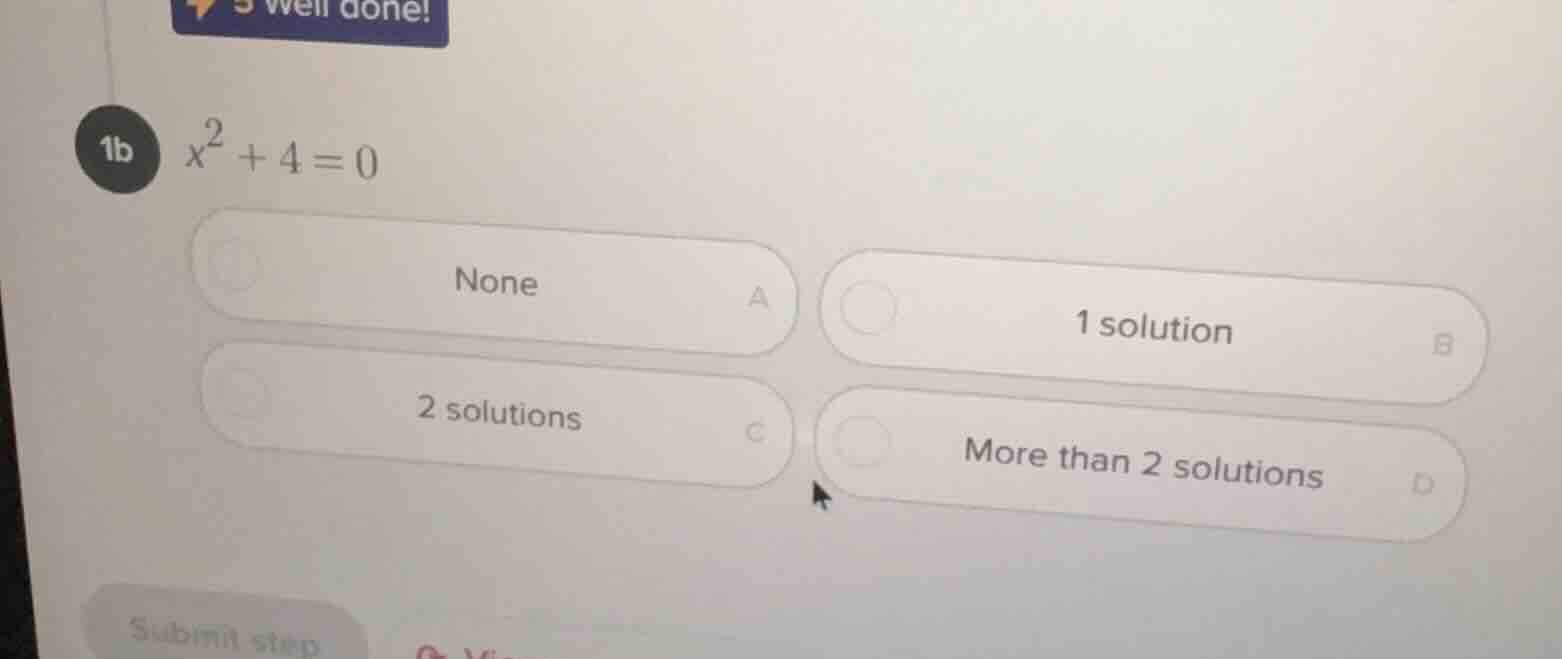
Question
1b
$x^2 + 4 = 0$
options: a. none, b. 1 solution, c. 2 solutions, d. more than 2 solutions
Step1: Analyze the equation \(x^2 + 4 = 0\)
We can rewrite it as \(x^2=- 4\).
Step2: Consider real - number solutions
For any real number \(x\), the square of a real number \(x^2\geq0\). But \(-4<0\), so there are no real - number solutions. However, if we consider complex numbers, \(x = \pm2i\) (where \(i=\sqrt{-1}\)) are solutions. But in the context of real - number solutions (which is a common context for such basic quadratic equation solution - counting problems unless specified otherwise), we analyze the equation in the real - number system. Since \(x^2=-4\) has no real solutions, but the options are about the number of solutions (probably in real numbers as it's a basic problem). Wait, actually, let's re - evaluate. The equation \(x^2 + 4=0\) can be solved for \(x\) as \(x^2=-4\), and in the set of complex numbers, \(x = 2i\) or \(x=-2i\), so there are 2 complex solutions. But maybe the question is in the context of real numbers? Wait, the options are "None", "1 solution", "2 solutions", "More than 2 solutions". Let's check the discriminant of the quadratic equation \(ax^{2}+bx + c = 0\) (here \(a = 1\), \(b = 0\), \(c = 4\)). The discriminant \(\Delta=b^{2}-4ac=0^{2}-4\times1\times4=-16<0\). In the real - number system, a quadratic equation \(ax^{2}+bx + c = 0\) with \(\Delta<0\) has no real solutions. But if we consider complex numbers, it has 2 solutions. However, for a basic problem like this (with options like "None", "1 solution", etc.), maybe the intended context is real numbers. Wait, but the option "2 solutions" is also there. Wait, let's re - examine the equation. The equation \(x^{2}+4 = 0\) is a quadratic equation. The general form of a quadratic equation is \(ax^{2}+bx + c = 0\), and the number of solutions (in complex numbers) of a quadratic equation is always 2 (counting multiplicities). But here, the equation \(x^{2}+4 = 0\) has two distinct complex solutions \(x = 2i\) and \(x=-2i\). But maybe the question is in the real - number domain. Wait, the options: "None" (A), "1 solution" (B), "2 solutions" (C), "More than 2 solutions" (D). If we are talking about real - number solutions, then the answer is "None" (A). But if we are talking about complex - number solutions, the answer is "2 solutions" (C). But since this is a basic problem (with the options given), and usually, in the context of such multiple - choice questions for students learning about quadratic equations, if not specified, sometimes they consider real - number solutions. Wait, no, actually, the degree of the polynomial is 2, so by the Fundamental Theorem of Algebra, a polynomial of degree \(n\) has \(n\) roots (counting multiplicities) in the complex plane. So the quadratic equation \(x^{2}+4 = 0\) has 2 solutions (in complex numbers). But let's check the discriminant: \(\Delta=b^{2}-4ac=0 - 16=-16<0\), which means in real numbers, there are no solutions, but in complex numbers, there are 2 solutions. But the options are "None", "1 solution", "2 solutions", "More than 2 solutions". So if we consider complex numbers, the answer is "2 solutions" (C).

Snap & solve any problem in the app
Get step-by-step solutions on Sovi AI
Photo-based solutions with guided steps
Explore more problems and detailed explanations
C. 2 solutions