QUESTION IMAGE
Question
- in 2006, a new species was discovered in the depths of the pacific ocean. because of its similar appearance this organism was thought to be a very large sea anemone. in 2014 scientists discovered that this organism, relicanthus daphneae, was not a sea anemone and reclassified r. daphneae into a new order. what is the most likely reason for reclassifying r. daphneae?
a. r. daphneae was observed by many other scientists who did not agree that it resembled a sea anemone
b. r. daphneae is genetically different from sea anemone and does not share a recent common ancestor.
c. r. daphneae has a diet that differs from many other sea anemone.
d. r. daphneae has much longer tentacles than most sea anemone.
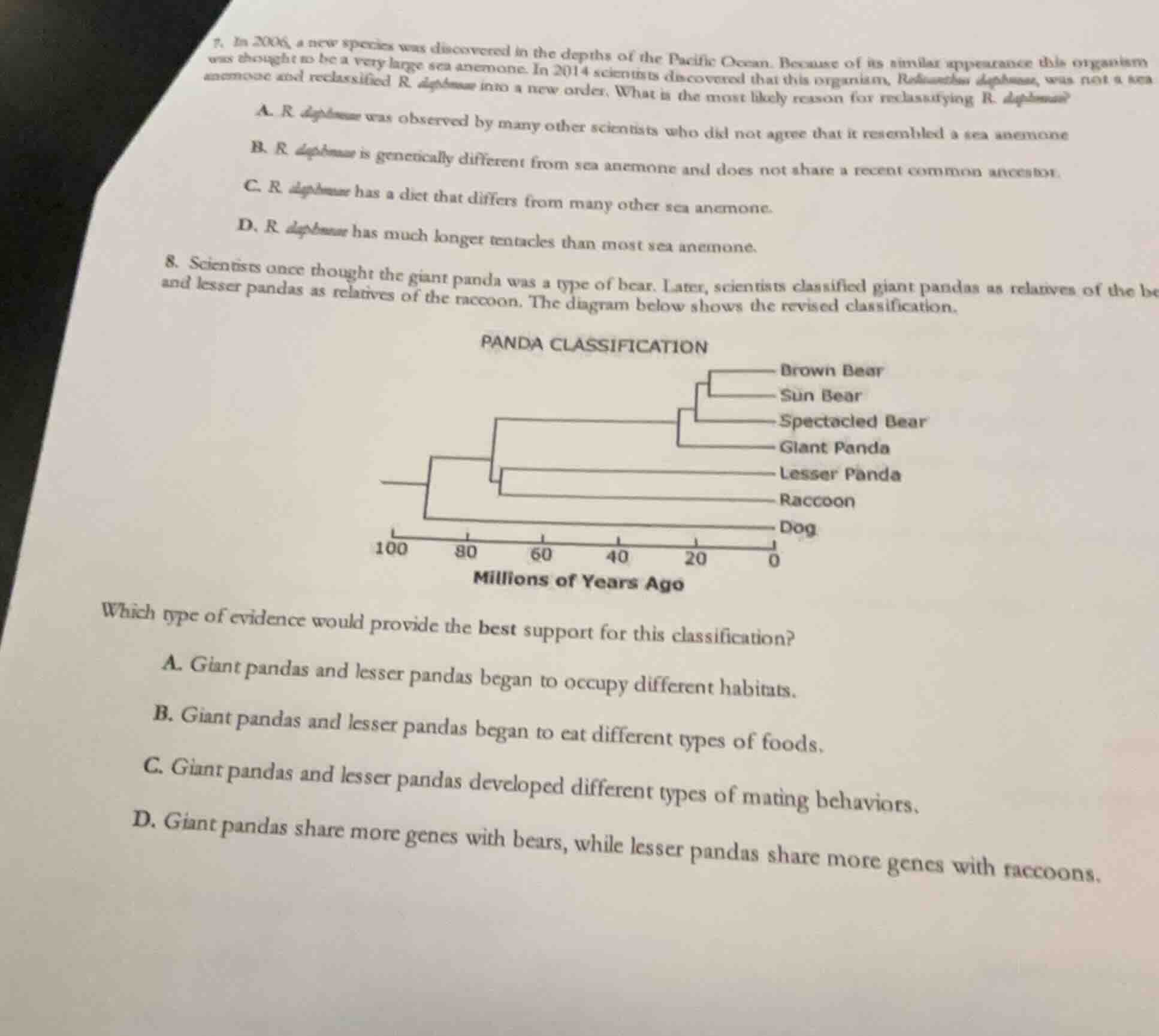
- scientists once thought the giant panda was a type of bear. later, scientists classified giant pandas as relatives of the be and lesser pandas as relatives of the raccoon. the diagram below shows the revised classification.
panda classification
diagram omitted
which type of evidence would provide the best support for this classification?
a. giant pandas and lesser pandas began to occupy different habitats.
b. giant pandas and lesser pandas began to eat different types of foods.
c. giant pandas and lesser pandas developed different types of mating behaviors.
d. giant pandas share more genes with bears, while lesser pandas share more genes with raccoons.
For Question 7:
Modern biological classification relies on evolutionary relationships, determined by genetic similarity and shared ancestry. Physical traits or diet are less definitive than genetic evidence for reclassifying organisms into new taxonomic groups.
For Question 8:
The classification diagram shows evolutionary relationships based on shared ancestry. Genetic evidence, which demonstrates shared genes between organisms, is the strongest support for this type of phylogenetic classification, as it directly reflects evolutionary relatedness.

Snap & solve any problem in the app
Get step-by-step solutions on Sovi AI
Photo-based solutions with guided steps
Explore more problems and detailed explanations
- B. R. daphnae is genetically different from sea anemone and does not share a recent common ancestor.
- D. Giant pandas share more genes with bears, while lesser pandas share more genes with raccoons.